Pacheco Rodrigo, Contreras Francisco, Zouali Moncef
Laboratory of Neuroimmunology, Fundación Ciencia & Vida , Santiago , Chile ; Programa de Biomedicina, Universidad San Sebastián , Santiago , Chile.
Laboratory of Neuroimmunology, Fundación Ciencia & Vida , Santiago , Chile ; Universidad Andrés Bello, Facultad de Ciencias Biológicas , Santiago , Chile.
Front Immunol. 2014 Mar 21;5:117. doi: 10.3389/fimmu.2014.00117. eCollection 2014.
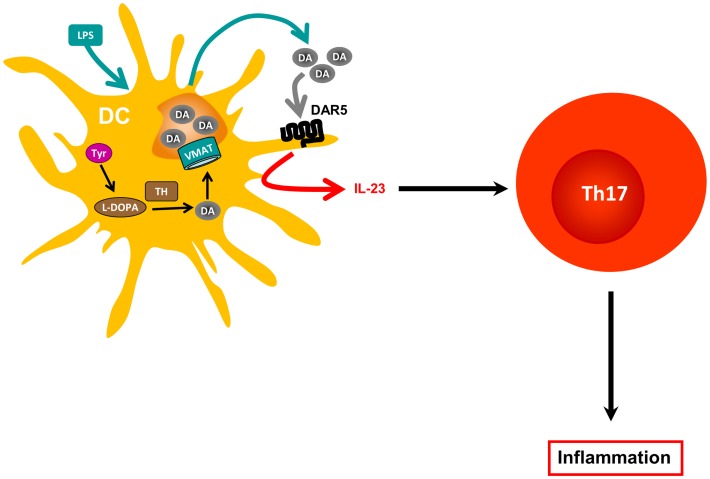
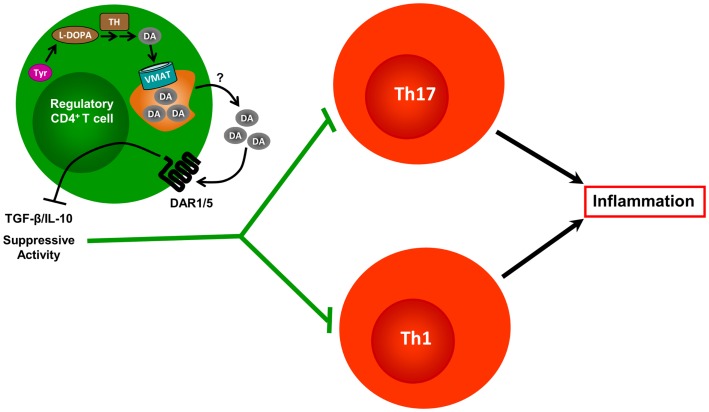
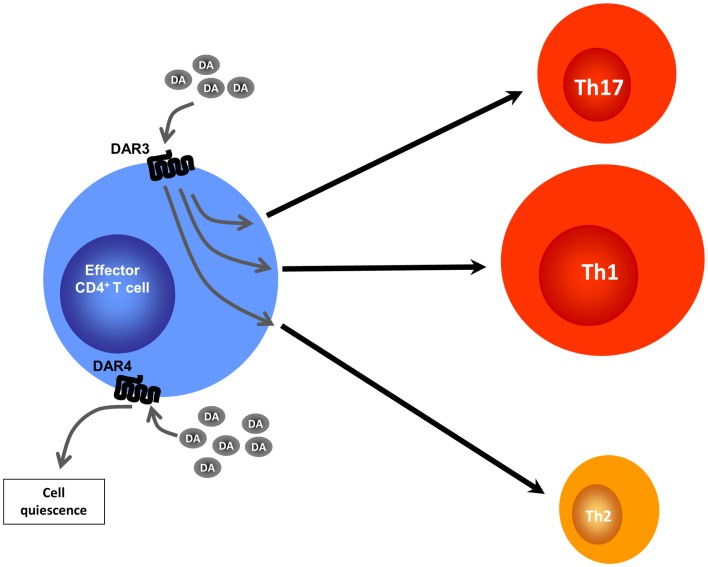
Bidirectional interactions between the immune and the nervous systems are of considerable interest both for deciphering their functioning and for designing novel therapeutic strategies. The past decade has brought a burst of insights into the molecular mechanisms involved in neuroimmune communications mediated by dopamine. Studies of dendritic cells (DCs) revealed that they express the whole machinery to synthesize and store dopamine, which may act in an autocrine manner to stimulate dopamine receptors (DARs). Depending on specific DARs stimulated on DCs and T cells, dopamine may differentially favor CD4(+) T cell differentiation into Th1 or Th17 inflammatory cells. Regulatory T cells can also release high amounts of dopamine that acts in an autocrine DAR-mediated manner to inhibit their suppressive activity. These dopaminergic regulations could represent a driving force during autoimmunity. Indeed, dopamine levels are altered in the brain of mouse models of multiple sclerosis (MS) and lupus, and in inflamed tissues of patients with inflammatory bowel diseases or rheumatoid arthritis (RA). The distorted expression of DARs in peripheral lymphocytes of lupus and MS patients also supports the importance of dopaminergic regulations in autoimmunity. Moreover, dopamine analogs had beneficial therapeutic effects in animal models, and in patients with lupus or RA. We propose models that may underlie key roles of dopamine and its receptors in autoimmune diseases.
免疫系统与神经系统之间的双向相互作用,对于解读它们的功能以及设计新的治疗策略都具有相当重要的意义。在过去十年里,人们对多巴胺介导的神经免疫通讯所涉及的分子机制有了大量的深入了解。对树突状细胞(DCs)的研究表明,它们具备合成和储存多巴胺的完整机制,多巴胺可能以自分泌方式作用于刺激多巴胺受体(DARs)。根据在DCs和T细胞上刺激的特定DARs,多巴胺可能会以不同方式促进CD4(+) T细胞分化为Th1或Th17炎性细胞。调节性T细胞也能释放大量多巴胺,以自分泌DAR介导的方式抑制其抑制活性。这些多巴胺能调节可能是自身免疫过程中的一种驱动力。事实上,在多发性硬化症(MS)和狼疮的小鼠模型大脑中,以及炎症性肠病或类风湿性关节炎(RA)患者的炎症组织中,多巴胺水平都会发生改变。狼疮和MS患者外周淋巴细胞中DARs的异常表达也支持了多巴胺能调节在自身免疫中的重要性。此外,多巴胺类似物在动物模型以及狼疮或RA患者中都具有有益的治疗效果。我们提出了一些模型,这些模型可能是多巴胺及其受体在自身免疫性疾病中发挥关键作用的基础。