Vendittelli Françoise, Tassié Marie-Caroline, Gerbaud Laurent, Lémery Didier
The Clermont-Ferrand University Hospital, 58 Rue Montalembert, Clermont-Ferrand, 63003 Cedex 1, France.
BMC Pregnancy Childbirth. 2014 Apr 9;14:135. doi: 10.1186/1471-2393-14-135.
The overall caesarean rate in France has increased from 14.3% in 1994-1996 to 21.0% in 2010. This increased rate is a concern in all developed countries: delivery by caesarean induces both short- and long-term maternal complications, and its use requires careful reflection. The principal objective of this work was to describe the global appropriateness of indications for caesareans among a selected sample of planned caesareans performed within the Auvergne perinatal health network. The secondary objectives were to describe the inappropriate planned caesarean risk according to the maternity unit level and the impact of this medical assessment on the global caesarean rate in this network.
This audit among maternity units belonging to the Auvergne perinatal network in France included women who had a planned caesarean at term, were nulliparous or primiparous, and had a singleton pregnancy in cephalic presentation or a twin pregnancy with twin 1 in cephalic presentation. We used the French guidelines issued from 1998 through 2010 as our benchmark for appropriateness.
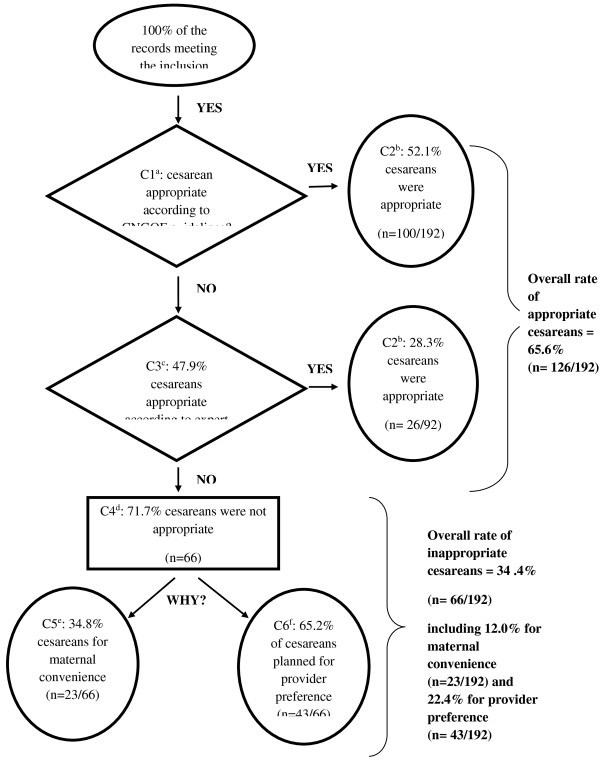
We analysed 192 cases (100% of the records eligible for the audit). The rate of appropriate caesareans among these planned caesareans was 65.6%. Among the inappropriate caesareans, the rate of "maternal-preference" caesareans was 12.0% and the rate of "provider-preference" caesareans 22.4%. The risk of an inappropriate caesarean did not differ statistically between the level I and level II maternity wards, each compared to the level III hospital. The overall caesarean rate in our entire network decreased from 20.5% to 18.5% (p < 0.001) in the year after the audit. It also decreased in 8 of the network's 10 maternity units, although the difference was statistically significant only in 2.
About one third of planned caesareans were inappropriate in our sample and our audit appeared to have some effect on medical practice in the short run.
法国的总体剖宫产率已从1994 - 1996年的14.3%上升至2010年的21.0%。这一上升比率在所有发达国家都受到关注:剖宫产分娩会引发产妇的短期和长期并发症,其应用需要谨慎考虑。这项工作的主要目的是描述奥弗涅围产期健康网络内选定的计划剖宫产样本中剖宫产指征的总体适宜性。次要目的是根据产科单位级别描述计划剖宫产不当的风险,以及这种医学评估对该网络总体剖宫产率的影响。
此次对法国奥弗涅围产期网络所属产科单位的审计纳入了足月计划剖宫产、未生育或初产、单胎头先露妊娠或双胎妊娠且双胎1为头先露的女性。我们将1998年至2010年发布的法国指南用作适宜性的基准。
我们分析了192例病例(符合审计条件记录的100%)。这些计划剖宫产中适宜剖宫产的比率为65.6%。在不当剖宫产中,“产妇偏好”剖宫产的比率为12.0%,“医疗服务提供者偏好”剖宫产的比率为22.4%。I级和II级产科病房与III级医院相比,不当剖宫产的风险在统计学上没有差异。在审计后的一年里,我们整个网络的总体剖宫产率从20.5%降至18.5%(p < 0.001)。该网络10个产科单位中有8个的剖宫产率也有所下降,尽管只有2个单位的差异具有统计学意义。
在我们的样本中,约三分之一的计划剖宫产是不当的,并且我们的审计在短期内似乎对医疗实践产生了一些影响。