Sakeah Evelyn, Doctor Henry V, McCloskey Lois, Bernstein Judith, Yeboah-Antwi Kojo, Mills Samuel
Social Science Unit, Navrongo Health Research Centre, Upper East Region, Navrongo, Ghana.
BMC Public Health. 2014 Apr 10;14:344. doi: 10.1186/1471-2458-14-344.
The burden of maternal mortality in sub-Saharan Africa is enormous. In Ghana the maternal mortality ratio was 350 per 100,000 live births in 2010. Skilled birth attendance has been shown to reduce maternal deaths and disabilities, yet in 2010 only 68% of mothers in Ghana gave birth with skilled birth attendants. In 2005, the Ghana Health Service piloted an enhancement of its Community-Based Health Planning and Services (CHPS) program, training Community Health Officers (CHOs) as midwives, to address the gap in skilled attendance in rural Upper East Region (UER). The study determined the extent to which CHO-midwives skilled delivery program achieved its desired outcomes in UER among birthing women.
We conducted a cross-sectional household survey with women who had ever given birth in the three years prior to the survey. We employed a two stage sampling techniques: In the first stage we proportionally selected enumeration areas, and the second stage involved random selection of households. In each household, where there is more than one woman with a child within the age limit, we interviewed the woman with the youngest child. We collected data on awareness of the program, use of the services and factors that are associated with skilled attendants at birth.
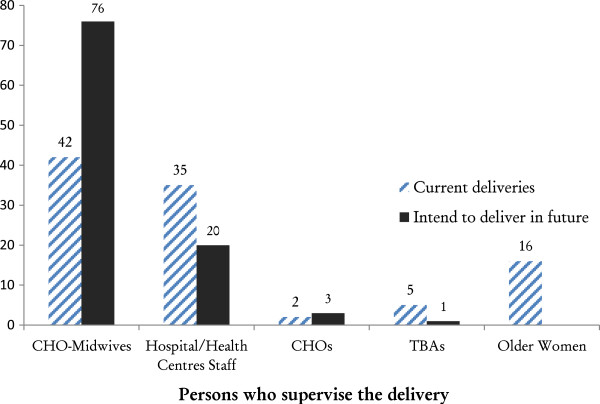
A total of 407 households/women were interviewed. Eighty three percent of respondents knew that CHO-midwives provided delivery services in CHPS zones. Seventy nine percent of the deliveries were with skilled attendants; and over half of these skilled births (42% of total) were by CHO-midwives. Multivariate analyses showed that women of the Nankana ethnic group and those with uneducated husbands were less likely to access skilled attendants at birth in rural settings.
The implementation of the CHO-midwife program in UER appeared to have contributed to expanded skilled delivery care access and utilization for rural women. However, women of the Nankana ethnic group and uneducated men must be targeted with health education to improve women utilizing skilled delivery services in rural communities of the region.
撒哈拉以南非洲地区孕产妇死亡负担巨大。2010年,加纳的孕产妇死亡率为每10万例活产中有350例死亡。有技能的助产服务已被证明可减少孕产妇死亡和残疾情况,但在2010年,加纳只有68%的产妇在有技能的助产人员陪同下分娩。2005年,加纳卫生服务局对其基于社区的卫生规划与服务(CHPS)项目进行了试点,培训社区卫生官员(CHO)担任助产士,以解决上东部农村地区(UER)助产技能服务方面的差距。该研究确定了CHO助产士技能分娩项目在UER分娩妇女中实现预期成果的程度。
我们对在调查前三年中生育过的妇女进行了横断面家庭调查。我们采用了两阶段抽样技术:第一阶段按比例选择普查区,第二阶段随机选择家庭。在每个家庭中,如果有多名妇女的孩子在年龄限制范围内,我们采访最小孩子的母亲。我们收集了关于项目知晓度、服务使用情况以及与分娩时熟练助产人员相关因素的数据。
总共采访了407户家庭/妇女。83%的受访者知道CHO助产士在CHPS地区提供分娩服务。79%的分娩有熟练的助产人员陪同;其中超过一半的熟练分娩(占总数的42%)是由CHO助产士完成的。多变量分析表明,在农村地区,南卡纳族妇女以及丈夫未受过教育的妇女在分娩时获得熟练助产人员服务的可能性较小。
在UER实施的CHO助产士项目似乎有助于扩大农村妇女获得熟练分娩护理的机会和使用率。然而,必须针对南卡纳族妇女和未受过教育的男性开展健康教育,以提高该地区农村社区妇女对熟练分娩服务的使用率。