Institute of Genomic and Systems Biology, Argonne National Laboratory Lemont, IL, USA ; Department of Ecology and Evolutionary Biology, University of Chicago Chicago, IL, USA.
Energy and Efficiency Division, Chemical and Biological Process Development Group, Pacific Northwest National Laboratory Richland, WA, USA ; Systems Microbiology and Biotechnology Group, Washington State University Richland, WA, USA.
Front Microbiol. 2014 Mar 25;5:108. doi: 10.3389/fmicb.2014.00108. eCollection 2014.
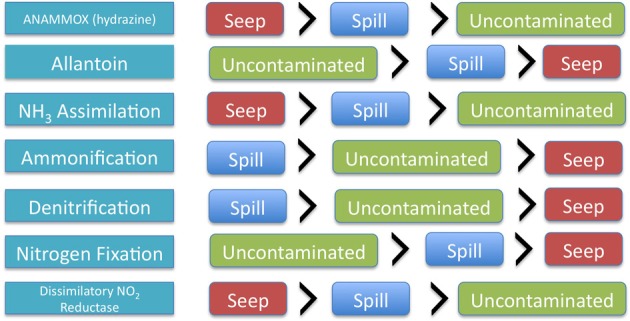
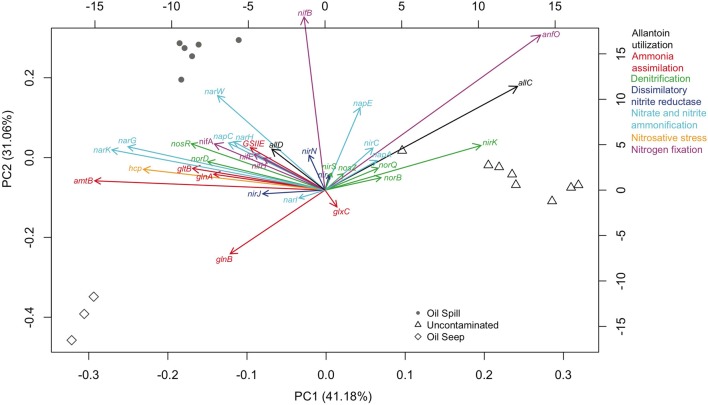
During hydrocarbon exposure, the composition and functional dynamics of marine microbial communities are altered, favoring bacteria that can utilize this rich carbon source. Initial exposure of high levels of hydrocarbons in aerobic surface sediments can enrich growth of heterotrophic microorganisms having hydrocarbon degradation capacity. As a result, there can be a localized reduction in oxygen potential within the surface layer of marine sediments causing anaerobic zones. We hypothesized that increasing exposure to elevated hydrocarbon concentrations would positively correlate with an increase in denitrification processes and the net accumulation of dinitrogen. This hypothesis was tested by comparing the relative abundance of genes associated with nitrogen metabolism and nitrogen cycling identified in 6 metagenomes from sediments contaminated by polyaromatic hydrocarbons from the Deepwater Horizon (DWH) oil spill in the Gulf of Mexico, and 3 metagenomes from sediments associated with natural oil seeps in the Santa Barbara Channel. An additional 8 metagenomes from uncontaminated sediments from the Gulf of Mexico were analyzed for comparison. We predicted relative changes in metabolite turnover as a function of the differential microbial gene abundances, which showed predicted accumulation of metabolites associated with denitrification processes, including anammox, in the contaminated samples compared to uncontaminated sediments, with the magnitude of this change being positively correlated to the hydrocarbon concentration and exposure duration. These data highlight the potential impact of hydrocarbon inputs on N cycling processes in marine sediments and provide information relevant for system scale models of nitrogen metabolism in affected ecosystems.
在烃类物质暴露期间,海洋微生物群落的组成和功能动态会发生变化,有利于能够利用这种丰富碳源的细菌。在有氧表层沉积物中最初暴露于高水平烃类物质时,可以富集具有烃类降解能力的异养微生物的生长。因此,海洋沉积物表层的氧势能会局部降低,导致出现厌氧区。我们假设,随着烃类浓度的升高,反硝化过程和氮气的净积累会呈正相关。通过比较来自墨西哥湾深海地平线(Deepwater Horizon,DWH)溢油事件中多环芳烃污染沉积物的 6 个宏基因组以及与圣巴巴拉海峡自然石油渗漏相关的 3 个宏基因组中与氮代谢和氮循环相关的基因的相对丰度,检验了这一假设。为了进行比较,还对来自墨西哥湾未受污染沉积物的另外 8 个宏基因组进行了分析。我们预测了代谢物周转率的相对变化作为微生物基因丰度差异的函数,结果表明与未受污染的沉积物相比,受污染的样本中与反硝化过程(包括厌氧氨氧化)相关的代谢物的积累预测增加,这种变化的幅度与烃浓度和暴露时间呈正相关。这些数据突出了烃类物质输入对海洋沉积物氮循环过程的潜在影响,并为受影响生态系统中氮代谢的系统尺度模型提供了相关信息。