Chatterjee Soumya, Kolappan Chockalingam, Subramani Rangasamy, Gopi Punnathanathu G, Chandrasekaran Vedhachalam, Fay Michael P, Babu Subash, Kumaraswami Vasanthapuram, Nutman Thomas B
Helminth Immunology Section, Laboratory of Parasitic Diseases, National Institute of Allergy and Infectious Diseases (NIAID), National Institutes of Health (NIH), Bethesda, Maryland, United States of America.
National Institute for Research in Tuberculosis, Chetpet, Chennai, India.
PLoS One. 2014 Apr 11;9(4):e94603. doi: 10.1371/journal.pone.0094603. eCollection 2014.
Filarial (and other helminth) infections are known to modulate mycobacteria-specific pro-inflammatory cytokine responses necessary for maintaining latency in tuberculosis (TB). We sought to address whether helminth co-infection alters progression to active pulmonary TB in a co-endemic area of South India.
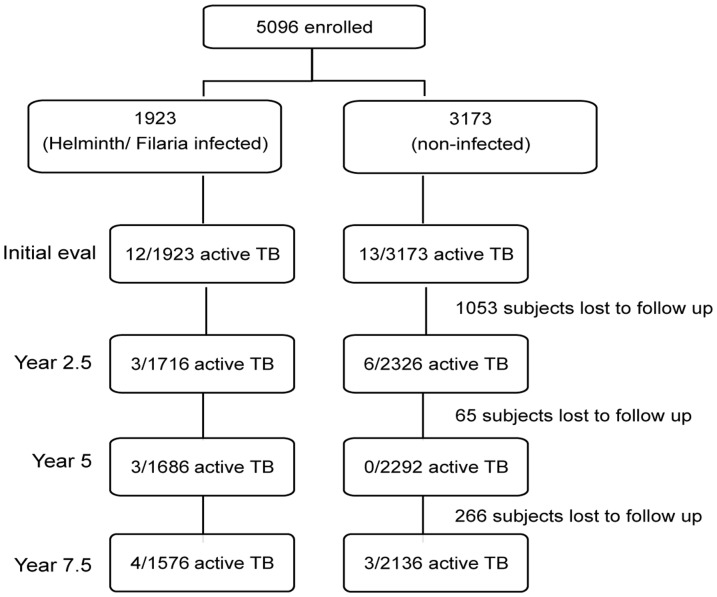
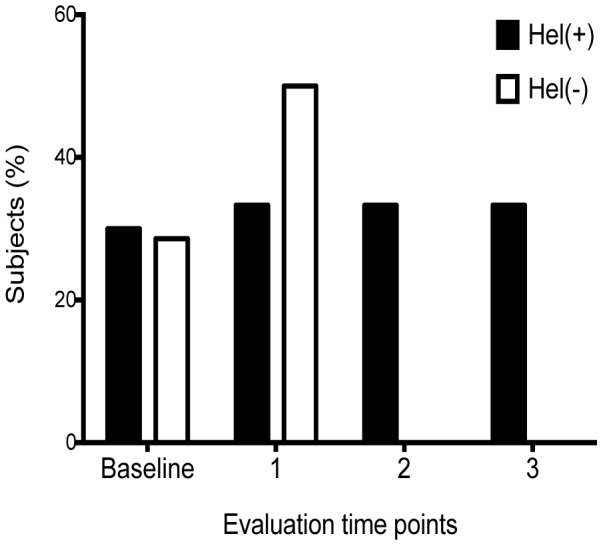
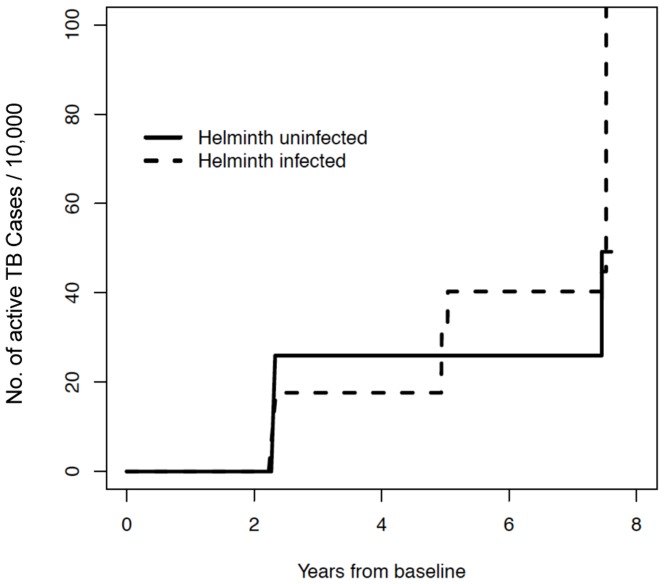
METHODS/PRINCIPAL FINDINGS: Incidence of active pulmonary TB was assessed in 5096 subjects from five villages among helminth-infected (hel⁺) and -uninfected (hel⁻) groups. Baseline stool examinations, circulating filarial antigen, and tuberculin skin testing (PPD) were performed along with chest radiographs, sputum microscopy, and culture. During three follow-up visits each 2.5 years, patients were assessed using PPD tests and questionnaires and--for those with potential symptoms of TB--sputum microscopy and culture. Of the 5096 subjects, 1923 were found to be hel⁺ and 3173 were hel⁻. Follow up interval stool examination could not be performed. In each group, 21 developed active TB over the course of the study. After adjusting for sex, age, BCG vaccination status, and PPD positivity, no difference was seen in active TB incidence between hel⁺ and hel- groups either at baseline (relative risk (RR) 1.60; 95% confidence interval (CI): 0.69, 3.71, P = 0·27), or when followed prospectively (RR 1.24; 95% CI: 0.48, 3.18, P = 0·66).
CONCLUSIONS/SIGNIFICANCE: Our findings suggest that, despite the immunomodulatory effects of helminth infection, baseline co-morbid infection with these parasites had little effect on the clinical progression from latent to active pulmonary TB.
已知丝虫(及其他蠕虫)感染可调节分枝杆菌特异性促炎细胞因子反应,而这种反应对于维持结核病(TB)的潜伏状态至关重要。我们试图探讨在印度南部的一个共流行地区,蠕虫合并感染是否会改变活动性肺结核的进展情况。
方法/主要发现:对来自五个村庄的5096名受试者进行了评估,这些受试者被分为蠕虫感染组(hel⁺)和未感染组(hel⁻)。进行了基线粪便检查、循环丝虫抗原检测以及结核菌素皮肤试验(PPD),同时还进行了胸部X光检查、痰涂片显微镜检查和培养。在每2.5年进行的三次随访中,使用PPD试验和问卷对患者进行评估,对于有潜在结核病症状的患者,还进行痰涂片显微镜检查和培养。在5096名受试者中,发现1923人是hel⁺,3173人是hel⁻。无法进行随访期间的间隔粪便检查。在每组中,有21人在研究过程中发展为活动性肺结核。在对性别、年龄、卡介苗接种状况和PPD阳性情况进行调整后,hel⁺组和hel⁻组在基线时的活动性肺结核发病率没有差异(相对风险(RR)为1.60;95%置信区间(CI):0.69,3.71,P = 0.27),前瞻性随访时也没有差异(RR为1.24;95%CI:0.48,3.18,P = 0.66)。
结论/意义:我们的研究结果表明,尽管蠕虫感染具有免疫调节作用,但这些寄生虫的基线合并感染对从潜伏性肺结核到活动性肺结核的临床进展影响很小。