Wang Lin, Ma Xiang-Yu, Zhang Yang, Feng Ya-Fei, Li Xiang, Hu Yun-Yu, Wang Zhen, Ma Zhen-Sheng, Lei Wei
Department of Orthopedics, Xijing Hospital, Fourth Military Medical University, Xi'an, Shaanxi, People's Republic of China.
School of Mechanical Engineering, Shanghai Jiao Tong University, State Key Laboratory of Mechanical System and Vibration, Shanghai, People's Republic of China.
PLoS One. 2014 Apr 11;9(4):e94276. doi: 10.1371/journal.pone.0094276. eCollection 2014.
The basic strategy to construct tissue engineered bone graft (TEBG) is to combine osteoblastic cells with three dimensional (3D) scaffold. Based on this strategy, we proposed the "Totally Vitalized TEBG" (TV-TEBG) which was characterized by abundant and homogenously distributed cells with enhanced cell proliferation and differentiation and further investigated its biological performance in repairing segmental bone defect.
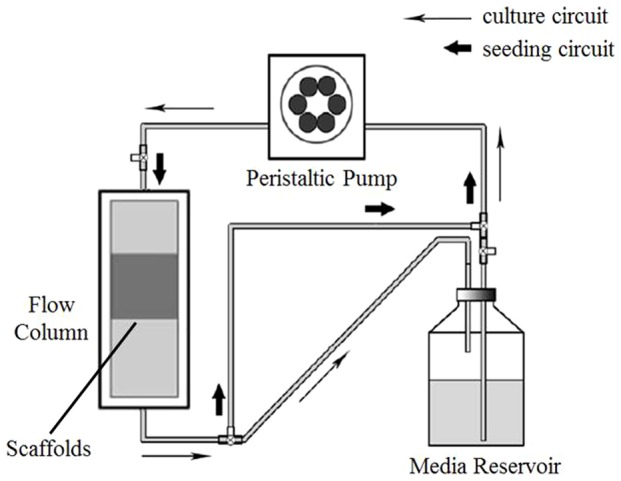
In this study, we constructed the TV-TEBG with the combination of customized flow perfusion seeding/culture system and β-tricalcium phosphate (β-TCP) scaffold fabricated by Rapid Prototyping (RP) technique. We systemically compared three kinds of TEBG constructed by perfusion seeding and perfusion culture (PSPC) method, static seeding and perfusion culture (SSPC) method, and static seeding and static culture (SSSC) method for their in vitro performance and bone defect healing efficacy with a rabbit model.
Our study has demonstrated that TEBG constructed by PSPC method exhibited better biological properties with higher daily D-glucose consumption, increased cell proliferation and differentiation, and better cell distribution, indicating the successful construction of TV-TEBG. After implanted into rabbit radius defects for 12 weeks, PSPC group exerted higher X-ray score close to autograft, much greater mechanical property evidenced by the biomechanical testing and significantly higher new bone formation as shown by histological analysis compared with the other two groups, and eventually obtained favorable healing efficacy of the segmental bone defect that was the closest to autograft transplantation.
This study demonstrated the feasibility of TV-TEBG construction with combination of perfusion seeding, perfusion culture and RP technique which exerted excellent biological properties. The application of TV-TEBG may become a preferred candidate for segmental bone defect repair in orthopedic and maxillofacial fields.
构建组织工程骨移植物(TEBG)的基本策略是将成骨细胞与三维(3D)支架相结合。基于此策略,我们提出了“完全活化的TEBG”(TV-TEBG),其特点是细胞丰富且分布均匀,细胞增殖和分化增强,并进一步研究了其修复节段性骨缺损的生物学性能。
在本研究中,我们将定制的流动灌注接种/培养系统与通过快速成型(RP)技术制造的β-磷酸三钙(β-TCP)支架相结合,构建了TV-TEBG。我们系统地比较了通过灌注接种和灌注培养(PSPC)方法、静态接种和灌注培养(SSPC)方法以及静态接种和静态培养(SSSC)方法构建的三种TEBG在体外的性能以及在兔模型中的骨缺损愈合效果。
我们的研究表明,通过PSPC方法构建的TEBG具有更好的生物学特性,每日葡萄糖消耗量更高,细胞增殖和分化增加,细胞分布更好,表明成功构建了TV-TEBG。植入兔桡骨缺损12周后,与其他两组相比,PSPC组的X线评分更高,接近自体移植,生物力学测试证明其力学性能更强,组织学分析显示新骨形成明显更多,最终获得了最接近自体移植的节段性骨缺损良好愈合效果。
本研究证明了结合灌注接种、灌注培养和RP技术构建TV-TEBG的可行性,该技术具有优异的生物学特性。TV-TEBG的应用可能成为骨科和颌面领域节段性骨缺损修复的首选方案。