Department of Surgery, Jinling Hospital, Nanjing University School of Medicine, Nanjing, China.
Department of General Surgery, The Affiliated Jiangyin Hospital of Southeast University Medical College, Jiangyin, China.
World J Emerg Surg. 2014 Apr 15;9:28. doi: 10.1186/1749-7922-9-28. eCollection 2014.
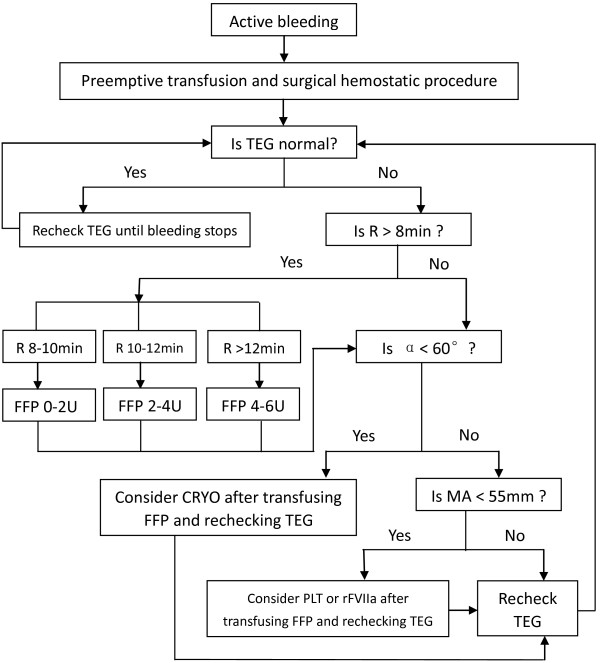
The optimal transfusion protocol remains unknown in the trauma setting. This retrospective cohort study aimed to determine if goal-directed transfusion protocol based on standard thrombelastography (TEG) is feasible and beneficial in patients with abdominal trauma.
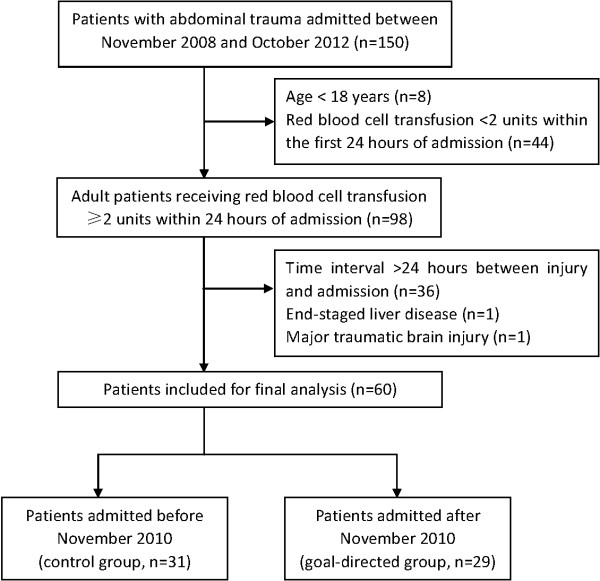
Sixty adult patients with abdominal trauma who received 2 or more units of red blood cell transfusion within 24 hours of admission were studied. Patients managed with goal-directed transfusion protocol via TEG (goal-directed group) were compared to patients admitted before utilization of the protocol (control group).
There were 29 patients in the goal-directed group and 31 in the control group. Baseline parameters were similar except for higher admission systolic blood pressure in the goal-directed group than the control group (121.8 ± 23.1 mmHg vs 102.7 ± 26.5 mmHg, p < 0.01). At 24 h, patients in the goal-directed group had shorter aPTT compared to patients in the control group (39.2 ± 16.3 s vs 58.6 ± 36.6 s, p = 0.044). Administration of total blood products at 24 h appeared to be fewer in the goal-directed group than the control group (10.2 [7.0-43.1]U vs 14.8 [8.3-37.6]U, p = 0.28), but this was not statistically significant. Subgroup analysis including patients with ISS ≥16 showed that patients in the goal-directed group had significantly fewer consumption of total blood products than patients in the control group (7[6.1, 47.0]U vs 37.6[14.5, 89.9]U, p = 0.015). No differences were found in mortality at 28d, length of stay in intensive care unit and hospital between the two groups.
Goal-directed transfusion protocol via standard TEG was achievable in patients with abdominal trauma. The novel protocol, compared to conventional transfusion management, has the potential to decrease blood product utilization and prevent exacerbation of coagulation function.
在创伤环境中,最佳输血方案仍不明确。本回顾性队列研究旨在确定基于标准血栓弹力图(TEG)的目标导向输血方案在腹部创伤患者中是否可行和有益。
研究纳入了 60 名在入院 24 小时内接受 2 个或更多单位红细胞输注的成年腹部创伤患者。通过 TEG 管理目标导向输血方案的患者(目标导向组)与在使用该方案前入院的患者(对照组)进行比较。
目标导向组有 29 名患者,对照组有 31 名患者。除目标导向组的入院收缩压高于对照组(121.8 ± 23.1mmHg 比 102.7 ± 26.5mmHg,p<0.01)外,两组患者的基线参数相似。24 小时时,目标导向组的 aPTT 短于对照组(39.2 ± 16.3s 比 58.6 ± 36.6s,p=0.044)。24 小时时,目标导向组的总输血量似乎少于对照组(10.2[7.0-43.1]U 比 14.8[8.3-37.6]U,p=0.28),但这无统计学意义。包括 ISS≥16 的患者的亚组分析显示,目标导向组的总输血量明显少于对照组(7[6.1, 47.0]U 比 37.6[14.5, 89.9]U,p=0.015)。两组患者在 28 天死亡率、重症监护病房和住院时间方面无差异。
腹部创伤患者可实现基于标准 TEG 的目标导向输血方案。与传统输血管理相比,该新方案有可能减少血液制品的使用,并防止凝血功能恶化。