Furtado Fabiana B, de Aquino Francisco J T, Nascimento Evandro A, de M Martins Carla, de Morais Sérgio A L, Chang Roberto, Cunha Luís C S, Leandro Luís F, Martins Carlos H G, Martins Mário M, da Silva Claudio V, Machado Fabrício C, de Oliveira Alberto
Laboratory of Natural Products and Chromatography, Chemistry Institute, Federal University of Uberlândia, Uberlândia, Minas Gerais 38408-144, Brazil.
Federal Institute Goiano, Morrinhos, Goiás 75650-000, Brazil.
Molecules. 2014 Apr 11;19(4):4560-77. doi: 10.3390/molecules19044560.
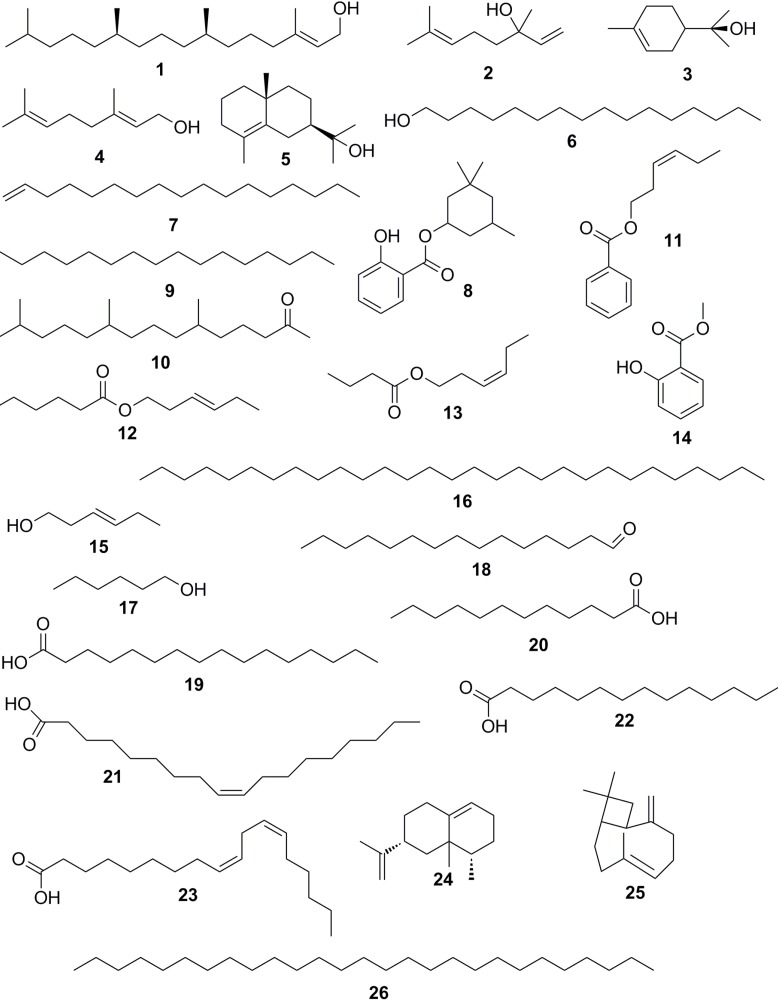
The seasonal chemical composition of essential oils from Inga laurina was determined by GC/MS. In the stem bark's essential oil extracted during the dry season, the presence of terpenoids (30.05%) stood out, and phytol (9.76%) was the major compound identified. For the stem bark oil obtained during the rainy season, in addition to terpenoids (26.63%), a large amount of fatty acids (46.84%) were identified, in particular palmitic acid (25.40%). Regarding the leaves' essential oil obtained in the dry season, esters (42.35%) were the main components. The main ester present was (Z)-hex-3-enyl benzoate (10.15%) and the major compound of this oil was (Z)-hex-3-en-1-ol (14.23%). Terpenoids (33.84%), long-chain alkanes (27.04%) and fatty acids (21.72%) were the main components of the essential oil from leaves in the rainy season. Phytol (33.21%), nonacosane (21.95%) and palmitic acid (15.20%) were the major compounds identified. The antimicrobial activity against aerobic and anaerobic oral bacteria was evaluated by the microdilution broth method and cytotoxic activity was carried out with Vero cells. The essential oils from the rainy season showed a better inhibition of the bacterial growth with Minimal Inhibitory Concentrations (MIC) values of 25 or 50 µg·mL⁻¹ for aerobic bacteria, and high selectivity against bacteria was observed. The large amount of fatty acids in rainy season oils may be related to the better inhibitory effects observed.
通过气相色谱/质谱联用仪(GC/MS)测定了月桂英加(Inga laurina)精油的季节性化学成分。在旱季提取的茎皮精油中,萜类化合物含量显著(30.05%),其中植醇(9.76%)是鉴定出的主要化合物。对于雨季获得的茎皮精油,除萜类化合物(26.63%)外,还鉴定出大量脂肪酸(46.84%),尤其是棕榈酸(25.40%)。关于旱季获得的叶精油,酯类(42.35%)是主要成分。主要的酯类是(Z)-己-3-烯基苯甲酸酯(10.15%),该精油的主要化合物是(Z)-己-3-烯-1-醇(14.23%)。萜类化合物(33.84%)、长链烷烃(27.04%)和脂肪酸(21.72%)是雨季叶精油的主要成分。植醇(33.21%)、二十九烷(21.95%)和棕榈酸(15.20%)是鉴定出的主要化合物。采用微量稀释肉汤法评估了对需氧和厌氧口腔细菌的抗菌活性,并用非洲绿猴肾细胞(Vero细胞)进行了细胞毒性活性检测。雨季的精油对细菌生长有较好的抑制作用,需氧菌的最低抑菌浓度(MIC)值为25或50μg·mL⁻¹,并且观察到对细菌具有高选择性。雨季精油中大量的脂肪酸可能与观察到的较好抑制效果有关。