Hoffmann Maria, Zhao Shaohua, Pettengill James, Luo Yan, Monday Steven R, Abbott Jason, Ayers Sherry L, Cinar Hediye N, Muruvanda Tim, Li Cong, Allard Marc W, Whichard Jean, Meng Jianghong, Brown Eric W, McDermott Patrick F
Division of Animal and Food Microbiology, Office of Research, Center for Veterinary Medicine, U.S. Food and Drug Administration, Laurel, Maryland, USA.
Genome Biol Evol. 2014 May;6(5):1046-68. doi: 10.1093/gbe/evu079.
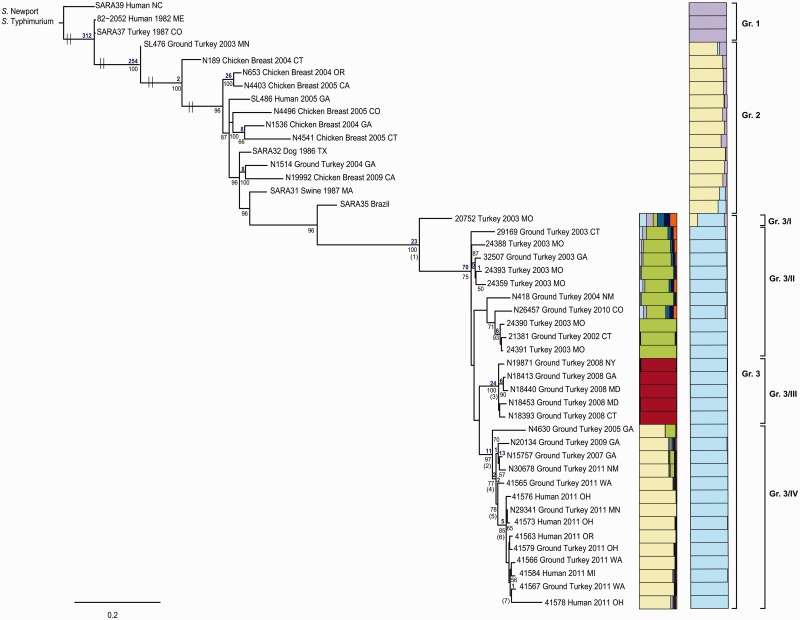
Salmonella enterica subsp. enterica serovar Heidelberg (S. Heidelberg) is one of the top serovars causing human salmonellosis. Recently, an antibiotic-resistant strain of this serovar was implicated in a large 2011 multistate outbreak resulting from consumption of contaminated ground turkey that involved 136 confirmed cases, with one death. In this study, we assessed the evolutionary diversity of 44 S. Heidelberg isolates using whole-genome sequencing (WGS) generated by the 454 GS FLX (Roche) platform. The isolates, including 30 with nearly indistinguishable (one band difference) Xbal pulsed-field gel electrophoresis patterns (JF6X01.0032, JF6X01.0058), were collected from various sources between 1982 and 2011 and included nine isolates associated with the 2011 outbreak. Additionally, we determined the complete sequence for the chromosome and three plasmids from a clinical isolate associated with the 2011 outbreak using the Pacific Biosciences (PacBio) system. Using single-nucleotide polymorphism (SNP) analyses, we were able to distinguish highly clonal isolates, including strains isolated at different times in the same year. The isolates from the recent 2011 outbreak clustered together with a mean SNP variation of only 17 SNPs. The S. Heidelberg isolates carried a variety of phages, such as prophage P22, P4, lambda-like prophage Gifsy-2, and the P2-like phage which carries the sopE1 gene, virulence genes including 62 pathogenicity, and 13 fimbrial markers and resistance plasmids of the incompatibility (Inc)I1, IncA/C, and IncHI2 groups. Twenty-one strains contained an IncX plasmid carrying a type IV secretion system. On the basis of the recent and historical isolates used in this study, our results demonstrated that, in addition to providing detailed genetic information for the isolates, WGS can identify SNP targets that can be utilized for differentiating highly clonal S. Heidelberg isolates.
肠炎沙门氏菌肠炎亚种海德堡血清型(S. Heidelberg)是导致人类沙门氏菌病的主要血清型之一。最近,该血清型的一种耐抗生素菌株与2011年因食用受污染火鸡肉引发的多州大规模疫情有关,此次疫情涉及136例确诊病例,其中1人死亡。在本研究中,我们使用454 GS FLX(罗氏)平台产生的全基因组测序(WGS)评估了44株海德堡沙门氏菌分离株的进化多样性。这些分离株包括30株具有几乎无法区分(相差一条带)的XbaI脉冲场凝胶电泳图谱(JF6X01.0032、JF6X01.0058),于1982年至2011年期间从不同来源收集,其中包括9株与2011年疫情相关的分离株。此外,我们使用太平洋生物科学公司(PacBio)系统确定了一株与2011年疫情相关的临床分离株的染色体和三个质粒的完整序列。通过单核苷酸多态性(SNP)分析,我们能够区分高度克隆的分离株,包括同年不同时间分离的菌株。2011年近期疫情中的分离株聚集在一起,平均SNP变异仅为17个SNP。海德堡沙门氏菌分离株携带多种噬菌体,如前噬菌体P22、P4、类λ前噬菌体Gifsy-2以及携带sopE1基因的类P2噬菌体、包括62个致病基因的毒力基因、13个菌毛标记以及不相容性(Inc)I1、IncA/C和IncHI2组的耐药质粒。21株菌株含有携带IV型分泌系统的IncX质粒。基于本研究中使用的近期和历史分离株,我们的结果表明,除了为分离株提供详细的遗传信息外,WGS还可以识别可用于区分高度克隆的海德堡沙门氏菌分离株的SNP靶点。