Edirmanasinghe Romaine, Finley Rita, Parmley E Jane, Avery Brent P, Carson Carolee, Bekal Sadjia, Golding George, Mulvey Michael R
Department of Medical Microbiology, University of Manitoba, Winnipeg, MB, Canada.
National Microbiology Laboratory, Public Health Agency of Canada, Winnipeg, MB, Canada.
Antimicrob Agents Chemother. 2017 Mar 24;61(4). doi: 10.1128/AAC.01919-16. Print 2017 Apr.
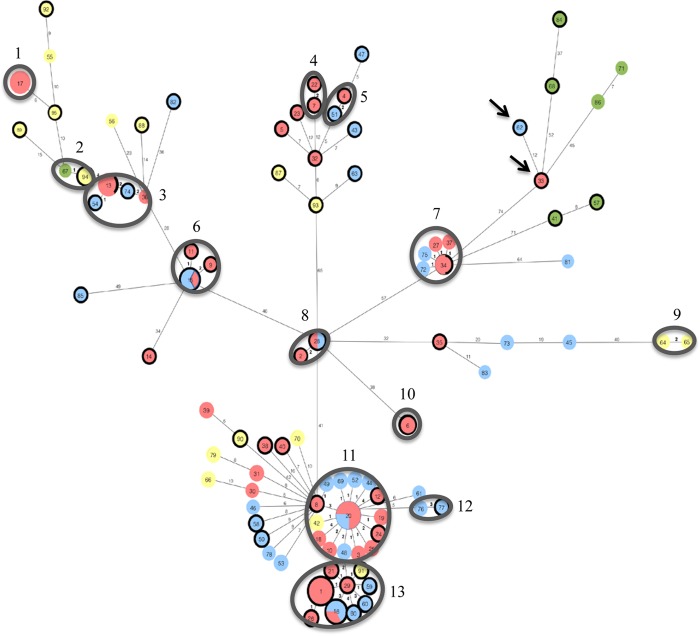
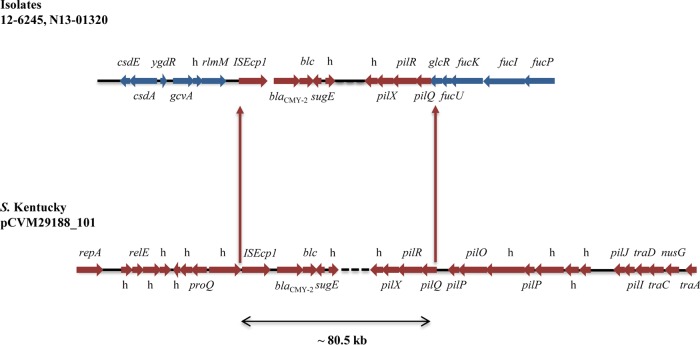
This study characterized cefoxitin-resistant and -susceptible serovar Heidelberg strains from humans, abattoir poultry, and retail poultry to assess the molecular relationships of isolates from these sources in Québec in 2012. Isolates were collected as part of the Canadian Integrated Program for Antimicrobial Resistance Surveillance (CIPARS). All isolates were subjected to antimicrobial susceptibility testing, PCR for CMY-2, pulsed-field gel electrophoresis (PFGE), and whole-genome sequencing (WGS). A total of 113 Heidelberg isolates from humans ( = 51), abattoir poultry ( = 18), and retail poultry ( = 44) were studied. All cefoxitin-resistant isolates ( = 65) were also resistant to amoxicillin-clavulanic acid, ampicillin, ceftiofur, and ceftriaxone, and all contained the CMY-2 gene. PFGE analysis showed that 111/113 (98.2%) isolates clustered together with ≥90% similarity. Core genome analysis using WGS identified 13 small clusters of isolates with 0 to 4 single nucleotide variations (SNVs), consisting of cefoxitin-resistant and -susceptible human, abattoir poultry, and retail poultry isolates. CMY-2 plasmids from cefoxitin-resistant isolates all belonged to incompatibility group I1. Analysis of IncI1 plasmid sequences revealed high identity (95 to 99%) to a previously described plasmid (pCVM29188_101) found in Kentucky. When compared to pCVM29188_101, all sequenced cefoxitin-resistant isolates were found to carry 1 of 10 possible variant plasmids. Transmission of Heidelberg may be occurring between human, abattoir poultry, and retail poultry sources, and transmission of a common CMY-2 plasmid may be occurring among Heidelberg strains with variable genetic backgrounds.
本研究对来自人类、屠宰场家禽和零售家禽的耐头孢西丁和对头孢西丁敏感的海德堡血清型菌株进行了特征分析,以评估2012年魁北克这些来源的分离株之间的分子关系。这些分离株是作为加拿大抗菌药物耐药性监测综合项目(CIPARS)的一部分收集的。所有分离株都进行了抗菌药物敏感性测试、CMY - 2的PCR检测、脉冲场凝胶电泳(PFGE)和全基因组测序(WGS)。共研究了113株来自人类(n = 51)、屠宰场家禽(n = 18)和零售家禽(n = 44)的海德堡分离株。所有耐头孢西丁的分离株(n = 65)也对阿莫西林 - 克拉维酸、氨苄西林、头孢噻呋和头孢曲松耐药,并且都含有CMY - 2基因。PFGE分析表明,111/113(98.2%)的分离株以≥90%的相似性聚集在一起。使用WGS进行的核心基因组分析确定了13个小的分离株簇,具有0至4个单核苷酸变异(SNV),包括耐头孢西丁和对头孢西丁敏感的人类、屠宰场家禽和零售家禽分离株。耐头孢西丁分离株的CMY - 2质粒均属于不相容群I1。对IncI1质粒序列的分析显示,与在肯塔基州发现的先前描述的质粒(pCVM29188_101)具有高度同一性(95%至99%)。与pCVM29188_101相比,所有测序的耐头孢西丁分离株被发现携带10种可能的变异质粒中的1种。海德堡菌株可能在人类、屠宰场家禽和零售家禽来源之间传播,并且一种常见的CMY -
2质粒可能在具有可变遗传背景的海德堡菌株之间传播。