Man Mao-Qiang, Lin Tzu-Kai, Santiago Juan L, Celli Anna, Zhong Lily, Huang Zhi-Ming, Roelandt Truus, Hupe Melanie, Sundberg John P, Silva Kathleen A, Crumrine Debra, Martin-Ezquerra Gemma, Trullas Carles, Sun Richard, Wakefield Joan S, Wei Maria L, Feingold Kenneth R, Mauro Theodora M, Elias Peter M
Dermatology Service, Department of Veterans Affairs Medical Center, San Francisco, California, USA; Department of Dermatology, University of California, San Francisco, San Francisco, California, USA.
Dermatology Service, Department of Veterans Affairs Medical Center, San Francisco, California, USA; Department of Dermatology, University of California, San Francisco, San Francisco, California, USA; Graduate Institute of Clinical Medicine, National Cheng Kung University Medical College, Tainan, Taiwan; Department of Dermatology, National Cheng Kung University Medical College and Hospital, Tainan, Taiwan.
J Invest Dermatol. 2014 Sep;134(9):2399-2407. doi: 10.1038/jid.2014.187. Epub 2014 Apr 14.
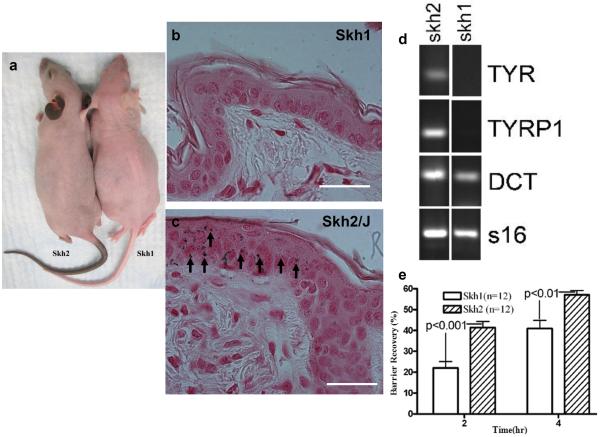
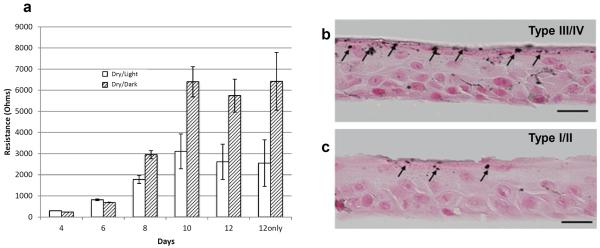
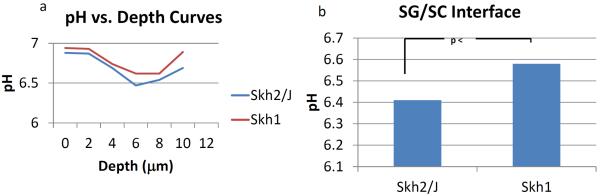
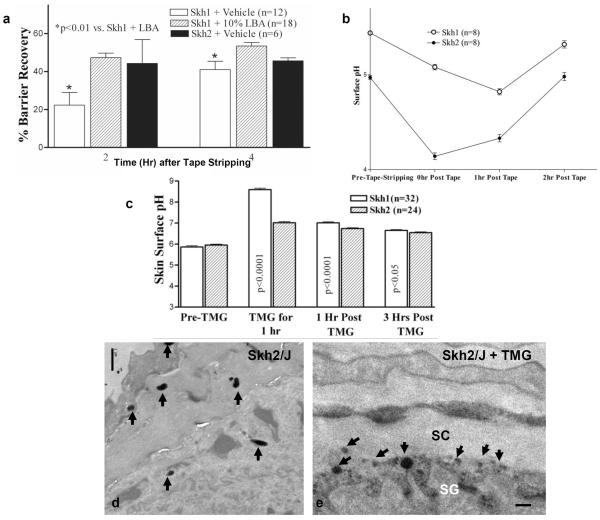
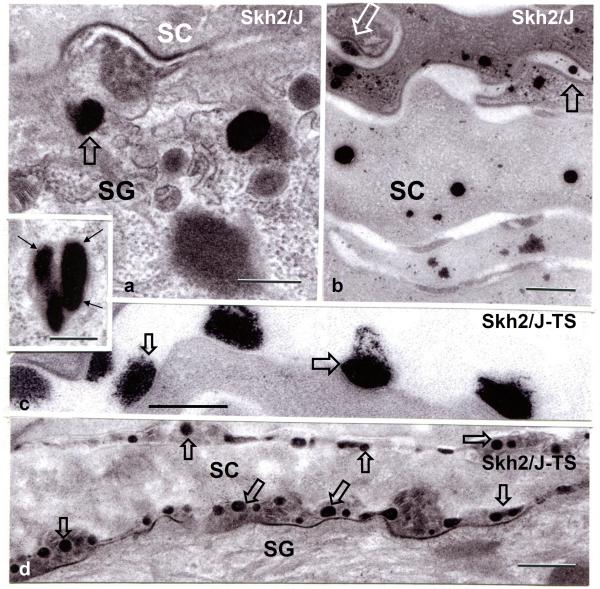
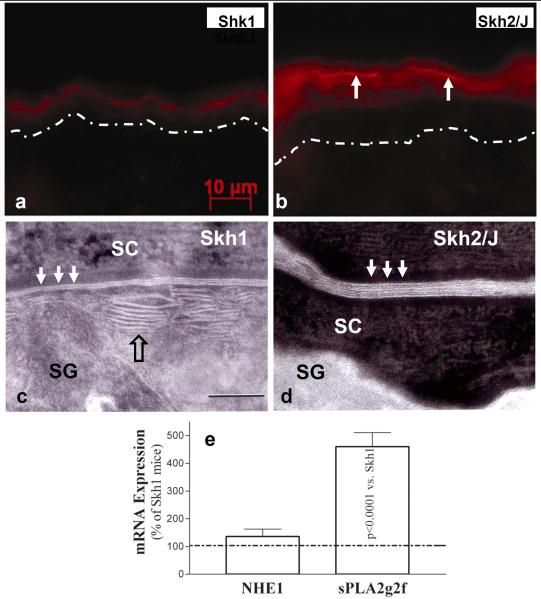
Humans with darkly pigmented skin display superior permeability barrier function in comparison with humans with lightly pigmented skin. The reduced pH of the stratum corneum (SC) of darkly pigmented skin could account for enhanced function, because acidifying lightly pigmented human SC resets barrier function to darkly pigmented levels. In SKH1 (nonpigmented) versus SKH2/J (pigmented) hairless mice, we evaluated how a pigment-dependent reduction in pH could influence epidermal barrier function. Permeability barrier homeostasis is enhanced in SKH2/J versus SKH1 mice, correlating with a reduced pH in the lower SC that colocalizes with the extrusion of melanin granules. Darkly pigmented human epidermis also shows substantial melanin extrusion in the outer epidermis. Both acute barrier disruption and topical basic pH challenges accelerate reacidification of SKH2/J (but not SKH1) SC, while inducing melanin extrusion. SKH2/J mice also display enhanced expression of the SC acidifying enzyme, secretory phospholipase A2f (sPLA2f). Enhanced barrier function of SKH2/J mice could be attributed to enhanced activity of two acidic pH-dependent, ceramide-generating enzymes, β-glucocerebrosidase and acidic sphingomyelinase, leading to accelerated maturation of SC lamellar bilayers. Finally, organotypic cultures of darkly pigmented human keratinocytes display enhanced barrier function in comparison with lightly pigmented cultures. Together, these results suggest that the superior barrier function of pigmented epidermis can be largely attributed to the pH-lowering impact of melanin persistence/extrusion and enhanced sPLA2f expression.
与皮肤色素较浅的人相比,皮肤色素较深的人表现出更强的渗透屏障功能。皮肤色素较深的人角质层(SC)pH值降低可能是其功能增强的原因,因为将皮肤色素较浅的人的SC酸化可将屏障功能恢复到皮肤色素较深的人的水平。在SKH1(无色素)和SKH2/J(有色素)无毛小鼠中,我们评估了色素依赖性pH降低如何影响表皮屏障功能。与SKH1小鼠相比,SKH2/J小鼠的渗透屏障稳态增强,这与较低SC中pH值降低相关,该降低与黑色素颗粒的挤出共定位。皮肤色素较深的人表皮在外层表皮中也显示出大量黑色素挤出。急性屏障破坏和局部碱性pH挑战均可加速SKH2/J(而非SKH1)SC的再酸化,同时诱导黑色素挤出。SKH2/J小鼠还表现出SC酸化酶分泌型磷脂酶A2f(sPLA2f)的表达增强。SKH2/J小鼠屏障功能增强可能归因于两种酸性pH依赖性神经酰胺生成酶β-葡萄糖脑苷脂酶和酸性鞘磷脂酶的活性增强,从而导致SC层状双分子层加速成熟。最后,与皮肤色素较浅的角质形成细胞培养物相比,皮肤色素较深的人角质形成细胞的器官型培养物显示出增强的屏障功能。总之,这些结果表明,色素沉着表皮的优越屏障功能在很大程度上可归因于黑色素持续存在/挤出的降pH影响和sPLA2f表达增强。