Department of Biology, Center for Cell and Genome Science, University of Utah, Salt Lake City, UT 84112.
J Cell Biol. 2014 Apr 14;205(1):11-20. doi: 10.1083/jcb.201310113.
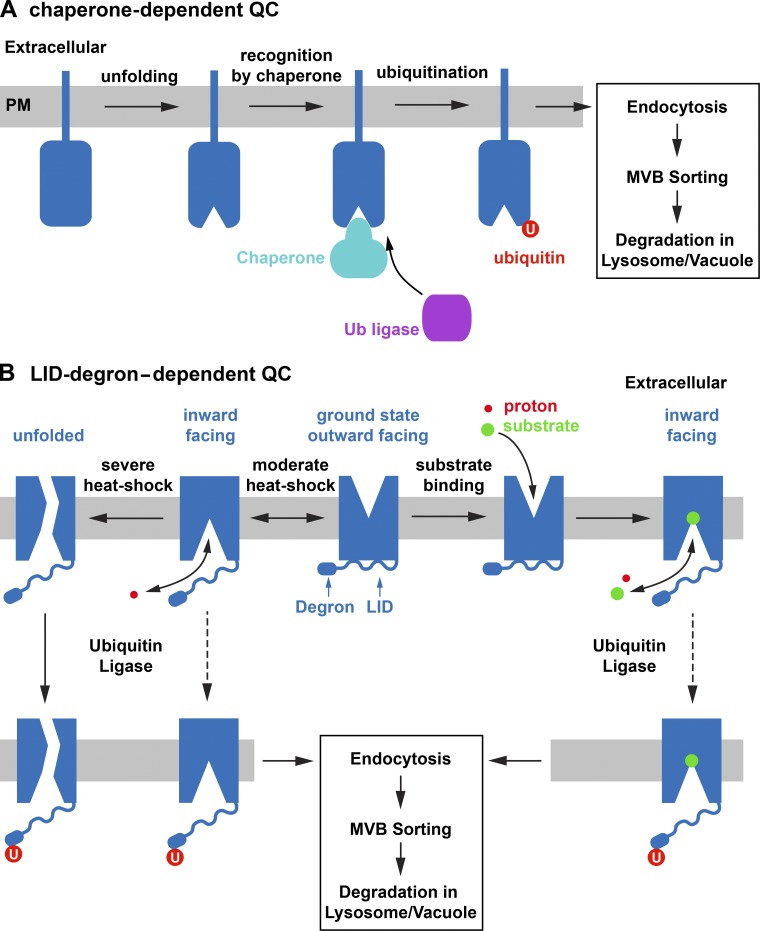
The plasma membrane quality control system of eukaryotic cells is able to recognize and degrade damaged cell surface proteins. Recent studies have identified two mechanisms involved in the recognition of unfolded transmembrane proteins. One system uses chaperones to detect unfolded cytoplasmic domains of transmembrane proteins, whereas the second mechanism relies on an internal quality control system of the protein, which can trigger degradation when the protein deviates from the folded state. Both quality control mechanisms are key to prevent proteotoxic effects at the cell surface and to ensure cell integrity.
真核细胞的质膜质量控制系统能够识别和降解受损的细胞表面蛋白。最近的研究确定了两种参与识别未折叠跨膜蛋白的机制。一种系统使用伴侣蛋白来检测跨膜蛋白的未折叠细胞质结构域,而第二种机制依赖于蛋白质的内部质量控制系统,当蛋白质偏离折叠状态时,该系统可以触发降解。这两种质量控制机制对于防止细胞表面的蛋白毒性效应和确保细胞完整性都是至关重要的。