INRA, Interactions Arbres/Microorganismes, UMR 1136 Champenoux, France ; Université de Lorraine, Interactions Arbres/Microorganismes, UMR 1136 Vandoeuvre-lès-Nancy, France.
Front Plant Sci. 2014 Mar 28;5:111. doi: 10.3389/fpls.2014.00111. eCollection 2014.
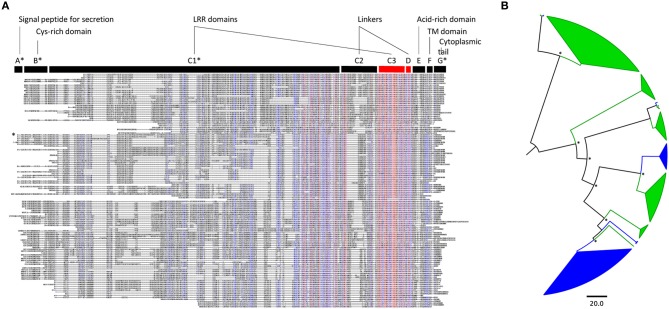
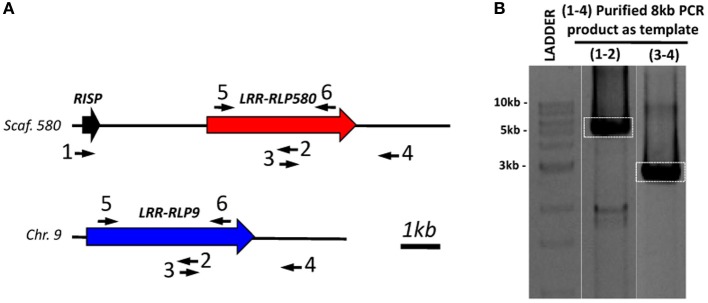
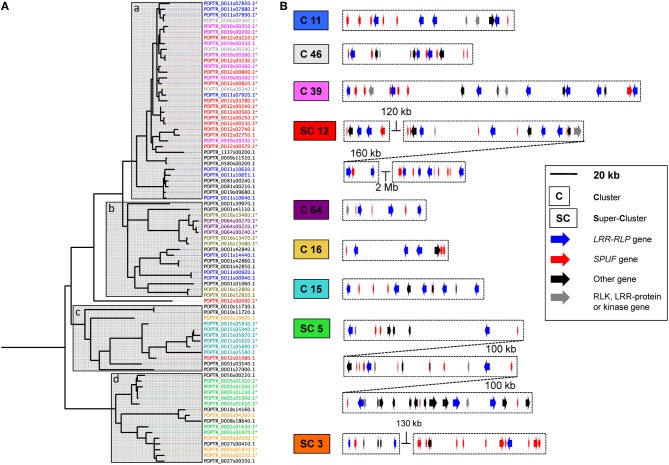
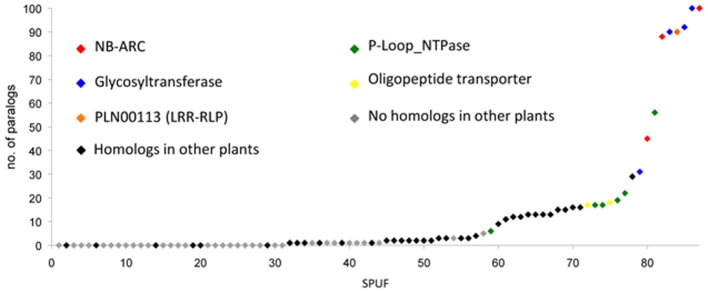
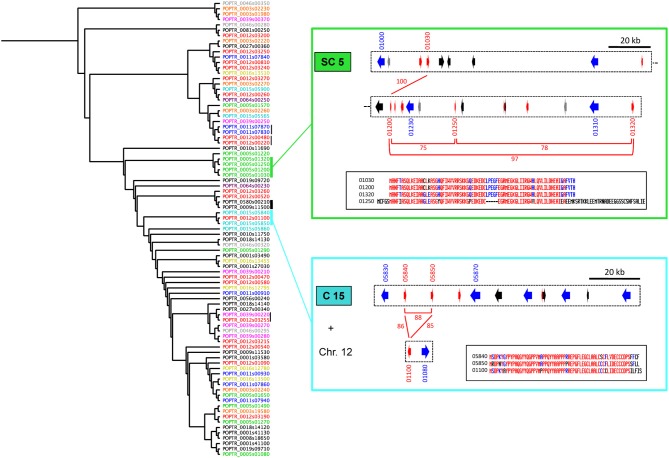
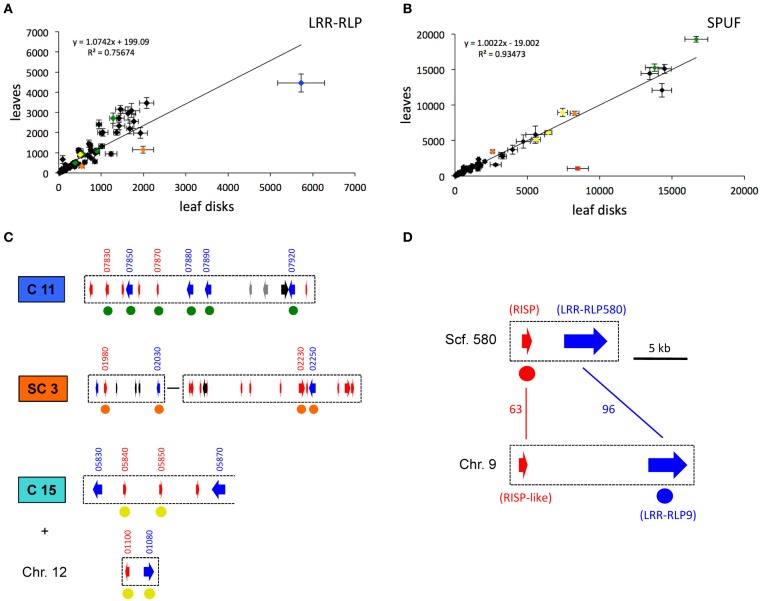
In plants, cell-surface receptors control immunity and development through the recognition of extracellular ligands. Leucine-rich repeat receptor-like proteins (LRR-RLPs) constitute a large multigene family of cell-surface receptors. Although this family has been intensively studied, a limited number of ligands has been identified so far, mostly because methods used for their identification and characterization are complex and fastidious. In this study, we combined genome and transcriptome analyses to describe the LRR-RLP gene family in the model tree poplar (Populus trichocarpa). In total, 82 LRR-RLP genes have been identified in P. trichocarpa genome, among which 66 are organized in clusters of up to seven members. In these clusters, LRR-RLP genes are interspersed by orphan, poplar-specific genes encoding small proteins of unknown function (SPUFs). In particular, the nine largest clusters of LRR-RLP genes (47 LRR-RLPs) include 71 SPUF genes that account for 59% of the non-LRR-RLP gene content within these clusters. Forty-four LRR-RLP and 55 SPUF genes are expressed in poplar leaves, mostly at low levels, except for members of some clusters that show higher and sometimes coordinated expression levels. Notably, wounding of poplar leaves strongly induced the expression of a defense SPUF gene named Rust-Induced Secreted protein (RISP) that has been previously reported as a marker of poplar defense responses. Interestingly, we show that the RISP-associated LRR-RLP gene is highly expressed in poplar leaves and slightly induced by wounding. Both gene promoters share a highly conserved region of ~300 nucleotides. This led us to hypothesize that the corresponding pair of proteins could be involved in poplar immunity, possibly as a ligand/receptor couple. In conclusion, we speculate that some poplar SPUFs, such as RISP, represent candidate endogenous peptide ligands of the associated LRR-RLPs and we discuss how to investigate further this hypothesis.
在植物中,细胞表面受体通过识别细胞外配体来控制免疫和发育。富含亮氨酸重复受体样蛋白(LRR-RLPs)构成了一个大型的细胞表面受体多基因家族。尽管这个家族已经被深入研究,但迄今为止只鉴定出了有限数量的配体,这主要是因为用于鉴定和表征它们的方法复杂且繁琐。在这项研究中,我们结合基因组和转录组分析,描述了模式树种毛白杨(Populus trichocarpa)中的 LRR-RLP 基因家族。总共在 P. trichocarpa 基因组中鉴定出 82 个 LRR-RLP 基因,其中 66 个基因组织成多达七个成员的簇。在这些簇中,LRR-RLP 基因被孤儿、杨树特异性基因编码的未知功能的小蛋白(SPUFs)所打断。特别是,九个最大的 LRR-RLP 基因簇(47 个 LRR-RLP)包含 71 个 SPUF 基因,占这些簇中非 LRR-RLP 基因含量的 59%。44 个 LRR-RLP 和 55 个 SPUF 基因在毛白杨叶片中表达,大多数表达水平较低,但某些簇的成员表达水平较高,有时呈协调表达。值得注意的是,毛白杨叶片的创伤强烈诱导了防御性 SPUF 基因 Rust-Induced Secreted protein(RISP)的表达,该基因先前被报道为毛白杨防御反应的标志物。有趣的是,我们发现 RISP 相关的 LRR-RLP 基因在毛白杨叶片中高度表达,并被创伤轻微诱导。这两个基因启动子都具有约 300 个核苷酸的高度保守区域。这使我们假设相应的蛋白对可能参与毛白杨的免疫反应,可能作为配体/受体对。总之,我们推测,一些杨树 SPUFs,如 RISP,代表相关 LRR-RLPs 的候选内源性肽配体,我们讨论了如何进一步研究这一假设。