Department of Gynecology, The Affiliated Hospital of Jining Medical University, Jining, Shandong Province, People's Republic China.
Department of ENT, The Affiliated Hospital of Jining Medical University, Jining, Shandong Province, People's Republic China.
PLoS One. 2014 Apr 15;9(4):e95048. doi: 10.1371/journal.pone.0095048. eCollection 2014.
High meat consumption, especially red and processed meat consumption is associated with an increased risk of several cancers, however, evidence for oral cavity and oropharynx cancer is limited. Thus, we performed this meta-analysis to determine the association between intakes of total meat, processed meat, red meat, and white meat, and the risk of oral cavity and oropharynx cancer.
Electronic search of Pubmed, Embase, and Cochrane Library Central database was conducted to select relevant studies. Fixed-effect and random-effect models were used to estimate summary relative risks (RR) and the corresponding 95% confidence intervals (CIs). Potential sources of heterogeneity were detected by meta-regression. Subgroup analyses and sensitivity analysis were also performed.
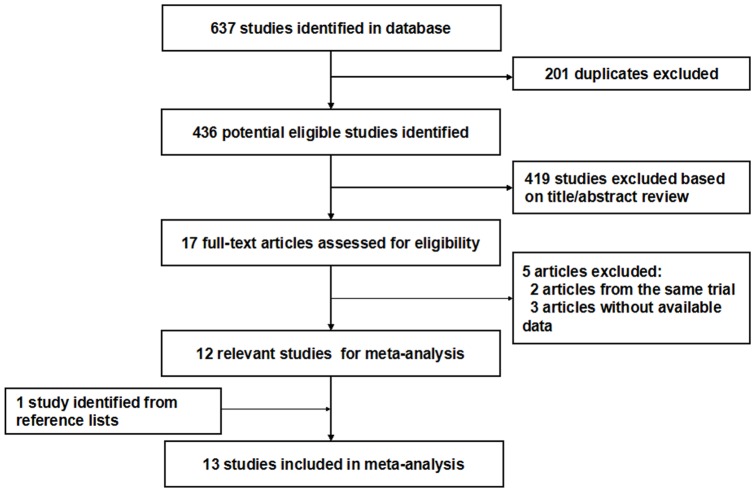
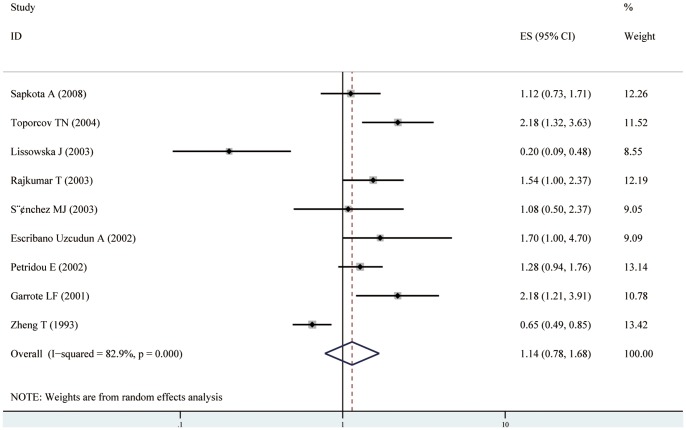
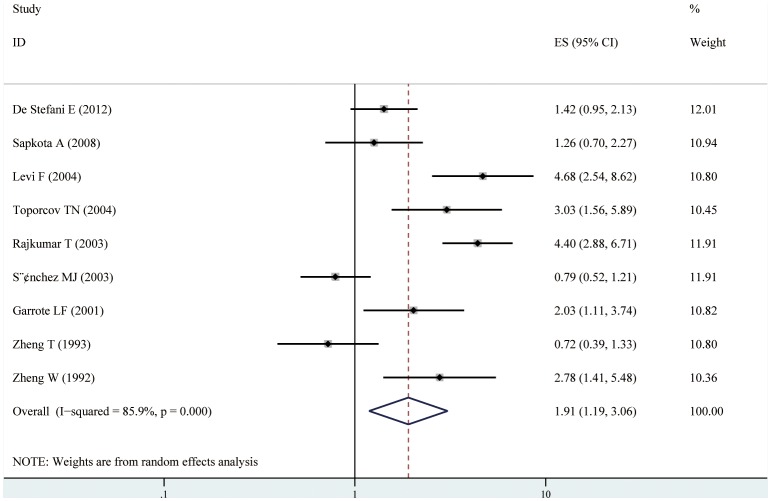
12 case-control studies and one cohort study were included in the analyses, including 501,730 subjects and 4,104 oral cavity and oropharynx cancer cases. Pooled results indicated that high consumption of total meat, red meat, and white meat were not significantly associated with increased risk of oral cavity and oropharynx cancer (RR = 1.14, 95% CI[0.78-1.68]; RR = 1.05, 95% CI[0.66, 1.66] and RR = 0.81, 95% CI[0.54, 1.22], respectively), while the high consumption of processed meat was significantly associated with a 91% increased risk of oral cavity and oropharynx cancer (RR = 1.91, 95% CI [1.19-3.06]). Sensitivity analysis indicated that no significant variation in combined RR by excluding any of the study, confirming the stability of present results.
The present meta-analysis suggested that high consumption of processed meat was significantly associated with an increased risk of oral cavity and oropharynx cancer, while there was no significantly association between total meat, red meat or white meat and the risk of oral cavity and oropharynx cancer. More prospective cohort studies are warranted to confirm these associations.
大量食用肉类,尤其是红肉和加工肉类,与多种癌症的风险增加有关,然而,有关口腔和口咽癌的证据有限。因此,我们进行了这项荟萃分析,以确定总肉类、加工肉类、红肉和白肉的摄入量与口腔和口咽癌风险之间的关系。
对 Pubmed、Embase 和 Cochrane Library Central 数据库进行电子检索,以选择相关研究。使用固定效应和随机效应模型来估计汇总相对风险(RR)和相应的 95%置信区间(CI)。通过荟萃回归检测潜在的异质性来源。还进行了亚组分析和敏感性分析。
纳入了 12 项病例对照研究和 1 项队列研究,共纳入 501730 名受试者和 4104 例口腔和口咽癌病例。汇总结果表明,大量食用总肉类、红肉和白肉与口腔和口咽癌风险增加无关(RR=1.14,95%CI[0.78-1.68];RR=1.05,95%CI[0.66-1.66]和 RR=0.81,95%CI[0.54-1.22]),而大量食用加工肉类与口腔和口咽癌风险增加 91%相关(RR=1.91,95%CI[1.19-3.06])。敏感性分析表明,排除任何一项研究后,联合 RR 的变化均不显著,证实了当前结果的稳定性。
本荟萃分析表明,大量食用加工肉类与口腔和口咽癌风险增加显著相关,而总肉类、红肉或白肉与口腔和口咽癌风险之间无显著关联。需要更多的前瞻性队列研究来证实这些关联。