Department of Radiation Oncology, The First Affiliated Hospital of Nanjing Medical University, Nanjing, China.
PLoS One. 2013 Aug 14;8(8):e70955. doi: 10.1371/journal.pone.0070955. eCollection 2013.
Red and processed meat was concluded as a limited-suggestive risk factor of gastric cancer by the World Cancer Research Fund. However, recent epidemiological studies have yielded inconclusive results.
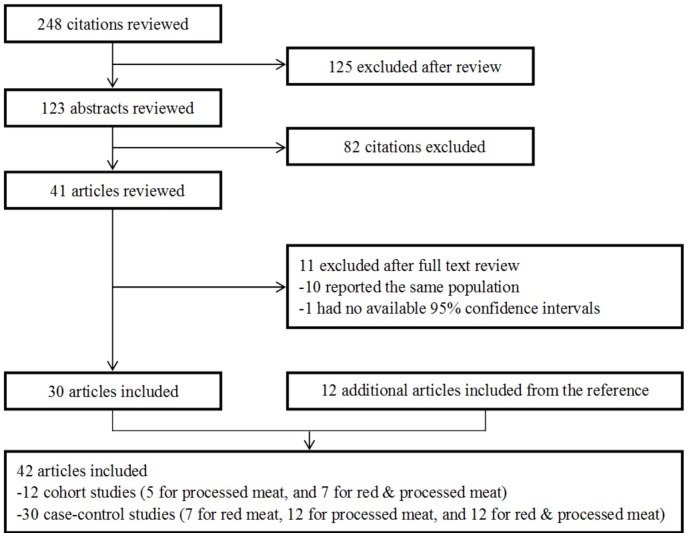
We searched Medline, EMBASE, and the Cochrane Library from their inception to April 2013 for both cohort and case-control studies which assessed the association between red and/or processed meat intake and gastric cancer risk. Study-specific relative risk estimates were polled by random-effect or fixed-effect models.
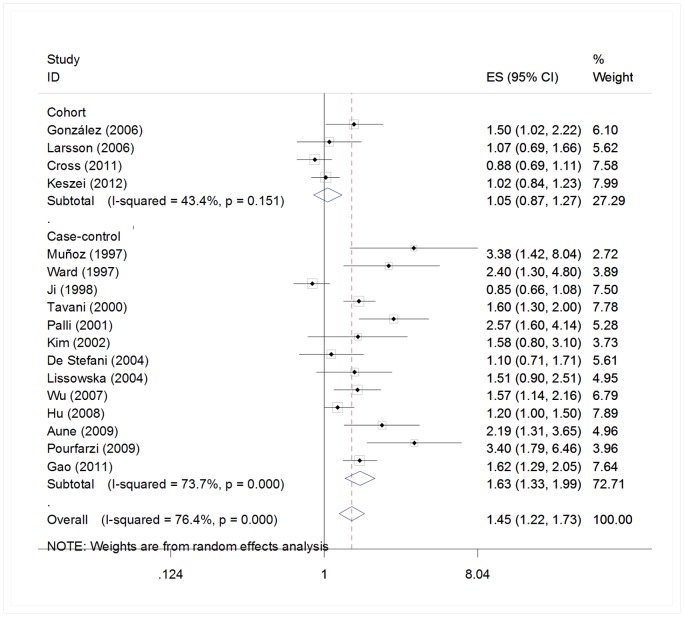
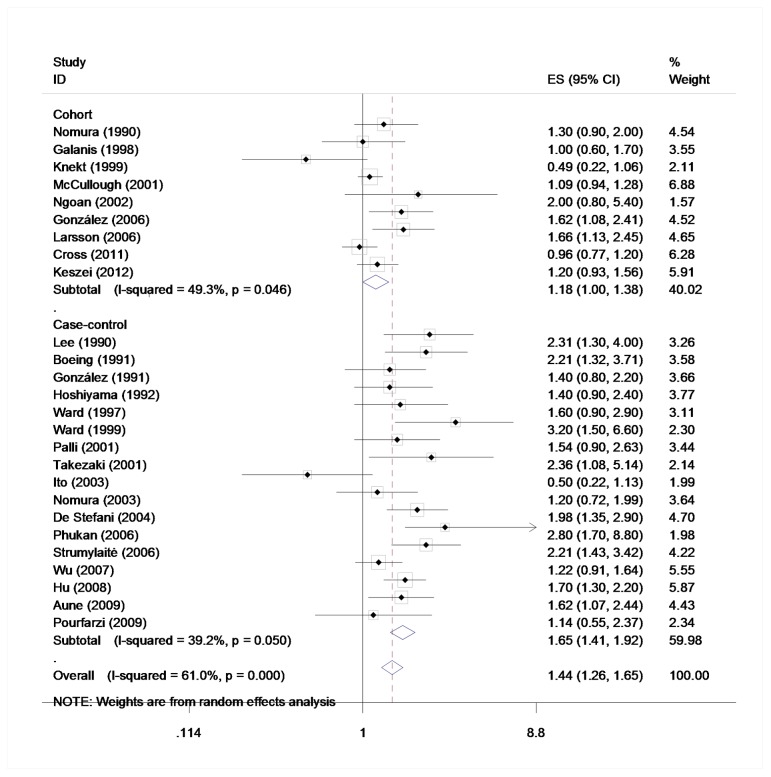
Twelve cohort and thirty case-control studies were included in the meta-analysis. Significant associations were found between both red (RR: 1.45, 95% CI: 1.22-1.73) and processed (RR: 1.45, 95% CI: 1.26-1.65) meat intake and gastric cancer risk generally. Positive findings were also existed in the items of beef (RR: 1.28, 95% CI: 1.04-1.57), bacon (RR: 1.37, 95% CI: 1.17-1.61), ham (RR: 1.44, 95% CI: 1.00-2.06), and sausage (RR: 1.33, 95% CI: 1.16-1.52). When conducted by study design, the association was significant in case-control studies (RR: 1.63, 95% CI: 1.33-1.99) but not in cohort studies (RR: 1.02, 95% CI: 0.90-1.17) for red meat. Increased relative risks were seen in high-quality, adenocarcinoma, cardia and European-population studies for red meat. And most subgroup analysis confirmed the significant association between processed meat intake and gastric cancer risk.
Our findings indicate that consumption of red and/or processed meat contributes to increased gastric cancer risk. However, further investigation is needed to confirm the association, especially for red meat.
世界癌症研究基金会认为红色和加工肉类是胃癌的有限提示性风险因素。然而,最近的流行病学研究得出的结果并不一致。
我们检索了 Medline、EMBASE 和 Cochrane Library 从成立到 2013 年 4 月的队列和病例对照研究,评估了红色和/或加工肉类摄入与胃癌风险之间的关系。通过随机效应或固定效应模型汇总研究特异性相对风险估计值。
共有 12 项队列研究和 30 项病例对照研究纳入荟萃分析。红色(RR:1.45,95%CI:1.22-1.73)和加工肉类(RR:1.45,95%CI:1.26-1.65)摄入与胃癌风险之间存在显著关联。牛肉(RR:1.28,95%CI:1.04-1.57)、培根(RR:1.37,95%CI:1.17-1.61)、火腿(RR:1.44,95%CI:1.00-2.06)和香肠(RR:1.33,95%CI:1.16-1.52)的摄入量也存在阳性结果。按研究设计进行分析时,病例对照研究中的关联具有统计学意义(RR:1.63,95%CI:1.33-1.99),而队列研究中则无统计学意义(RR:1.02,95%CI:0.90-1.17)。对于红色肉类,高质量、腺癌、贲门和欧洲人群研究中观察到的相对风险增加。大多数亚组分析证实了加工肉类摄入与胃癌风险之间的显著关联。
我们的研究结果表明,红色和/或加工肉类的消费会增加胃癌的风险。然而,需要进一步的研究来证实这种关联,特别是对于红色肉类。