1 Department of Pharmaceutics, Ernest Mario School of Pharmacy, Rutgers, The State University of New Jersey, Piscataway, NJ 08854, USA ; 2 Department of Environmental Sciences, Rutgers, The State University of New Jersey, New Brunswick, NJ 08901, USA ; 3 Environmental and Occupational Health Sciences Institute, Piscataway, NJ 08854, USA ; 4 Department of Pharmaceutical Sciences, Oregon State University, Corvallis 97331, USA ; 5 Rutgers Cancer Institute of New Jersey, New Brunswick, NJ 08903, USA.
Cancer Biol Med. 2014 Mar;11(1):44-55. doi: 10.7497/j.issn.2095-3941.2014.01.004.
Various nanoparticles have been designed and tested in order to select optimal carriers for the inhalation delivery of anticancer drugs to the lungs.
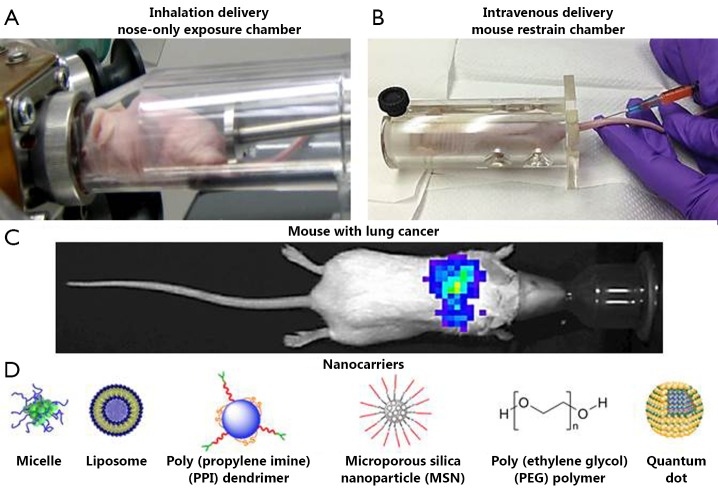
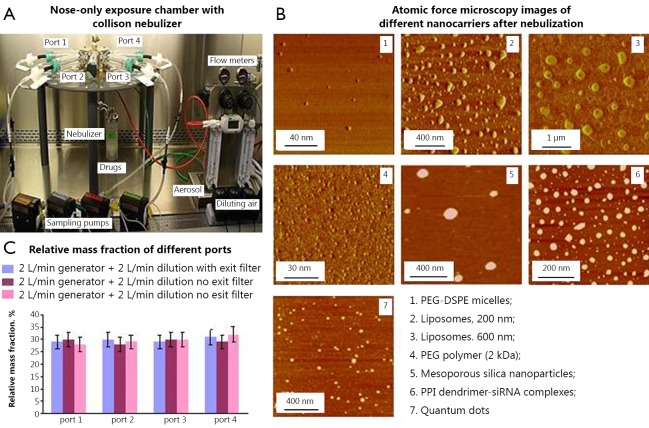
THE FOLLOWING NANOCARRIERS WERE STUDIED: micelles, liposomes, mesoporous silica nanoparticles (MSNs), poly propyleneimine (PPI) dendrimer-siRNA complexes nanoparticles, quantum dots (QDs), and poly (ethylene glycol) polymers. All particles were characterized using the following methods: dynamic light scattering, zeta potential, atomic force microscopy, in vitro cyto- and genotoxicity. In vivo organ distribution of all nanoparticles, retention in the lungs, and anticancer effects of liposomes loaded with doxorubicin were examined in nude mice after the pulmonary or intravenous delivery.
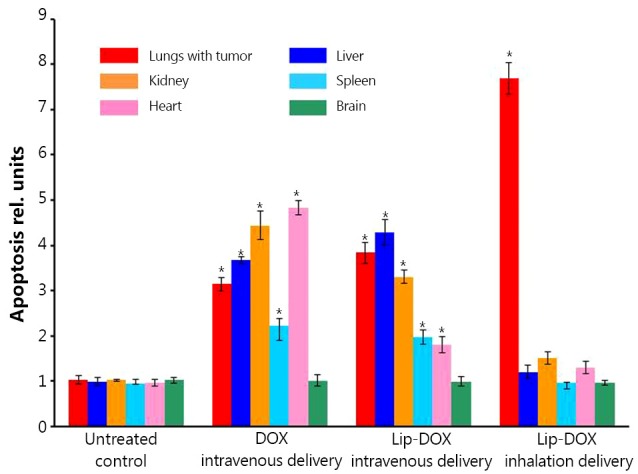
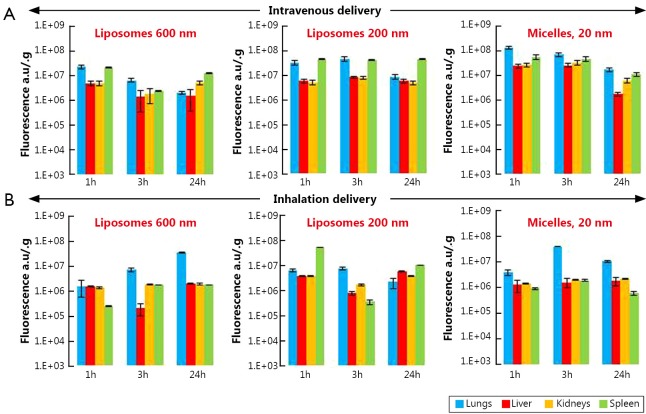
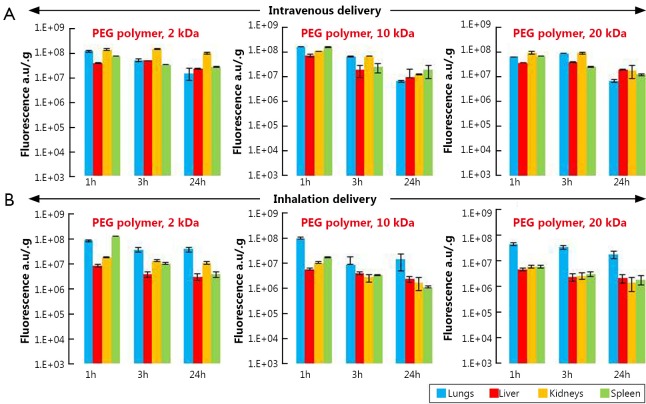
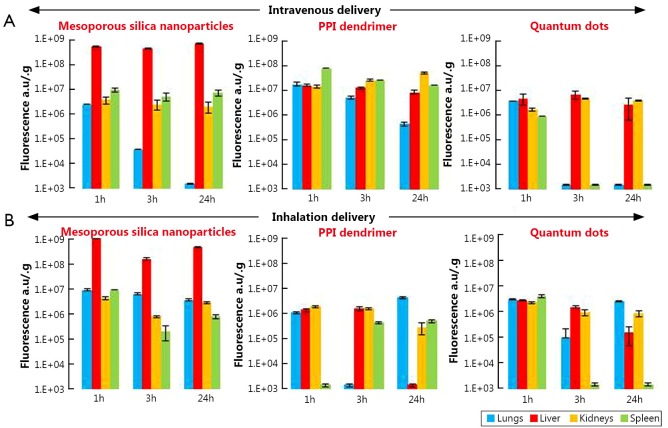
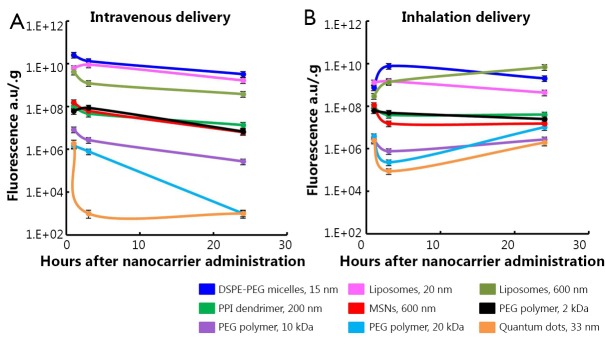
Significant differences in lung uptake were found after the inhalation delivery of lipid-based and non-lipid-based nanoparticles. The accumulation of liposomes and micelles in lungs remained relatively high even 24 h after inhalation when compared with MSNs, QDs, and PPI dendrimers. There were notable differences between nanoparticle accumulation in the lungs and other organs 1 and 3 h after inhalation or intravenous administrations, but 24 h after intravenous injection all nanoparticles were mainly accumulated in the liver, kidneys, and spleen. Inhalation delivery of doxorubicin by liposomes significantly enhanced its anticancer effect and prevented severe adverse side effects of the treatment in mice bearing the orthotopic model of lung cancer.
The results of the study demonstrate that lipid-based nanocarriers had considerably higher accumulation and longer retention time in the lungs when compared with non-lipid-based carriers after the inhalation delivery. These particles are most suitable for effective inhalation treatment of lung cancer.
为了选择将抗癌药物吸入肺部的最佳载体,设计并测试了各种纳米颗粒。
研究了以下纳米载体:胶束、脂质体、介孔硅纳米颗粒(MSNs)、聚丙稀亚胺(PPI)树枝状高分子-siRNA 复合物纳米颗粒、量子点(QDs)和聚乙二醇聚合物。所有颗粒均采用以下方法进行表征:动态光散射、Zeta 电位、原子力显微镜、体外细胞毒性和遗传毒性。在裸鼠中进行了肺部或静脉内给药后,研究了所有纳米颗粒的体内器官分布、在肺部的保留以及载有多柔比星的脂质体的抗癌作用。
在吸入脂质基和非脂质基纳米颗粒后,肺部的摄取量存在显著差异。与 MSNs、QDs 和 PPI 树枝状高分子相比,脂质体和胶束在肺部的积累即使在吸入后 24 小时仍相对较高。在吸入或静脉内给药后 1 和 3 小时,纳米颗粒在肺部和其他器官中的积累存在显著差异,但在静脉内注射后 24 小时,所有纳米颗粒主要在肝脏、肾脏和脾脏中积累。通过脂质体吸入给予多柔比星可显著增强其抗癌作用,并防止荷肺癌原位模型小鼠治疗的严重不良反应。
研究结果表明,与非脂质基载体相比,脂质基纳米载体在吸入给药后肺部的积累和保留时间明显更长。这些颗粒最适合用于有效的肺癌吸入治疗。