Batista Chary Marquez, Mariano Eric Domingos, Barbosa Breno José Alencar Pires, Morgalla Matthias, Marie Suely Kazue Nagahashi, Teixeira Manoel Jacobsen, Lepski Guilherme
Department of Neurology, School of Medicine, University of São Paulo, Avenida Dr. Arnaldo 455, LIM 15, 4th Floor, 01246-903 Cerqueira Cesar, SP, Brazil ; Center for Cellular and Molecular Studies and Therapy-NAP-NETCEM, University of São Paulo, Brazil.
Department of Neurology, School of Medicine, University of São Paulo, Avenida Dr. Arnaldo 455, LIM 15, 4th Floor, 01246-903 Cerqueira Cesar, SP, Brazil.
Biomed Res Int. 2014;2014:438639. doi: 10.1155/2014/438639. Epub 2014 Mar 11.
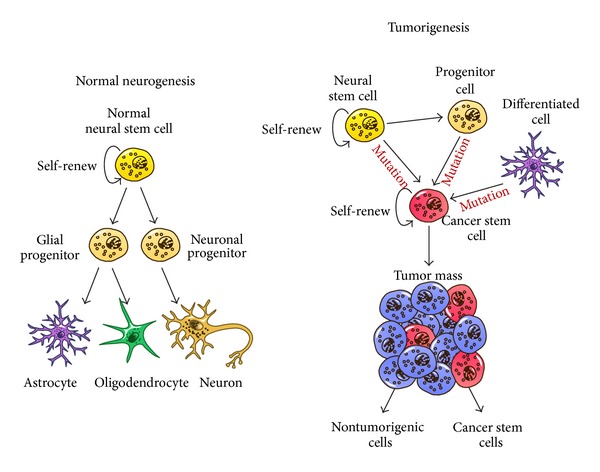
Malignant brain tumors, including glioblastoma multiforme (GBM), are known for their high degree of invasiveness, aggressiveness, and lethality. These tumors are made up of heterogeneous cell populations and only a small part of these cells (known as cancer stem cells) is responsible for the initiation and recurrence of the tumor. The biology of cancer stem cells and their role in brain tumor growth and therapeutic resistance has been extensively investigated. Recent work suggests that glial tumors arise from neural stem cells that undergo a defective process of differentiation. The understanding of this process might permit the development of novel treatment strategies targeting cancer stem cells. In the present review, we address the mechanisms underlying glial tumor formation, paying special attention to cancer stem cells and the role of the microenvironment in preserving them and promoting tumor growth. Recent advancements in cancer stem cell biology, especially regarding tumor initiation and resistance to chemo- or radiotherapy, have led to the development of novel treatment strategies that focus on the niche of the stem cells that make up the tumor. Encouraging results from preclinical studies predict that these findings will be translated into the clinical field in the near future.
恶性脑肿瘤,包括多形性胶质母细胞瘤(GBM),以其高度侵袭性、攻击性和致死性而闻名。这些肿瘤由异质性细胞群体组成,其中只有一小部分细胞(称为癌症干细胞)负责肿瘤的起始和复发。癌症干细胞的生物学特性及其在脑肿瘤生长和治疗抗性中的作用已得到广泛研究。最近的研究表明,胶质肿瘤起源于经历分化缺陷过程的神经干细胞。对这一过程的理解可能有助于开发针对癌症干细胞的新型治疗策略。在本综述中,我们阐述了胶质肿瘤形成的潜在机制,特别关注癌症干细胞以及微环境在维持它们和促进肿瘤生长中的作用。癌症干细胞生物学的最新进展,特别是关于肿瘤起始和对化疗或放疗抗性的进展,已导致开发出专注于构成肿瘤的干细胞生态位的新型治疗策略。临床前研究的鼓舞性结果预测,这些发现将在不久的将来转化到临床领域。