Cleutjens Fiona A H M, Janssen Daisy J A, Ponds Rudolf W H M, Dijkstra Jeanette B, Wouters Emiel F M
Program Development Centre, CIRO+, Centre of Expertise for Chronic Organ Failure, Hornerheide 1, 6085NM Horn, The Netherlands.
Program Development Centre, CIRO+, Centre of Expertise for Chronic Organ Failure, Hornerheide 1, 6085NM Horn, The Netherlands ; Centre of Expertise for Palliative Care, Maastricht UMC+, P Debyelaan 25, 6202 AZ Maastricht, The Netherlands.
Biomed Res Int. 2014;2014:697825. doi: 10.1155/2014/697825. Epub 2014 Mar 16.
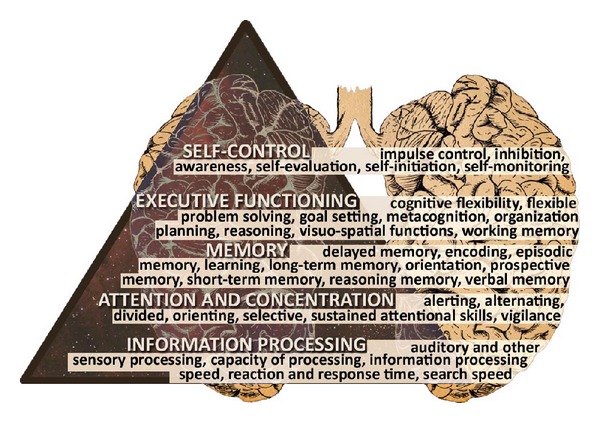
Over the past few decades, chronic obstructive lung disease (COPD) has been considered a disease of the lungs, often caused by smoking. Nowadays, COPD is regarded as a systemic disease. Both physical effects and effects on brains, including impaired psychological and cognitive functioning, have been demonstrated. Patients with COPD may have cognitive impairment, either globally or in single cognitive domains, such as information processing, attention and concentration, memory, executive functioning, and self-control. Possible causes are hypoxemia, hypercapnia, exacerbations, and decreased physical activity. Cognitive impairment in these patients may be related to structural brain abnormalities, such as gray-matter pathologic changes and the loss of white matter integrity which can be induced by smoking. Cognitive impairment can have a negative impact on health and daily life and may be associated with widespread consequences for disease management programs. It is important to assess cognitive functioning in patients with COPD in order to optimize patient-oriented treatment and to reduce personal discomfort, hospital admissions, and mortality. This paper will summarize the current knowledge about cognitive impairment as extrapulmonary feature of COPD. Hereby, the impact of smoking on cognitive functioning and the impact of cognitive impairment on smoking behaviour will be examined.
在过去几十年里,慢性阻塞性肺疾病(COPD)一直被认为是一种肺部疾病,通常由吸烟引起。如今,COPD被视为一种全身性疾病。其对身体的影响以及对大脑的影响,包括心理和认知功能受损,都已得到证实。COPD患者可能存在整体或单一认知领域的认知障碍,如信息处理、注意力和专注力、记忆、执行功能以及自我控制等方面。可能的原因包括低氧血症、高碳酸血症、病情加重以及身体活动减少。这些患者的认知障碍可能与大脑结构异常有关,如灰质病理变化和白质完整性丧失,而吸烟可能会引发这些变化。认知障碍会对健康和日常生活产生负面影响,并且可能给疾病管理项目带来广泛后果。评估COPD患者的认知功能对于优化以患者为导向的治疗、减少个人不适、住院次数和死亡率非常重要。本文将总结关于认知障碍作为COPD肺外特征的当前知识。在此,将探讨吸烟对认知功能的影响以及认知障碍对吸烟行为的影响。