Shi Xuesong, Bisaria Namita, Benz-Moy Tara L, Bonilla Steve, Pavlichin Dmitri S, Herschlag Daniel
Department of Biochemistry, ‡Department of Chemistry, §Department of Chemical Engineering, ∥Department of Physics, Stanford University , Stanford, California 94305, United States.
J Am Chem Soc. 2014 May 7;136(18):6643-8. doi: 10.1021/ja413033d. Epub 2014 Apr 28.
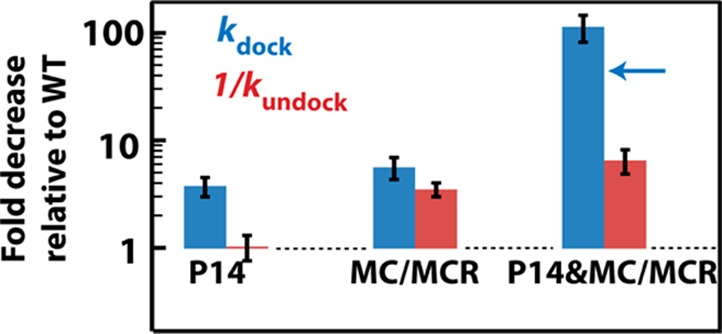
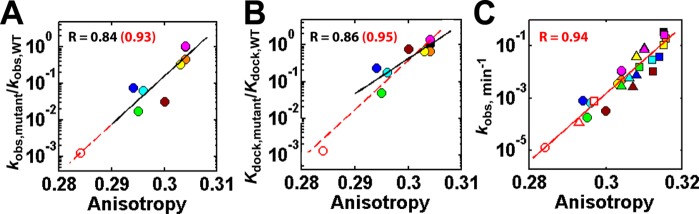
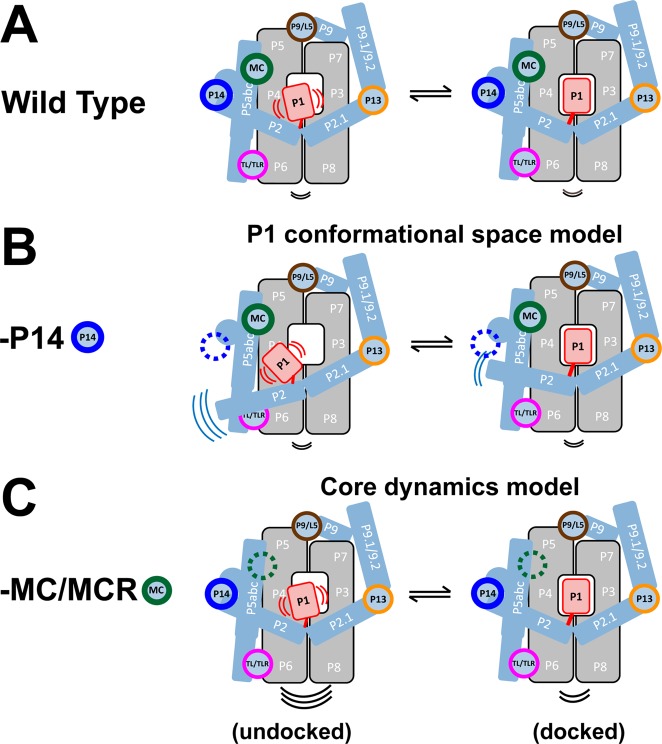
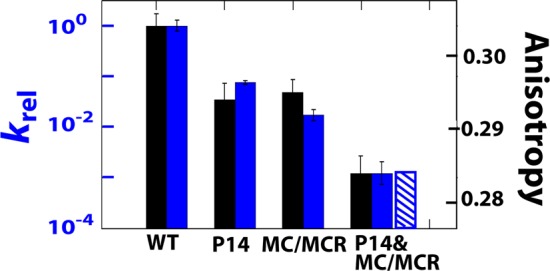
We determined the effects of mutating the long-range tertiary contacts of the Tetrahymena group I ribozyme on the dynamics of its substrate helix (referred to as P1) and on catalytic activity. Dynamics were assayed by fluorescence anisotropy of the fluorescent base analogue, 6-methyl isoxanthopterin, incorporated into the P1 helix, and fluorescence anisotropy and catalytic activity were measured for wild type and mutant ribozymes over a range of conditions. Remarkably, catalytic activity correlated with P1 anisotropy over 5 orders of magnitude of activity, with a correlation coefficient of 0.94. The functional and dynamic effects from simultaneous mutation of the two long-range contacts that weaken P1 docking are cumulative and, based on this RNA's topology, suggest distinct underlying origins for the mutant effects. Tests of mechanistic predictions via single molecule FRET measurements of rate constants for P1 docking and undocking suggest that ablation of the P14 tertiary interaction frees P2 and thereby enhances the conformational space explored by the undocked attached P1 helix. In contrast, mutation of the metal core tertiary interaction disrupts the conserved core into which the P1 helix docks. Thus, despite following a single correlation, the two long-range tertiary contacts facilitate P1 helix docking by distinct mechanisms. These results also demonstrate that a fluorescence anisotropy probe incorporated into a specific helix within a larger RNA can report on changes in local helical motions as well as differences in more global dynamics. This ability will help uncover the physical properties and behaviors that underlie the function of RNAs and RNA/protein complexes.
我们确定了嗜热四膜虫I组核酶的远程三级接触发生突变对其底物螺旋(称为P1)动力学和催化活性的影响。通过掺入P1螺旋中的荧光碱基类似物6-甲基异黄蝶呤的荧光各向异性来测定动力学,并在一系列条件下测量野生型和突变型核酶的荧光各向异性和催化活性。值得注意的是,在5个数量级的活性范围内,催化活性与P1各向异性相关,相关系数为0.94。削弱P1对接的两个远程接触同时突变所产生的功能和动力学效应是累积性的,并且基于该RNA的拓扑结构,表明突变效应有不同的潜在起源。通过对P1对接和去对接速率常数进行单分子荧光共振能量转移测量来检验机制预测,结果表明P14三级相互作用的缺失使P2得以释放,从而增加了未对接的附着P1螺旋所探索的构象空间。相比之下,金属核心三级相互作用的突变破坏了P1螺旋对接进入的保守核心。因此,尽管遵循单一相关性,但这两个远程三级接触通过不同机制促进P1螺旋对接。这些结果还表明,掺入较大RNA中特定螺旋的荧光各向异性探针可以报告局部螺旋运动的变化以及更全局动力学的差异。这种能力将有助于揭示RNA和RNA/蛋白质复合物功能背后的物理性质和行为。