Higashihara Eiji, Nutahara Kikuo, Tanbo Mitsuhiro, Hara Hidehiko, Miyazaki Isao, Kobayashi Kuninori, Nitatori Toshiaki
Department of ADPKD Research, Kyorin University School of Medicine, Tokyo, Japan Department of Urology, Kyorin University School of Medicine, Tokyo, Japan.
Department of Urology, Kyorin University School of Medicine, Tokyo, Japan.
Nephrol Dial Transplant. 2014 Sep;29(9):1710-9. doi: 10.1093/ndt/gfu093. Epub 2014 Apr 15.
The clinical effects of increased water intake on autosomal dominant polycystic kidney disease (ADPKD) progression are unknown.
ADPKD patients with creatinine clearance ≧ 50 mL/min/1.73 m(2) were divided into high (H-, n = 18) and free (F-, n = 16) water-intake groups, mainly according to their preference. Prior to the study, 30 patients underwent annual evaluation of total kidney volume (TKV) and 24-h urine for an average of 33 months. During the 1-year study period, TKV and 24-h urine were analyzed at the beginning and end of the study and every 4 months, respectively.
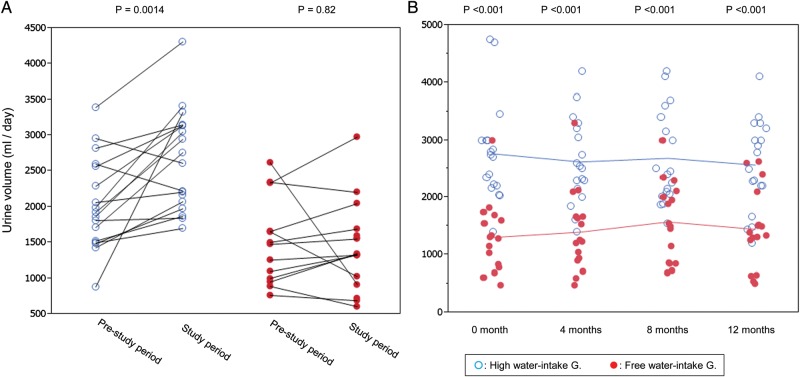
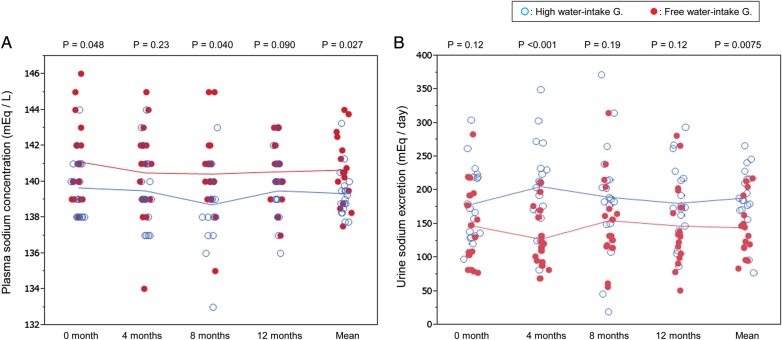
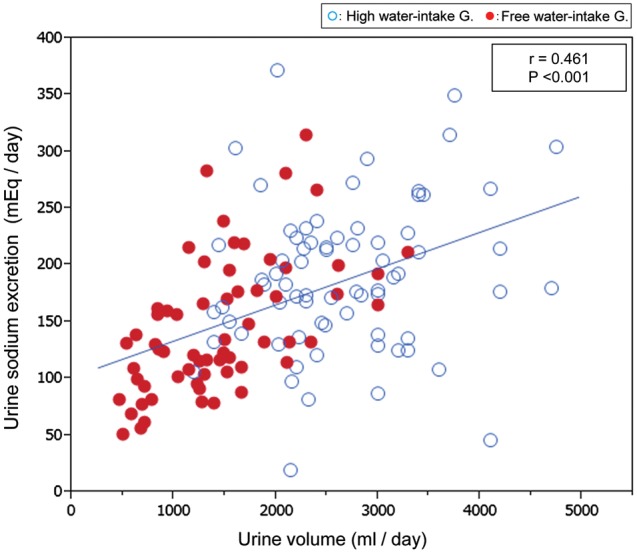
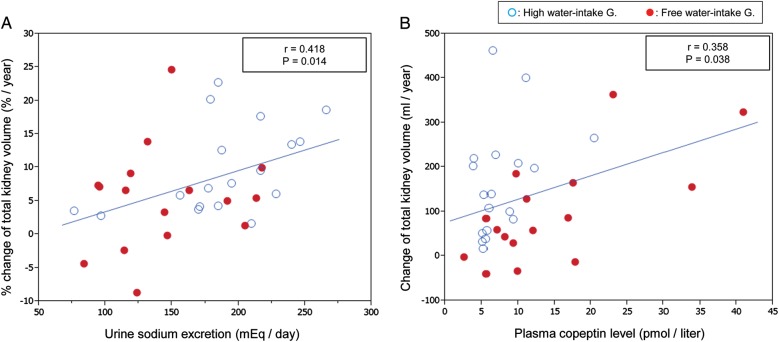
During the pre-study period, urine volume (UV) in the H-group was higher (P = 0.034), but TKV and kidney function and their slopes were not significantly different between the two groups. After the study commenced, UV further increased (P < 0.001) in the H-group but not in the F-group. During the study period, TKV and kidney function slopes were not significantly different between the two groups (primary endpoint). Plasma copeptin was lower (P = 0.024) in the H-group than in the F-group. TKV and kidney function slopes became worse (P = 0.047 and 0.011, respectively) after high water intake (H-group) but not in the F-group. High UV was associated with increased urine sodium, and urine sodium positively correlated with the % TKV slope (P = 0.014).
Although the main endpoint was not significant, high water intake enhanced disease progression in the H-group when compared with the pre-study period. These findings necessitate a long-term randomized study before drawing a final conclusion.
增加水摄入量对常染色体显性多囊肾病(ADPKD)进展的临床影响尚不清楚。
肌酐清除率≧50 mL/min/1.73 m²的ADPKD患者主要根据其偏好分为高水摄入量组(H组,n = 18)和自由水摄入量组(F组,n = 16)。在研究前,30名患者平均33个月接受一次总肾体积(TKV)和24小时尿液的年度评估。在1年的研究期间,分别在研究开始和结束时以及每4个月分析一次TKV和24小时尿液。
在研究前期,H组的尿量(UV)较高(P = 0.034),但两组之间的TKV、肾功能及其斜率无显著差异。研究开始后,H组的UV进一步增加(P < 0.001),而F组没有。在研究期间,两组之间的TKV和肾功能斜率无显著差异(主要终点)。H组的血浆 copeptin低于F组(P = 0.024)。高水摄入量(H组)后TKV和肾功能斜率变差(分别为P = 0.047和0.011),而F组没有。高UV与尿钠增加相关,尿钠与TKV斜率百分比呈正相关(P = 0.014)。
虽然主要终点不显著,但与研究前期相比,高水摄入量在H组中加速了疾病进展。在得出最终结论之前,这些发现需要进行长期随机研究。