Centre for Research in Evolutionary and Environmental Anthropology, University of Roehampton, London, United Kingdom.
The Orang-utan Tropical Peatland Project, Centre for International Cooperation in Sustainable Management of Tropical Peatland, Universitas Palangka Raya, Palangka Raya, Central Kalimantan, Indonesia; Centre for Research in Animal Behaviour, College of Life and Environmental Sciences, University of Exeter, Exeter, United Kingdom.
PLoS One. 2014 Apr 16;9(4):e95039. doi: 10.1371/journal.pone.0095039. eCollection 2014.
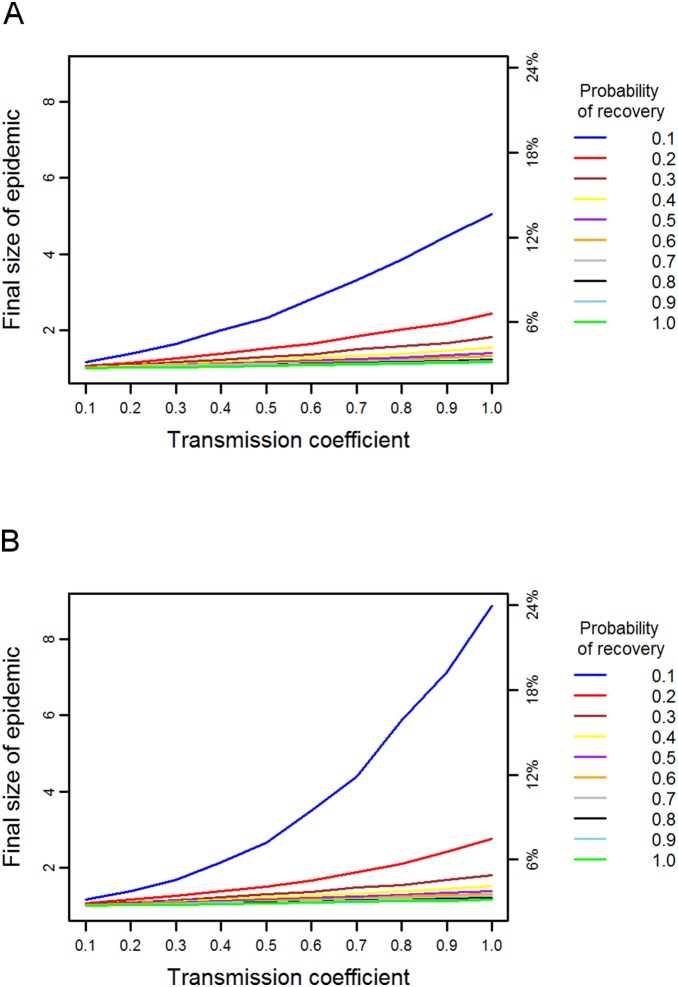
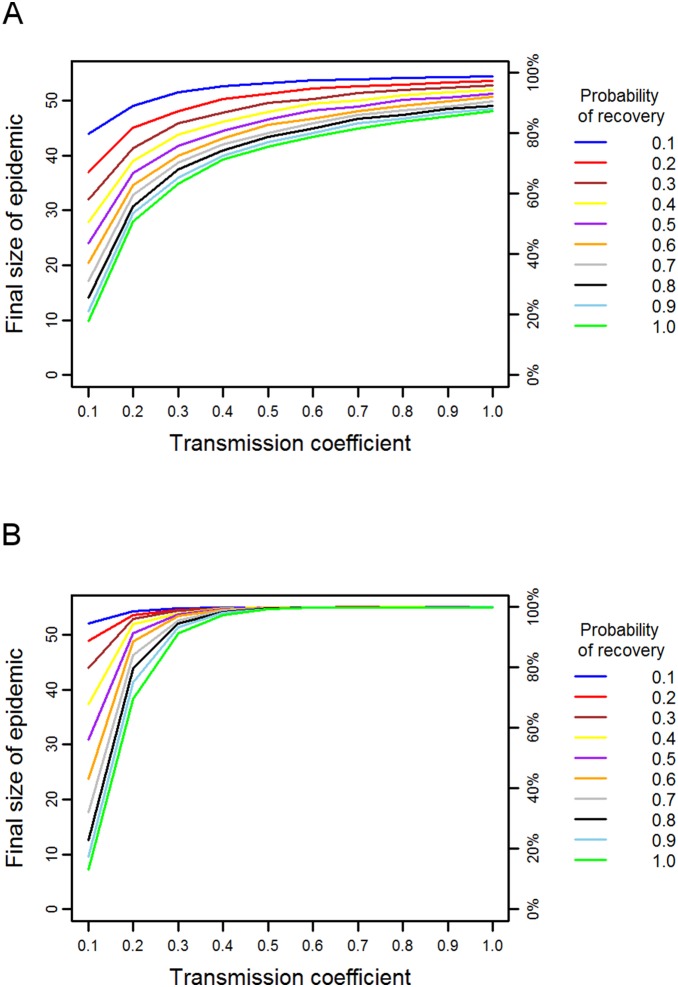
All great ape species are endangered, and infectious diseases are thought to pose a particular threat to their survival. As great ape species vary substantially in social organisation and gregariousness, there are likely to be differences in susceptibility to disease types and spread. Understanding the relation between social variables and disease is therefore crucial for implementing effective conservation measures. Here, we simulate the transmission of a range of diseases in a population of orang-utans in Sabangau Forest (Central Kalimantan) and a community of chimpanzees in Budongo Forest (Uganda), by systematically varying transmission likelihood and probability of subsequent recovery. Both species have fission-fusion social systems, but differ considerably in their level of gregariousness. We used long-term behavioural data to create networks of association patterns on which the spread of different diseases was simulated. We found that chimpanzees were generally far more susceptible to the spread of diseases than orang-utans. When simulating different diseases that varied widely in their probability of transmission and recovery, it was found that the chimpanzee community was widely and strongly affected, while in orang-utans even highly infectious diseases had limited spread. Furthermore, when comparing the observed association network with a mean-field network (equal contact probability between group members), we found no major difference in simulated disease spread, suggesting that patterns of social bonding in orang-utans are not an important determinant of susceptibility to disease. In chimpanzees, the predicted size of the epidemic was smaller on the actual association network than on the mean-field network, indicating that patterns of social bonding have important effects on susceptibility to disease. We conclude that social networks are a potentially powerful tool to model the risk of disease transmission in great apes, and that chimpanzees are particularly threatened by infectious disease outbreaks as a result of their social structure.
所有大型猿类物种都濒临灭绝,人们认为传染病对它们的生存构成了特别的威胁。由于大型猿类物种在社会组织和群居性方面存在很大差异,因此它们对疾病类型和传播的易感性可能存在差异。因此,了解社会变量与疾病之间的关系对于实施有效的保护措施至关重要。在这里,我们通过系统地改变传播可能性和随后恢复的可能性,模拟了沙班加乌森林(中加里曼丹)的猩猩种群和布顿戈森林(乌干达)的黑猩猩社区中一系列疾病的传播。这两个物种都有分裂-融合的社会系统,但群居性差异很大。我们使用长期的行为数据来创建关联模式网络,在该网络上模拟了不同疾病的传播。我们发现,黑猩猩通常比猩猩更容易受到疾病传播的影响。当模拟不同的疾病时,这些疾病在传播和恢复的可能性上差异很大,结果发现黑猩猩社区受到了广泛而强烈的影响,而在猩猩中,即使是传染性很强的疾病传播也很有限。此外,当将观察到的关联网络与平均场网络(群体成员之间的接触概率相等)进行比较时,我们发现模拟疾病传播没有明显差异,这表明猩猩的社会结合模式不是对疾病易感性的重要决定因素。在黑猩猩中,实际关联网络上预测的疫情规模比平均场网络上小,这表明社会结合模式对疾病易感性有重要影响。我们得出的结论是,社交网络是一种在大型猿类中模拟疾病传播风险的潜在强大工具,由于其社会结构,黑猩猩特别容易受到传染病爆发的威胁。