Department of Biology, Miami University and Center for Visual Sciences at Miami University (CVSMU), Oxford, OH 45056, USA.
BMC Biol. 2014 Apr 17;12:28. doi: 10.1186/1741-7007-12-28.
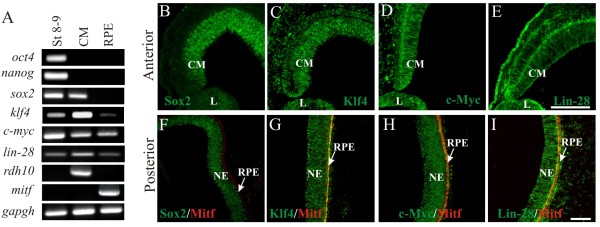
One of the promises in regenerative medicine is to regenerate or replace damaged tissues. The embryonic chick can regenerate its retina by transdifferentiation of the retinal pigmented epithelium (RPE) and by activation of stem/progenitor cells present in the ciliary margin. These two ways of regeneration occur concomitantly when an external source of fibroblast growth factor 2 (FGF2) is present after injury (retinectomy). During the process of transdifferentiation, the RPE loses its pigmentation and is reprogrammed to become neuroepithelium, which differentiates to reconstitute the different cell types of the neural retina. Somatic mammalian cells can be reprogrammed to become induced pluripotent stem cells by ectopic expression of pluripotency-inducing factors such as Oct4, Sox2, Klf4, c-Myc and in some cases Nanog and Lin-28. However, there is limited information concerning the expression of these factors during natural regenerative processes. Organisms that are able to regenerate their organs could share similar mechanisms and factors with the reprogramming process of somatic cells. Herein, we investigate the expression of pluripotency-inducing factors in the RPE after retinectomy (injury) and during transdifferentiation in the presence of FGF2.
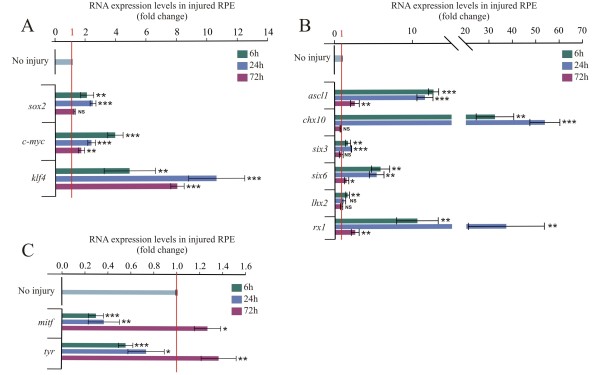
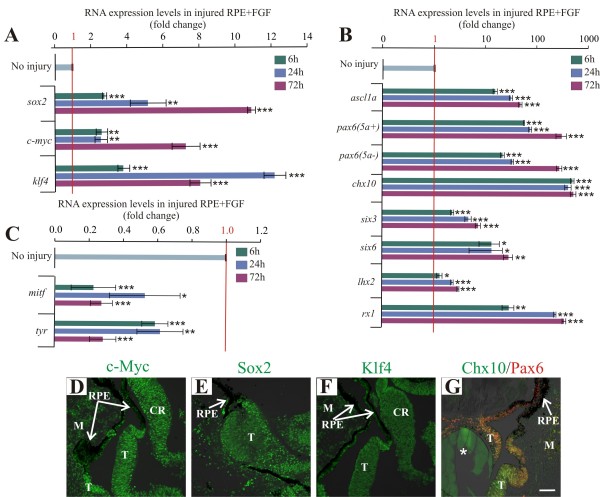
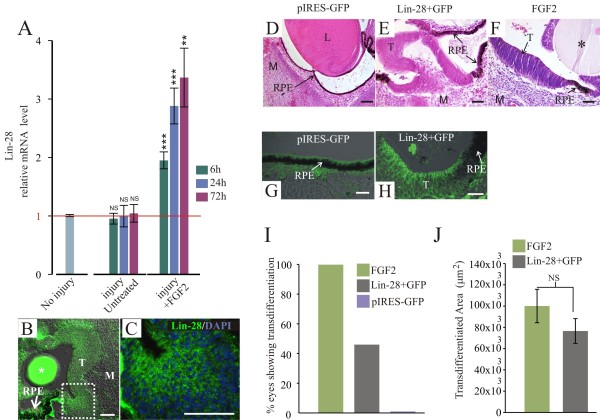
We present evidence that upon injury, the quiescent (p27(Kip1)+/BrdU-) RPE cells transiently dedifferentiate and express sox2, c-myc and klf4 along with eye field transcriptional factors and display a differential up-regulation of alternative splice variants of pax6. However, this transient process of dedifferentiation is not sustained unless FGF2 is present. We have identified lin-28 as a downstream target of FGF2 during the process of retina regeneration. Moreover, we show that overexpression of lin-28 after retinectomy was sufficient to induce transdifferentiation of the RPE in the absence of FGF2.
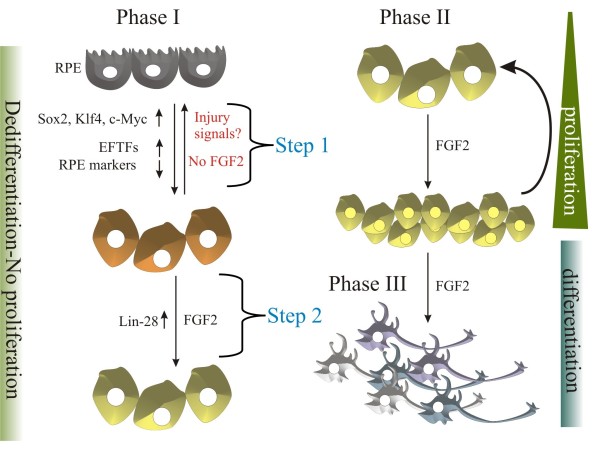
These findings delineate in detail the molecular changes that take place in the RPE during the process of transdifferentiation in the embryonic chick, and specifically identify Lin-28 as an important factor in this process. We propose a novel model in which injury signals initiate RPE dedifferentiation, while FGF2 up-regulates Lin-28, allowing for RPE transdifferentiation to proceed.
再生医学的一个承诺是再生或替代受损组织。胚胎鸡可以通过视网膜色素上皮 (RPE) 的转分化和睫状缘中存在的干细胞/祖细胞的激活来再生其视网膜。当损伤(视网膜切除术)后存在外源成纤维细胞生长因子 2 (FGF2) 时,这两种再生方式同时发生。在转分化过程中,RPE 失去色素沉着并被重新编程成为神经上皮,它分化为重新构成神经视网膜的不同细胞类型。体细胞可以通过异位表达多能诱导因子如 Oct4、Sox2、Klf4、c-Myc,在某些情况下还包括 Nanog 和 Lin-28,被重新编程成为诱导多能干细胞。然而,关于这些因子在自然再生过程中的表达,信息有限。能够再生其器官的生物体可能与体细胞的重编程过程共享类似的机制和因子。在此,我们研究了在存在 FGF2 的情况下,视网膜切除术后(损伤)和转分化过程中 RPE 中多能诱导因子的表达。
我们提供的证据表明,损伤后,静止的(p27(Kip1)+/BrdU-) RPE 细胞短暂去分化并表达 sox2、c-myc 和 klf4 以及眼场转录因子,并显示 pax6 的选择性剪接变体的差异上调。然而,除非存在 FGF2,否则这种短暂的去分化过程不会持续。我们已经确定 lin-28 是 FGF2 在视网膜再生过程中的下游靶标。此外,我们表明,在视网膜切除术后过表达 lin-28 足以在没有 FGF2 的情况下诱导 RPE 的转分化。
这些发现详细描述了胚胎鸡在转分化过程中 RPE 发生的分子变化,并特别确定 Lin-28 是该过程中的一个重要因素。我们提出了一个新的模型,其中损伤信号启动 RPE 去分化,而 FGF2 上调 Lin-28,允许 RPE 转分化继续进行。