Knibbs Luke D, Johnson Graham R, Kidd Timothy J, Cheney Joyce, Grimwood Keith, Kattenbelt Jacqueline A, O'Rourke Peter K, Ramsay Kay A, Sly Peter D, Wainwright Claire E, Wood Michelle E, Morawska Lidia, Bell Scott C
International Laboratory for Air Quality and Health, Queensland University of Technology, Brisbane, Queensland, Australia School of Population Health, The University of Queensland, Herston, Queensland, Australia.
International Laboratory for Air Quality and Health, Queensland University of Technology, Brisbane, Queensland, Australia.
Thorax. 2014 Aug;69(8):740-5. doi: 10.1136/thoraxjnl-2014-205213. Epub 2014 Apr 17.
Person-to-person transmission of respiratory pathogens, including Pseudomonas aeruginosa, is a challenge facing many cystic fibrosis (CF) centres. Viable P aeruginosa are contained in aerosols produced during coughing, raising the possibility of airborne transmission.
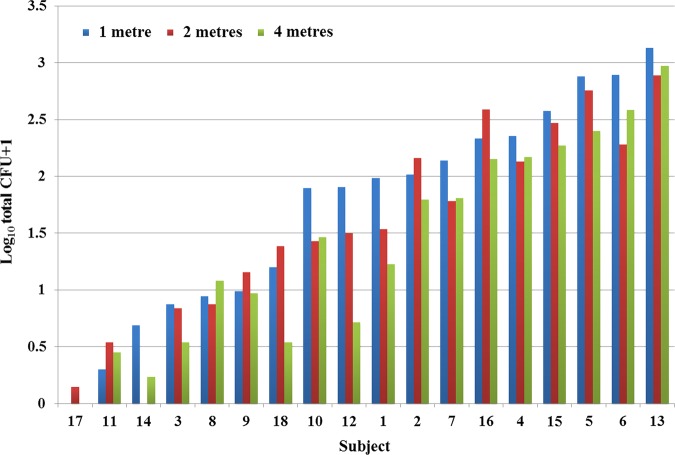
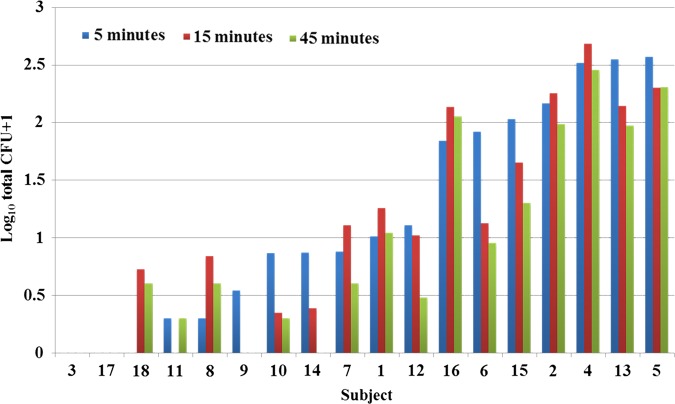
Using purpose-built equipment, we measured viable P aeruginosa in cough aerosols at 1, 2 and 4 m from the subject (distance) and after allowing aerosols to age for 5, 15 and 45 min in a slowly rotating drum to minimise gravitational settling and inertial impaction (duration). Aerosol particles were captured and sized employing an Anderson Impactor and cultured using conventional microbiology. Sputum was also cultured and lung function and respiratory muscle strength measured.
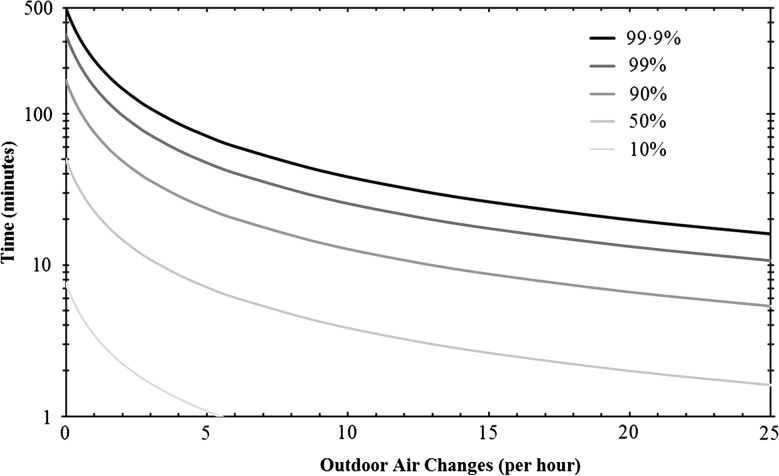
Nineteen patients with CF, mean age 25.8 (SD 9.2) years, chronically infected with P aeruginosa, and 10 healthy controls, 26.5 (8.7) years, participated. Viable P aeruginosa were detected in cough aerosols from all patients with CF, but not from controls; travelling 4 m in 17/18 (94%) and persisting for 45 min in 14/18 (78%) of the CF group. Marked inter-subject heterogeneity of P aeruginosa aerosol colony counts was seen and correlated strongly (r=0.73-0.90) with sputum bacterial loads. Modelling decay of viable P aeruginosa in a clinic room suggested that at the recommended ventilation rate of two air changes per hour almost 50 min were required for 90% to be removed after an infected patient left the room.
Viable P aeruginosa in cough aerosols travel further and last longer than recognised previously, providing additional evidence of airborne transmission between patients with CF.
包括铜绿假单胞菌在内的呼吸道病原体的人际传播是许多囊性纤维化(CF)中心面临的一项挑战。咳嗽过程中产生的气溶胶中含有活的铜绿假单胞菌,这增加了空气传播的可能性。
我们使用特制设备,在距受试者1米、2米和4米处(距离),以及在缓慢旋转的鼓中让气溶胶老化5分钟、15分钟和45分钟以尽量减少重力沉降和惯性撞击后(持续时间),测量咳嗽气溶胶中的活铜绿假单胞菌。使用安德森撞击器捕获气溶胶颗粒并确定其大小,并采用传统微生物学方法进行培养。同时对痰液进行培养,并测量肺功能和呼吸肌力量。
19例平均年龄为25.8(标准差9.2)岁、长期感染铜绿假单胞菌的CF患者和10例平均年龄为26.5(8.7)岁的健康对照者参与了研究。在所有CF患者的咳嗽气溶胶中均检测到活的铜绿假单胞菌,而对照者中未检测到;在CF组中,17/18(94%)的细菌可传播4米,14/18(78%)的细菌可存活45分钟。观察到铜绿假单胞菌气溶胶菌落计数存在明显的个体间异质性,且与痰液细菌载量密切相关(r=0.73 - 0.90)。对诊室中活铜绿假单胞菌衰变的建模表明,按照每小时换气两次的推荐通风率,感染患者离开房间后,几乎需要50分钟才能清除90%的细菌。
咳嗽气溶胶中的活铜绿假单胞菌传播距离比之前认为的更远,存活时间更长,这为CF患者之间的空气传播提供了更多证据。