Kelleher Andrew R, Gordon Bradley S, Kimball Scot R, Jefferson Leonard S
Department of Cellular and Molecular Physiology, The Pennsylvania State University College of Medicine, Hershey, Pennsylvania.
Physiol Rep. 2014 Feb 25;2(2):e00246. doi: 10.1002/phy2.246. eCollection 2014 Feb 1.
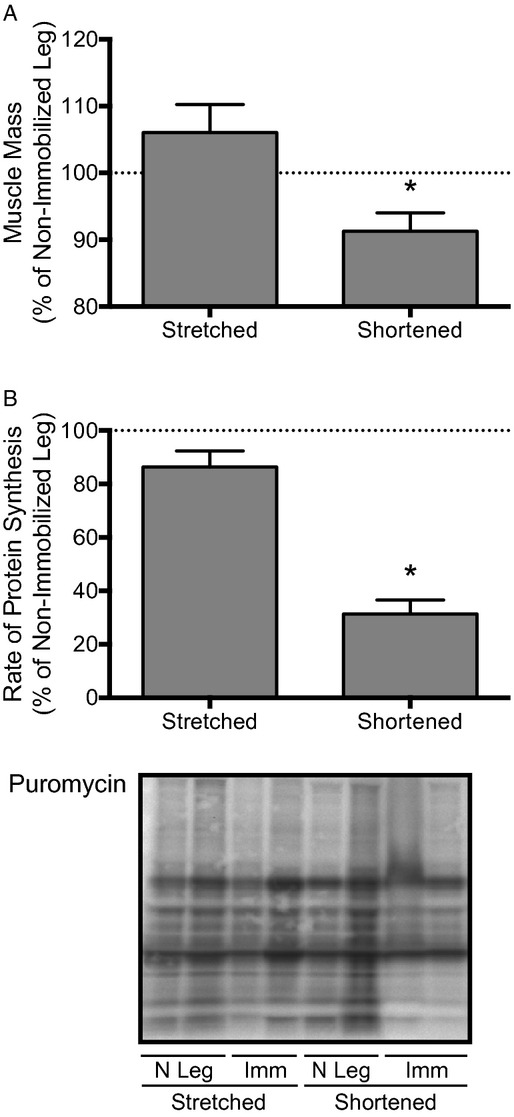
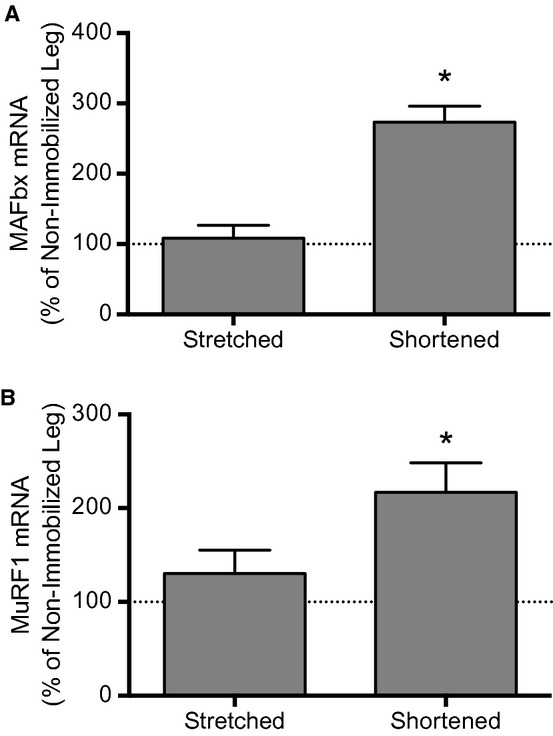
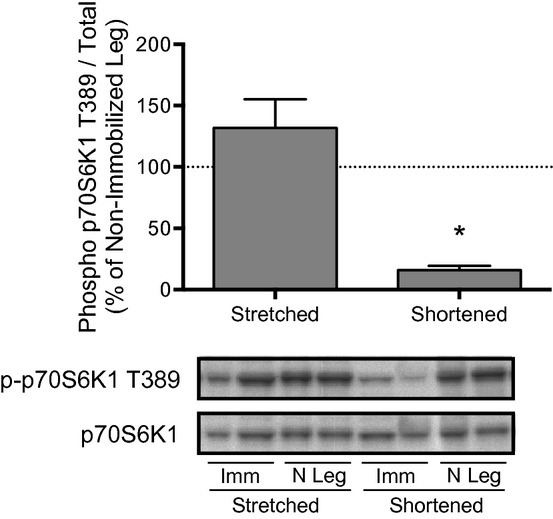
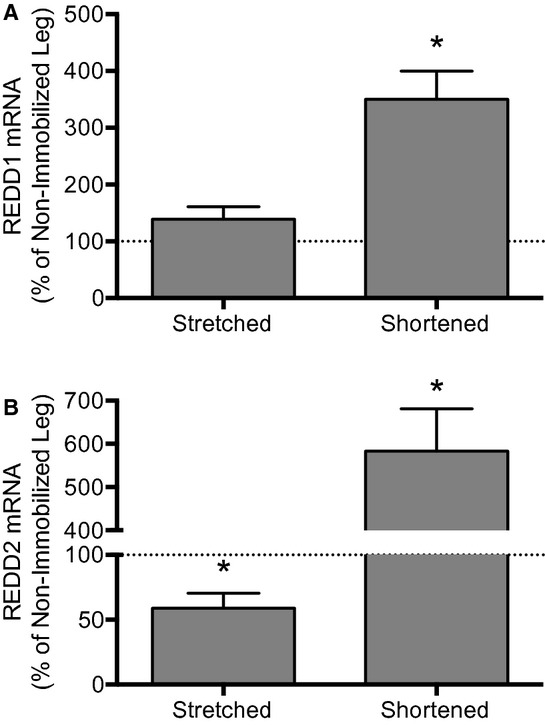
Immobilized skeletal muscle fixed in a shortened position displays disuse atrophy, whereas when fixed in a stretched position it does not (Goldspink, D. F. (1977) J Physiol 264, 267-282). Although significant advances have been made in our understanding of mechanisms involved in development of atrophy in muscle fixed in a shortened position, little is known about why mass is maintained when muscle is immobilized in a stretched position. In the present study, we hypothesized that skeletal muscle immobilized in a stretched position would be protected from gene expression changes known to be associated with disuse atrophy. To test the hypothesis, male Sprague-Dawley rats were anesthetized using isoflurane and subjected to unilateral hindlimb immobilization for 3 days with the soleus fixed in either a shortened or stretched position. All comparisons were made to the contralateral nonimmobilized muscle. Soleus immobilized in a shortened position exhibited disuse atrophy, attenuated rates of protein synthesis, attenuated mTORC1 signaling, and induced expression of genes for REDD1, REDD2, MAFbx, and MuRF1. In contrast, immobilization of the soleus in a stretched position prevented these changes as it exhibited no difference in muscle mass, rates of protein synthesis, mTORC1 signaling, or expression of genes encoding REDD1, MAFbx or MuRF1, with REDD2 expression being reduced compared to control. In conclusion, fixed muscle length plays a major role in immobilization-induced skeletal muscle atrophy whereby placing muscle in a shortened position leads to induction of gene expression for REDD1, REDD2, and atrogenes.
固定在缩短位置的骨骼肌会出现废用性萎缩,而固定在伸展位置时则不会(戈德斯平克,D. F.(1977年)《生理学杂志》264卷,267 - 282页)。尽管我们在理解固定在缩短位置的肌肉萎缩发生机制方面取得了重大进展,但对于肌肉固定在伸展位置时为何质量得以维持却知之甚少。在本研究中,我们假设固定在伸展位置的骨骼肌能够免受已知与废用性萎缩相关的基因表达变化的影响。为了验证这一假设,使用异氟烷麻醉雄性斯普拉格 - 道利大鼠,并对单侧后肢进行固定3天,比目鱼肌分别固定在缩短或伸展位置。所有比较均与对侧未固定的肌肉进行。固定在缩短位置的比目鱼肌表现出废用性萎缩、蛋白质合成速率降低、mTORC1信号减弱以及REDD1、REDD2、MAFbx和MuRF1基因的诱导表达。相比之下,将比目鱼肌固定在伸展位置可防止这些变化,因为它在肌肉质量、蛋白质合成速率、mTORC1信号或编码REDD1、MAFbx或MuRF1的基因表达方面没有差异,与对照组相比,REDD2表达降低。总之,固定的肌肉长度在固定诱导的骨骼肌萎缩中起主要作用,将肌肉置于缩短位置会导致REDD1、REDD2和萎缩相关基因的表达诱导。