• 文献检索
  • 文档翻译
  • 深度研究
  • 学术资讯
  • Suppr Zotero 插件Zotero 插件
  • 邀请有礼
  • 套餐&价格
  • 历史记录
应用&插件
Suppr Zotero 插件Zotero 插件浏览器插件Mac 客户端Windows 客户端微信小程序
定价
高级版会员购买积分包购买API积分包
服务
文献检索文档翻译深度研究API 文档MCP 服务
关于我们
关于 Suppr公司介绍联系我们用户协议隐私条款
关注我们

Suppr 超能文献

核心技术专利:CN118964589B侵权必究
粤ICP备2023148730 号-1Suppr @ 2026

文献检索

告别复杂PubMed语法,用中文像聊天一样搜索,搜遍4000万医学文献。AI智能推荐,让科研检索更轻松。

立即免费搜索

文件翻译

保留排版,准确专业,支持PDF/Word/PPT等文件格式,支持 12+语言互译。

免费翻译文档

深度研究

AI帮你快速写综述,25分钟生成高质量综述,智能提取关键信息,辅助科研写作。

立即免费体验

患有自闭症谱系障碍的个体在理解反讽时不会运用社会刻板印象。

Individuals with autism spectrum disorders do not use social stereotypes in irony comprehension.

作者信息

Zalla Tiziana, Amsellem Frederique, Chaste Pauline, Ervas Francesca, Leboyer Marion, Champagne-Lavau Maud

机构信息

Institut Jean Nicod, CNRS, UMR 8129, Institut d'Etude de la Cognition, Ecole Normale Supérieure, Paris, France.

INSERM U 955, IMRB & University Paris Est Creteil, AP-HP, Henri Mondor-Albert Chenevier Hospitals, Department of Psychiatry, Fondation FondaMental, French National Science Foundation, Creteil, France.

出版信息

PLoS One. 2014 Apr 18;9(4):e95568. doi: 10.1371/journal.pone.0095568. eCollection 2014.

DOI:10.1371/journal.pone.0095568
PMID:24748103
原文链接:https://pmc.ncbi.nlm.nih.gov/articles/PMC3991690/
Abstract

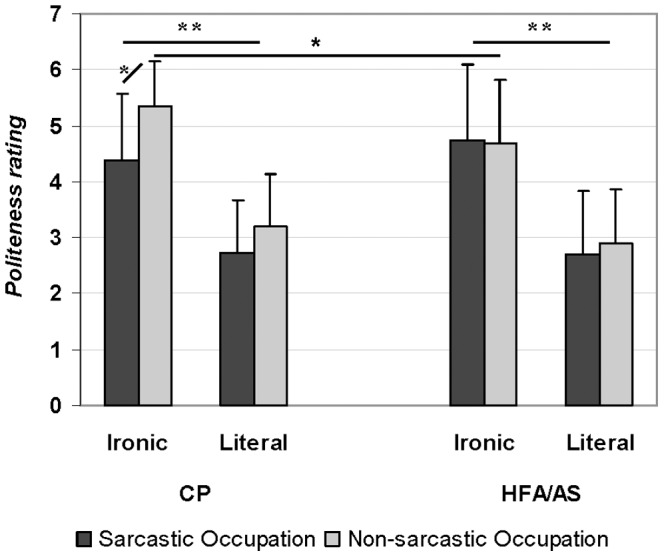
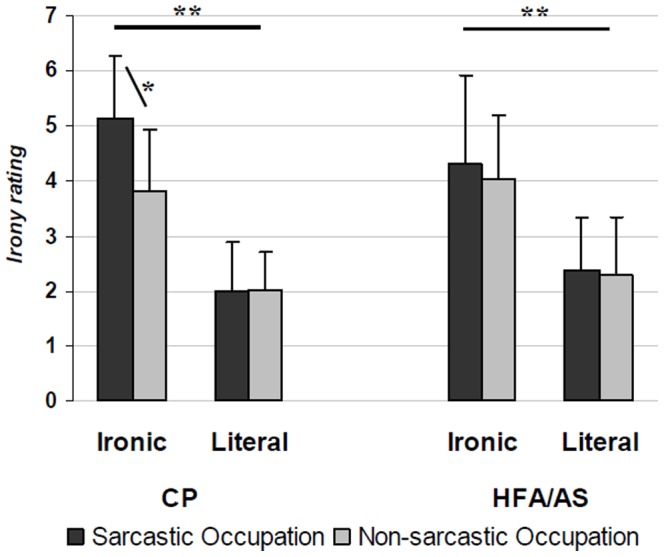
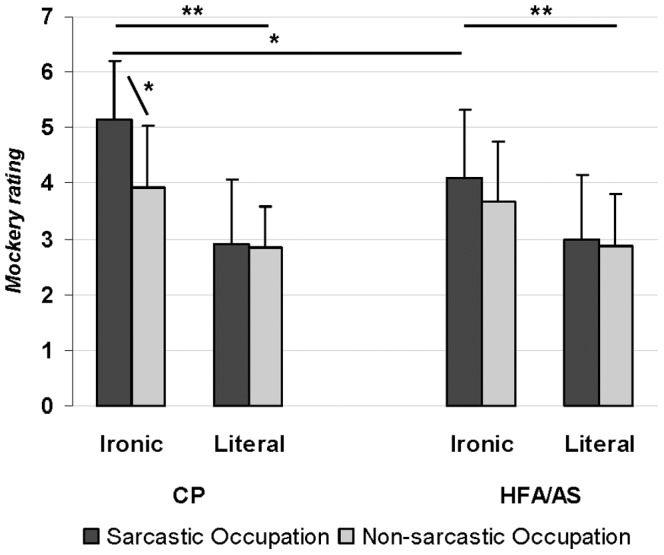
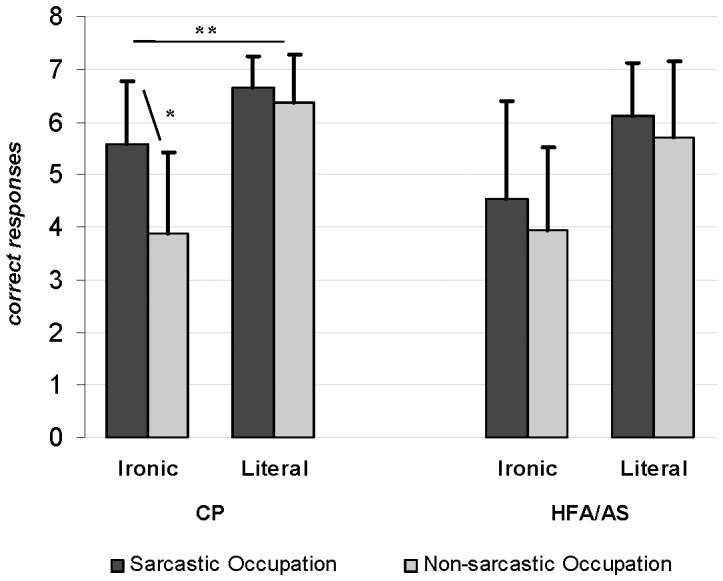
Social and communication impairments are part of the essential diagnostic criteria used to define Autism Spectrum Disorders (ASDs). Difficulties in appreciating non-literal speech, such as irony in ASDs have been explained as due to impairments in social understanding and in recognizing the speaker's communicative intention. It has been shown that social-interactional factors, such as a listener's beliefs about the speaker's attitudinal propensities (e.g., a tendency to use sarcasm, to be mocking, less sincere and more prone to criticism), as conveyed by an occupational stereotype, do influence a listener's interpretation of potentially ironic remarks. We investigate the effect of occupational stereotype on irony detection in adults with High Functioning Autism or Asperger Syndrome (HFA/AS) and a comparison group of typically developed adults. We used a series of verbally presented stories containing ironic or literal utterances produced by a speaker having either a "sarcastic" or a "non-sarcastic" occupation. Although individuals with HFA/AS were able to recognize ironic intent and occupational stereotypes when the latter are made salient, stereotype information enhanced irony detection and modulated its social meaning (i.e., mockery and politeness) only in comparison participants. We concluded that when stereotype knowledge is not made salient, it does not automatically affect pragmatic communicative processes in individuals with HFA/AS.

摘要

社交和沟通障碍是用于定义自闭症谱系障碍(ASD)的基本诊断标准的一部分。自闭症患者理解非字面言语存在困难,比如理解反讽,这被解释为是由于社交理解和识别说话者交际意图方面的障碍所致。研究表明,职业刻板印象所传达的社交互动因素,比如听众对说话者态度倾向(例如使用讽刺、嘲笑、不那么真诚且更倾向于批评的倾向)的看法,确实会影响听众对潜在反讽言论的解读。我们调查了职业刻板印象对高功能自闭症或阿斯伯格综合征(HFA/AS)成人患者以及一组发育正常的成人对照组的反讽识别的影响。我们使用了一系列口头讲述的故事,其中包含由具有“讽刺性”或“非讽刺性”职业的说话者说出的反讽或字面话语。尽管HFA/AS患者在职业刻板印象凸显时能够识别反讽意图和职业刻板印象,但只有对照组参与者中,刻板印象信息增强了反讽识别并调节了其社会意义(即嘲笑和礼貌)。我们得出结论,当刻板印象知识不凸显时,它不会自动影响HFA/AS患者的语用交际过程。
https://cdn.ncbi.nlm.nih.gov/pmc/blobs/6a2a/3991690/efedd6d7b99f/pone.0095568.g004.jpg
https://cdn.ncbi.nlm.nih.gov/pmc/blobs/6a2a/3991690/2820f27dfe62/pone.0095568.g001.jpg
https://cdn.ncbi.nlm.nih.gov/pmc/blobs/6a2a/3991690/73e223c222a8/pone.0095568.g002.jpg
https://cdn.ncbi.nlm.nih.gov/pmc/blobs/6a2a/3991690/de02afa56600/pone.0095568.g003.jpg
https://cdn.ncbi.nlm.nih.gov/pmc/blobs/6a2a/3991690/efedd6d7b99f/pone.0095568.g004.jpg
https://cdn.ncbi.nlm.nih.gov/pmc/blobs/6a2a/3991690/2820f27dfe62/pone.0095568.g001.jpg
https://cdn.ncbi.nlm.nih.gov/pmc/blobs/6a2a/3991690/73e223c222a8/pone.0095568.g002.jpg
https://cdn.ncbi.nlm.nih.gov/pmc/blobs/6a2a/3991690/de02afa56600/pone.0095568.g003.jpg
https://cdn.ncbi.nlm.nih.gov/pmc/blobs/6a2a/3991690/efedd6d7b99f/pone.0095568.g004.jpg

相似文献

1
Individuals with autism spectrum disorders do not use social stereotypes in irony comprehension.患有自闭症谱系障碍的个体在理解反讽时不会运用社会刻板印象。
PLoS One. 2014 Apr 18;9(4):e95568. doi: 10.1371/journal.pone.0095568. eCollection 2014.
2
The communicative style of a speaker can affect language comprehension? ERP evidence from the comprehension of irony.说话者的交际风格会影响语言理解吗?来自反语理解的 ERP 证据。
Brain Res. 2010 Jan 22;1311:121-35. doi: 10.1016/j.brainres.2009.10.077. Epub 2009 Nov 10.
3
Impact of social knowledge about the speaker on irony understanding: Evidence from neural oscillations.社会知识对说话者的影响与反讽理解:来自神经振荡的证据。
Soc Neurosci. 2023 Feb;18(1):28-45. doi: 10.1080/17470919.2023.2203948. Epub 2023 May 9.
4
I was being sarcastic!: The effect of foreign accent and political ideology on irony (mis)understanding.我是在讽刺!:外国口音和政治意识形态对反讽(误解)的影响。
Acta Psychol (Amst). 2022 Feb;222:103479. doi: 10.1016/j.actpsy.2021.103479. Epub 2021 Dec 23.
5
When irony is faster than its literal control: The role of mindreading during irony comprehension.当反讽的速度快于其字面控制时:在反讽理解过程中读心的作用。
J Exp Psychol Learn Mem Cogn. 2024 Mar;50(3):509-522. doi: 10.1037/xlm0001219. Epub 2023 Mar 16.
6
Processing of Written Irony in Autism Spectrum Disorder: An Eye-Movement Study.自闭症谱系障碍中书面反讽的加工处理:一项眼动研究。
Autism Res. 2015 Dec;8(6):749-60. doi: 10.1002/aur.1490. Epub 2015 May 11.
7
Role of sentence-final particles and prosody in irony comprehension in Cantonese-speaking children with and without Autism Spectrum Disorders.句末语气词和韵律在有和没有自闭症谱系障碍的粤语儿童反讽理解中的作用。
Clin Linguist Phon. 2013 Jan;27(1):18-32. doi: 10.3109/02699206.2012.734893.
8
Processing of ironic language in children with high-functioning autism spectrum disorder.高功能自闭症谱系障碍儿童的反讽语言处理。
J Autism Dev Disord. 2011 Aug;41(8):1097-112. doi: 10.1007/s10803-010-1131-7.
9
Do executive function and theory of mind predict pragmatic abilities following traumatic brain injury? An analysis of sincere, deceitful and ironic communicative acts.执行功能和心理理论能否预测创伤性脑损伤后的语用能力?对真诚、欺骗和讽刺性交际行为的分析。
J Commun Disord. 2018 Sep-Oct;75:102-117. doi: 10.1016/j.jcomdis.2018.05.002. Epub 2018 May 26.
10
Neural basis of irony comprehension in children with autism: the role of prosody and context.自闭症儿童理解反讽的神经基础:韵律和语境的作用。
Brain. 2006 Apr;129(Pt 4):932-43. doi: 10.1093/brain/awl032. Epub 2006 Feb 15.

引用本文的文献

1
Assessing communicative-pragmatic ability in telehealth: e-ABaCo in autistic individuals.评估远程医疗中的交际语用能力:自闭症个体的电子ABaCo。
Front Psychiatry. 2025 Apr 28;16:1568108. doi: 10.3389/fpsyt.2025.1568108. eCollection 2025.
2
Barriers to Employment: Raters' Perceptions of Male Autistic and Non-Autistic Candidates During a Simulated Job Interview and the Impact of Diagnostic Disclosure.就业障碍:在模拟求职面试中评估者对患有自闭症和未患自闭症的男性求职者的看法以及诊断信息披露的影响。
Autism Adulthood. 2021 Dec 1;3(4):300-309. doi: 10.1089/aut.2020.0075. Epub 2021 Dec 7.
3
Social behavioural adaptation in Autism.

本文引用的文献

1
Brief report: stereotypes in autism revisited.简要报告:自闭症中的刻板印象再探。
J Autism Dev Disord. 2012 Oct;42(10):2246-51. doi: 10.1007/s10803-012-1460-9.
2
Processing of ironic language in children with high-functioning autism spectrum disorder.高功能自闭症谱系障碍儿童的反讽语言处理。
J Autism Dev Disord. 2011 Aug;41(8):1097-112. doi: 10.1007/s10803-010-1131-7.
3
Faux pas detection and intentional action in Asperger Syndrome. A replication on a French sample.阿斯伯格综合征中的失言检测与故意行为:对法国样本的一项重复研究
自闭症的社会行为适应。
PLoS Comput Biol. 2020 Mar 16;16(3):e1007700. doi: 10.1371/journal.pcbi.1007700. eCollection 2020 Mar.
4
A New Test for Irony Detection: The Influence of Schizotypal, Borderline, and Autistic Personality Traits.一种用于反讽检测的新测试:分裂型、边缘型和自闭症人格特质的影响。
Front Psychiatry. 2019 Feb 14;10:28. doi: 10.3389/fpsyt.2019.00028. eCollection 2019.
5
Prior Knowledge, Episodic Control and Theory of Mind in Autism: Toward an Integrative Account of Social Cognition.自闭症中的先验知识、情景控制与心理理论:迈向社会认知的综合阐释
Front Psychol. 2018 Sep 5;9:752. doi: 10.3389/fpsyg.2018.00752. eCollection 2018.
6
Figurative language comprehension in individuals with autism spectrum disorder: A meta-analytic review.自闭症谱系障碍个体的隐喻语言理解:元分析综述。
Autism. 2018 Feb;22(2):99-117. doi: 10.1177/1362361316668652. Epub 2016 Nov 30.
J Autism Dev Disord. 2009 Feb;39(2):373-82. doi: 10.1007/s10803-008-0634-y. Epub 2008 Aug 23.
4
Can autistic children predict behavior by social stereotypes?自闭症儿童能通过社会刻板印象预测行为吗?
Curr Biol. 2007 Jun 19;17(12):R451-2. doi: 10.1016/j.cub.2007.04.051.
5
Neural basis of irony comprehension in children with autism: the role of prosody and context.自闭症儿童理解反讽的神经基础:韵律和语境的作用。
Brain. 2006 Apr;129(Pt 4):932-43. doi: 10.1093/brain/awl032. Epub 2006 Feb 15.
6
An islet of social ability in Asperger Syndrome: judging social attributes from faces.阿斯伯格综合征患者社交能力的一个孤岛:从面部判断社交属性。
Brain Cogn. 2006 Jun;61(1):69-77. doi: 10.1016/j.bandc.2005.12.007. Epub 2006 Feb 3.
7
How do individuals with Asperger syndrome respond to nonliteral language and inappropriate requests in computer-mediated communication?患有阿斯伯格综合征的个体在计算机介导的交流中如何回应非字面语言和不恰当的请求?
J Autism Dev Disord. 2005 Aug;35(4):429-43. doi: 10.1007/s10803-005-5033-z.
8
The metaphor and sarcasm scenario test: a new instrument to help differentiate high functioning pervasive developmental disorder from attention deficit/hyperactivity disorder.隐喻与讽刺情景测试:一种有助于区分高功能广泛性发育障碍与注意力缺陷/多动障碍的新工具。
Brain Dev. 2004 Aug;26(5):301-6. doi: 10.1016/S0387-7604(03)00170-0.
9
The human amygdala: an evolved system for relevance detection.人类杏仁核:一个用于相关性检测的进化系统。
Rev Neurosci. 2003;14(4):303-16. doi: 10.1515/revneuro.2003.14.4.303.
10
Impact of right hemispheric damage on a hierarchy of complexity evidenced in young normal subjects.右半球损伤对年轻正常受试者所呈现的复杂性层级的影响。
Brain Cogn. 2003 Nov;53(2):152-7. doi: 10.1016/s0278-2626(03)00099-x.