Greaves Felix, Laverty Antony A, Cano Daniel Ramirez, Moilanen Karo, Pulman Stephen, Darzi Ara, Millett Christopher
Centre for Health Policy, Imperial College London, St Mary's Hospital, London, UK.
Department of Primary Care and Public Health, Imperial College London, London, UK.
BMJ Qual Saf. 2014 Oct;23(10):838-46. doi: 10.1136/bmjqs-2014-002875. Epub 2014 Apr 19.
Twitter is increasingly being used by patients to comment on their experience of healthcare. This may provide information for understanding the quality of healthcare providers and improving services.
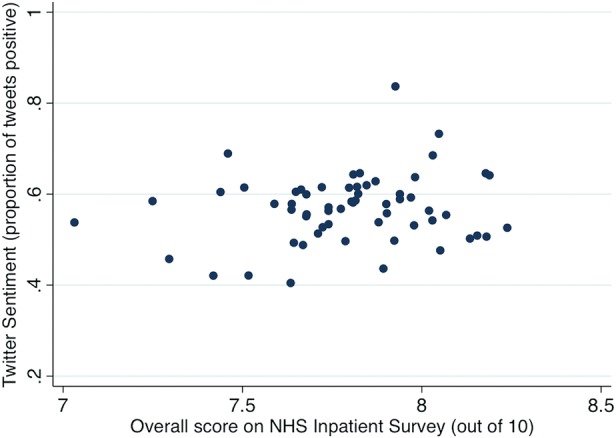
To examine whether tweets sent to hospitals in the English National Health Service contain information about quality of care. To compare sentiment on Twitter about hospitals with established survey measures of patient experience and standardised mortality rates.
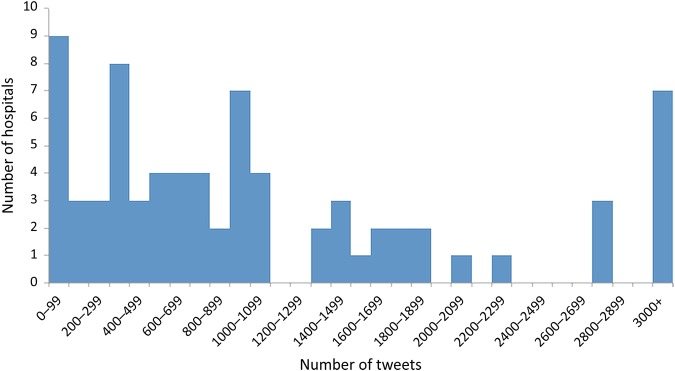
A mixed methods study including a quantitative analysis of all 198,499 tweets sent to English hospitals over a year and a qualitative directed content analysis of 1000 random tweets. Twitter sentiment and conventional quality metrics were compared using Spearman's rank correlation coefficient.
11% of tweets to hospitals contained information about care quality, with the most frequent topic being patient experience (8%). Comments on effectiveness or safety of care were present, but less common (3%). 77% of tweets about care quality were positive in tone. Other topics mentioned in tweets included messages of support to patients, fundraising activity, self-promotion and dissemination of health information. No associations were observed between Twitter sentiment and conventional quality metrics.
Only a small proportion of tweets directed at hospitals discuss quality of care and there was no clear relationship between Twitter sentiment and other measures of quality, potentially limiting Twitter as a medium for quality monitoring. However, tweets did contain information useful to target quality improvement activity. Recent enthusiasm by policy makers to use social media as a quality monitoring and improvement tool needs to be carefully considered and subjected to formal evaluation.
患者越来越多地使用推特来评论他们的医疗保健经历。这可能为了解医疗服务提供者的质量和改善服务提供信息。
研究发送给英国国家医疗服务体系(NHS)医院的推文是否包含有关医疗质量的信息。将推特上关于医院的情绪与既定的患者体验调查指标和标准化死亡率进行比较。
一项混合方法研究,包括对一年内向英国医院发送的所有198499条推文进行定量分析,以及对1000条随机推文进行定性定向内容分析。使用斯皮尔曼等级相关系数比较推特情绪和传统质量指标。
发送给医院的推文中,11%包含有关医疗质量的信息,最常见的主题是患者体验(8%)。存在关于医疗有效性或安全性的评论,但较少见(3%)。77%关于医疗质量的推文语气积极。推文中提到的其他主题包括对患者的支持信息、筹款活动、自我推广和健康信息传播。未观察到推特情绪与传统质量指标之间的关联。
针对医院的推文中只有一小部分讨论医疗质量,推特情绪与其他质量指标之间没有明确关系,这可能限制推特作为质量监测媒介的作用。然而,推文确实包含有助于确定质量改进活动目标的信息。政策制定者近期对使用社交媒体作为质量监测和改进工具的热情需要仔细考虑并进行正式评估。