Resende Leandro Santos de Araújo, Rabelo-Santos Sílvia Helena, Sarian Luís Otávio, Figueiredo Alves Rosane Ribeiro, Ribeiro Andréa Alves, Zeferino Luiz Carlos, Derchain Sophie
Department of Obstetrics and Gynaecology, Faculty of Medical Sciences, State University of Campinas - UNICAMP, Campinas, SP, Brazil.
BMC Infect Dis. 2014 Apr 22;14:214. doi: 10.1186/1471-2334-14-214.
Cervical cancer ranks third in prevalence and fourth as cause of death in women worldwide. In Brazil, 17,540 women were diagnosed in 2012 with the disease. Persistent infection with high-risk HPV types is a necessary condition for the development of pre-invasive and invasive cervical neoplasia. Currently, over 100 HPV types have been identified, but HPV16 and 18 are recognized as the mayor culprits in cervical carcinogenesis. Our objective was to assess the relationships between single- (ST) and multiple-type (MT) HPV infections with patients' age and lesion pathological status.
328 patients with either squamous or glandular intraepithelial or invasive cervical lesion were selected. All subjects were tested for HPV genotypes with reverse hybridization for 21 high- (hr-HPV) and 16 low-risk (lr-HPV) probes. Prevalence of ST and MT HPV infections was compared across histological types and age strata.
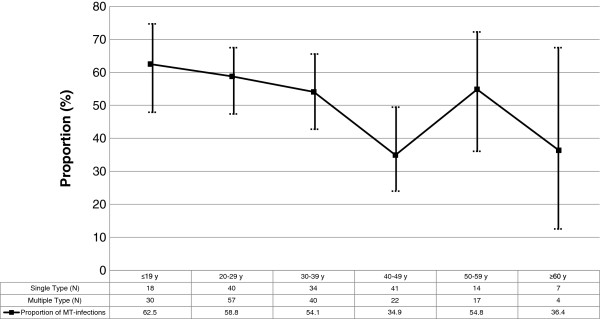
287 (87%) women had at least one HPV type detected and 149 (52%) had MT infections. The most prevalent HPV type was HPV16, present in 142 cases (49% of all HPV-positive cases), followed by HPV58, 52, 31, 35 and 33. HPV18, in single or multiple infections, occurred in 23 cases (8% of hr-HPV cases). Almost all glandular lesions were associated with HPV16 and 18 alone. Multiple infections were significantly more prevalent in squamous than in glandular lesion for HPV16 and 18 (P = 0.04 and 0.03 respectively). The prevalence of MT infections followed a bimodal distribution; peaking in women younger 29 years and in those aged 50 to 59.
Our data indicate that prevention strategies for pre-invasive and invasive squamous lesions should be focused on HPV16 and a few alpha-9 HPV types. It is clear to us that in young women, prophylaxis must cover a large amalgam of HPV types beyond classic HPV16 and 18.
宫颈癌在全球女性疾病患病率中排名第三,在死因中排名第四。2012年巴西有17540名女性被诊断患有此病。高危型人乳头瘤病毒(HPV)的持续感染是宫颈上皮内瘤变及浸润性宫颈癌发生的必要条件。目前已鉴定出100多种HPV类型,但HPV16和HPV18被认为是宫颈癌发生的主要元凶。我们的目的是评估单一型(ST)和多重型(MT)HPV感染与患者年龄及病变病理状态之间的关系。
选取328例患有鳞状或腺上皮内病变或浸润性宫颈病变的患者。所有受试者均采用反向杂交法对21种高危型(hr-HPV)和16种低危型(lr-HPV)探针进行HPV基因型检测。比较不同组织学类型和年龄组中ST和MT HPV感染的患病率。
287例(87%)女性至少检测到一种HPV类型,149例(52%)为MT感染。最常见的HPV类型是HPV16,共142例(占所有HPV阳性病例的49%),其次是HPV58、52、31、35和33。HPV18单独或多重感染共23例(占hr-HPV病例的8%)。几乎所有腺上皮病变仅与HPV16和HPV18相关。对于HPV16和HPV18,多重感染在鳞状病变中的患病率显著高于腺上皮病变(P值分别为0.04和0.03)。MT感染的患病率呈双峰分布,在29岁以下及50至59岁女性中达到峰值。
我们的数据表明,宫颈上皮内瘤变及浸润性鳞状病变的预防策略应聚焦于HPV16及少数α-9型HPV。显然,对于年轻女性,预防措施必须涵盖除经典的HPV16和HPV18之外的大量HPV类型。