Key Laboratory of Medical Virology, NHFPC, National Institute for Viral Disease Control and Prevention, China CDC, Beijing, China.
PLoS One. 2014 Apr 21;9(4):e95635. doi: 10.1371/journal.pone.0095635. eCollection 2014.
Viral hemorrhagic fevers (VHFs) are a group of animal and human illnesses that are mostly caused by several distinct families of viruses including bunyaviruses, flaviviruses, filoviruses and arenaviruses. Although specific signs and symptoms vary by the type of VHF, initial signs and symptoms are very similar. Therefore rapid immunologic and molecular tools for differential diagnosis of hemorrhagic fever viruses (HFVs) are important for effective case management and control of the spread of VHFs. Real-time quantitative reverse transcriptase-polymerase chain reaction (qRT-PCR) assay is one of the reliable and desirable methods for specific detection and quantification of virus load. Multiplex PCR assay has the potential to produce considerable savings in time and resources in the laboratory detection.
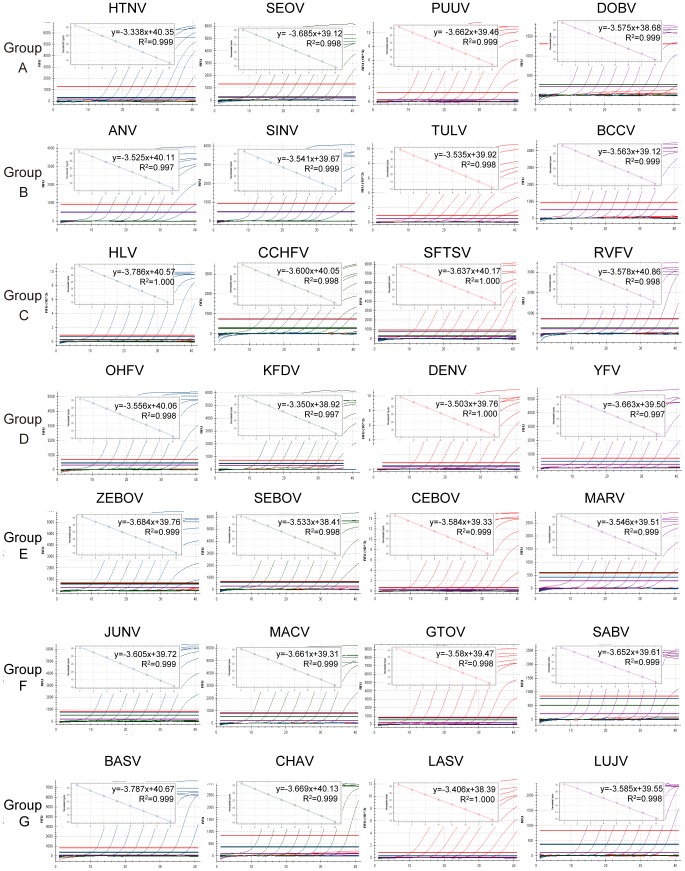
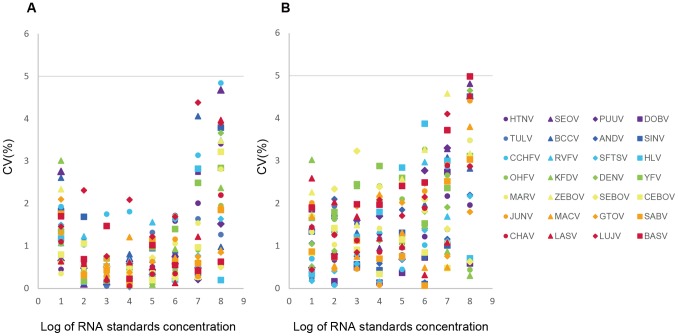
Primers/probe sets were designed based on appropriate specific genes for each of 28 HFVs which nearly covered all the HFVs, and identified with good specificity and sensitivity using monoplex assays. Seven groups of multiplex one-step real-time qRT-PCR assays in a universal experimental system were then developed by combining all primers/probe sets into 4-plex reactions and evaluated with serial dilutions of synthesized viral RNAs. For all the multiplex assays, no cross-reactivity with other HFVs was observed, and the limits of detection were mainly between 45 and 150 copies/PCR. The reproducibility was satisfactory, since the coefficient of variation of Ct values were all less than 5% in each dilution of synthesized viral RNAs for both intra-assays and inter-assays. Evaluation of the method with available clinical serum samples collected from HFRS patients, SFTS patients and Dengue fever patients showed high sensitivity and specificity of the related multiplex assays on the clinical specimens.
Overall, the comprehensive multiplex one-step real-time qRT-PCR assays were established in this study, and proved to be specific, sensitive, stable and easy to serve as a useful tool for rapid detection of HFVs.
病毒性出血热(VHFs)是一组主要由几种不同病毒科引起的动物和人类疾病,包括布尼亚病毒科、黄病毒科、丝状病毒科和沙粒病毒科。尽管不同类型的 VHF 有特定的体征和症状,但初始体征和症状非常相似。因此,用于鉴别诊断出血热病毒(HFVs)的快速免疫和分子工具对于有效管理病例和控制 VHFs 的传播非常重要。实时定量逆转录聚合酶链反应(qRT-PCR)检测是一种可靠且理想的特定病毒载量检测和定量方法。多重 PCR 检测法具有在实验室检测中节省时间和资源的潜力。
根据 28 种 HFVs 的每种病毒的适当特定基因设计了引物/探针组,通过单重检测试验鉴定具有良好的特异性和敏感性。然后在通用实验系统中开发了七种组合所有引物/探针组的四重一步实时 qRT-PCR 多重检测法,并通过合成病毒 RNA 的系列稀释进行评估。对于所有多重检测法,均未观察到与其他 HFVs 的交叉反应,检测限主要在 45 到 150 拷贝/PCR 之间。重复性良好,因为在每个稀释的合成病毒 RNA 中,内试验和间试验的 Ct 值的变异系数均小于 5%。使用从 HFRS 患者、SFTS 患者和登革热患者采集的临床血清样本对该方法进行评估,结果表明相关多重检测法对临床标本具有较高的灵敏度和特异性。
总之,本研究建立了全面的一步实时多重 qRT-PCR 检测法,该方法特异性、敏感性、稳定性良好,易于作为快速检测 HFVs 的有用工具。