de Mateo Sara, Sassone-Corsi Paolo
Center for Epigenetics and Metabolism School of Medicine, Department of Biological Chemistry, University of California, Irvine, United States.
Center for Epigenetics and Metabolism School of Medicine, Department of Biological Chemistry, University of California, Irvine, United States.
Semin Cell Dev Biol. 2014 May;29:84-92. doi: 10.1016/j.semcdb.2014.04.021. Epub 2014 Apr 19.
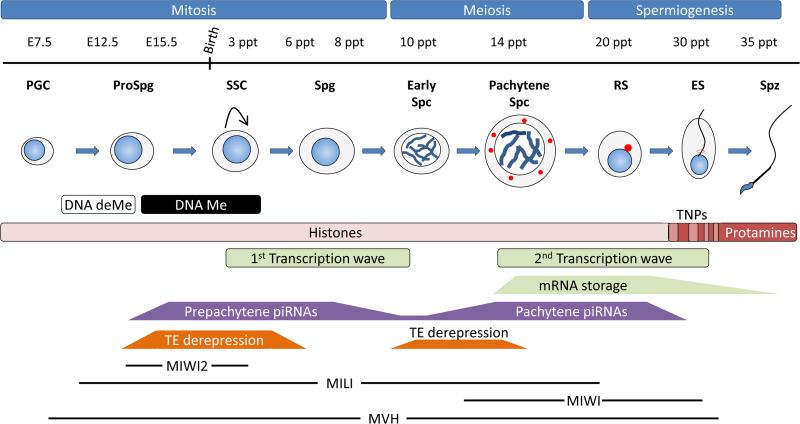
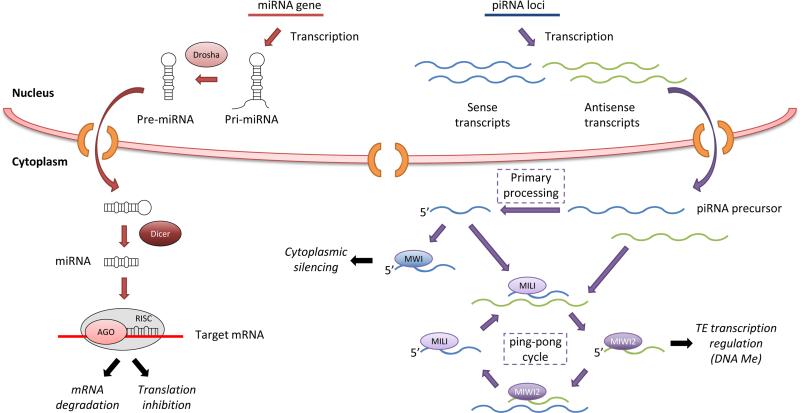
The spermatogenic process relays in highly regulated gene expression mechanisms at the transcriptional and post-transcriptional levels to generate the male gamete that is needed for the perpetuation of the species. Small non-coding RNA pathways have been determined to participate in the post-transcriptional regulatory processes of germ cells. The most important sncRNA molecules that are critically involved in spermatogenesis belong to the miRNA and piRNAs pathways as illustrated by animal models where ablation of specific protein components displays male infertility. Several elements of these regulatory pathways have been found in the nuage or germ granule, a non-membranous cytoplasmatic structure that can be seen in spermatocytes and spermatids. This notion suggests that germ granules may act as organizer centers for silencing pathways in the germline. In general, miRNAs regulate spermatogenesis through targeting and down-regulation of specific transcripts to eventually promote sperm development. However, piRNAs are powerful repressors of transposon elements expression in the spermatogenic process. Here we describe the suggested functions that miRNA and piRNAs pathways execute in the regulation of spermatogenesis and include some recent studies in the field. Despite major strides on the detailed molecular mechanisms of sncRNAs in relation to spermatogenesis, there is plenty to discover on this fascinating regulatory program.
精子发生过程依赖于转录和转录后水平上高度调控的基因表达机制,以产生物种延续所需的雄配子。已确定小非编码RNA途径参与生殖细胞的转录后调控过程。如动物模型所示,在精子发生中起关键作用的最重要的小非编码RNA分子属于miRNA和piRNA途径,其中特定蛋白质成分的缺失会导致雄性不育。在核仁或生殖颗粒(一种可在精母细胞和精子细胞中看到的无膜细胞质结构)中发现了这些调控途径的几个元件。这一观点表明,生殖颗粒可能作为种系中沉默途径的组织者中心。一般来说,miRNA通过靶向和下调特定转录本来调节精子发生,最终促进精子发育。然而,piRNA是精子发生过程中转座子元件表达的强大抑制剂。在这里,我们描述了miRNA和piRNA途径在精子发生调控中所执行的假定功能,并包括该领域的一些最新研究。尽管在小非编码RNA与精子发生相关的详细分子机制方面取得了重大进展,但在这个迷人的调控程序上仍有许多有待发现的地方。