Jacobs Niels C L, Völlink Trijntje, Dehue Francine, Lechner Lilian
Faculty of Psychology, Open University, Valkenburgerweg 177, 6419 AT Heerlen, The Netherlands.
BMC Public Health. 2014 Apr 24;14:396. doi: 10.1186/1471-2458-14-396.
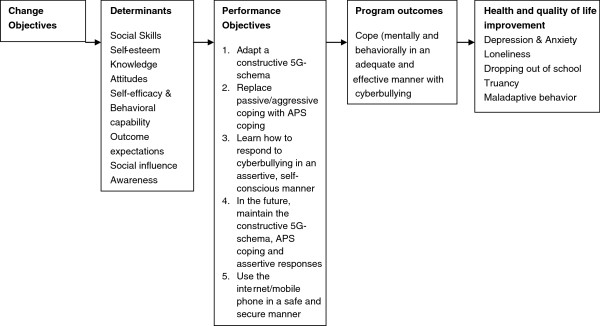
The purpose of this article is to give an integrative insight into the theoretical and empirical-based development of the Online Pestkoppenstoppen (Stop Bullies Online/Stop Online Bullies). This intervention aims to reduce the number of cyberbully victims and their symptoms of depression and anxiety (program goal), by teaching cyberbully victims how to cope in an adequate and effective manner with cyberbully incidents (program's outcomes).
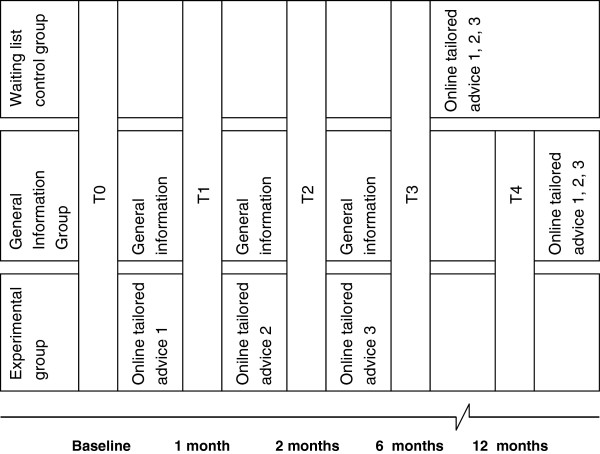
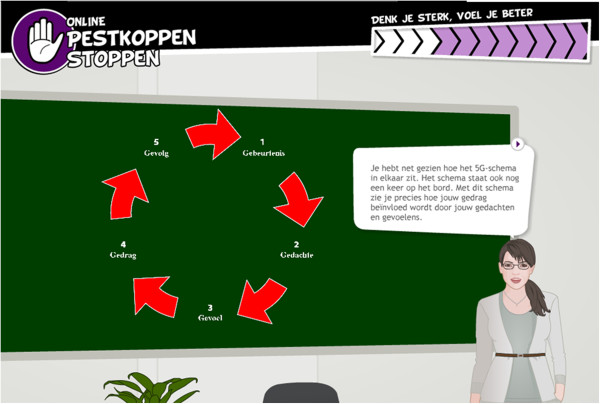
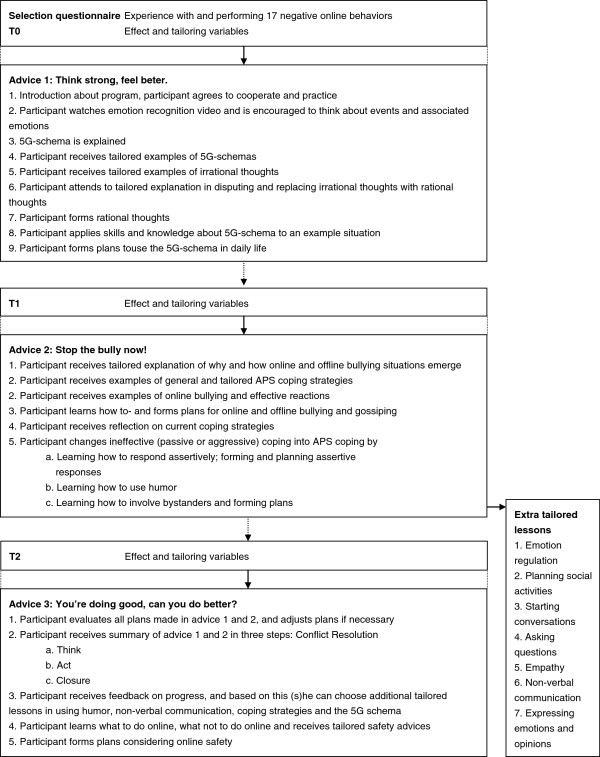
METHOD/DESIGN: In developing the program the different steps of the Intervention Mapping protocol are systematically used. In this article we describe each step of Intervention Mapping. Sources used for the development were a literature review, a Delphi study among experts, focus group interviews with the target group, and elements from a proven effective anti-bullying program. The result is a fully automated web-based tailored intervention for cyberbully victims (12-15 years) consisting of three web-based advice sessions delivered over three months. The first advice aims to teach participants how behavior is influenced by the thoughts they have, how to recognize and dispute irrational thoughts and how to form rational thoughts. In the second advice, participants will learn about the way bullying emerges, how their behavior influences bullying and how they can use effective coping strategies in order to stop (online) bullying. In the third advice, participants receive feedback and will learn how to use the Internet and mobile phones in a safe manner. Each advice is tailored to the participant's personal characteristics (e.g., personality, self-efficacy, coping strategies used and (ir)rational thoughts). To ensure implementation of the program after testing it for effectiveness, the intervention was pretested in the target-population and an implementation plan was designed. Finally, we will elaborate on the planned randomized controlled trial in which the intervention will be compared to a general information group and waiting list control group. This evaluation will provide insight into the intervention's efficacy to reduce cyberbullying and its negative effects.
Intervention Mapping is a time consuming but profound way to ensure that each step of developing an intervention is taken, and resulted in three web-based tailored pieces of advices that teach adolescents how to cope more effectively with cyberbullying experiences.
NTR3613, 14-09-2012.
本文旨在对在线制止霸凌(Stop Bullies Online/Stop Online Bullies)基于理论和实证的发展进行综合洞察。该干预措施旨在通过教导网络霸凌受害者如何以适当且有效的方式应对网络霸凌事件(项目成果),来减少网络霸凌受害者的数量及其抑郁和焦虑症状(项目目标)。
方法/设计:在开发该项目时,系统地运用了干预映射协议的不同步骤。在本文中,我们描述了干预映射的每个步骤。开发过程中使用的资料来源包括文献综述、专家德尔菲研究、与目标群体的焦点小组访谈以及一个经证实有效的反霸凌项目的要素。结果是为网络霸凌受害者(12 - 15岁)设计了一个基于网络的全自动定制干预措施,包括在三个月内提供的三次基于网络的咨询课程。第一次咨询旨在教导参与者行为是如何受到他们的想法影响的,如何识别和反驳不合理的想法以及如何形成合理的想法。在第二次咨询中,参与者将了解霸凌是如何产生的,他们的行为如何影响霸凌以及他们如何使用有效的应对策略来制止(在线)霸凌。在第三次咨询中,参与者会收到反馈,并将学习如何安全地使用互联网和手机。每次咨询都根据参与者的个人特征(如个性、自我效能感、使用的应对策略和(不)合理想法)进行定制。为确保在测试其有效性后该项目能够实施,在目标人群中对干预措施进行了预测试,并设计了一个实施计划。最后,我们将详细阐述计划中的随机对照试验,在该试验中,将把干预措施与一个一般信息组和等待名单对照组进行比较。该评估将深入了解干预措施在减少网络霸凌及其负面影响方面的效果。
干预映射是一种耗时但深入的方式,可确保干预开发的每一步都得以落实,并产生了三个基于网络的定制咨询内容,教导青少年如何更有效地应对网络霸凌经历。
NTR3613,2012年9月14日。