Bagheri Sm, Hejazian Sh, Dashti-R Mh
Department of Physiology/Herbal Medicine Research Center, Shahid Sadoghi University of Medical Sciences, Yazd, Iran.
Ann Med Health Sci Res. 2014 Mar;4(2):238-41. doi: 10.4103/2141-9248.129050.
In Iranian folk medicine, several plants are used for treatment of gastrointestinal disorders, such as diarrhea and spasm. One of these herbal medications are the essential oil yielded from seeds of Ferula assa-foetida L. and an oleo-gum-resin known as asafetida, which is exudated from its root. F. assa-foetida grows wildly in south and central mountains of Iran.
In this study, relaxant effect of asafoetida and seed's essential oil of F. assa-foetida was investigated in isolated rat's ileum in three doses.
A total of 5 cm of ileum was removed and sets for recording its isotonic contractions. The amplitude of contractions induced by different doses of asafoetida and essential oil before and after exposing the specimens with cumulative logarithmic concentrations of acetylcholine (Ach) was evaluated. The relaxant effect of asafoetida and seed's essential oil of F. assa-foetida was investigated in isolated rat's ileum in three doses (0.1 0.2 and 0.3%). All statistical analysis was by GraphPad Prism 5 (San Diego, California) and comparisons were made by means of the analysis of variances followed by Tukey's test. The statistical significance was considered as P < 0.05.
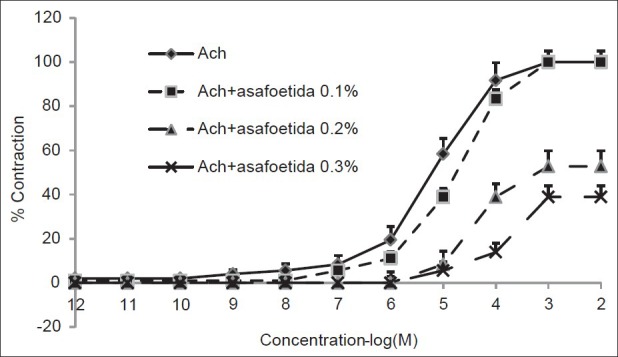
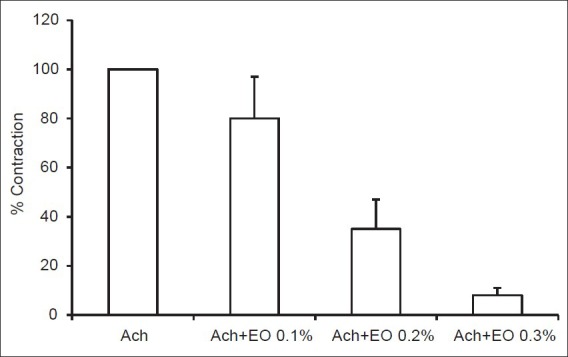
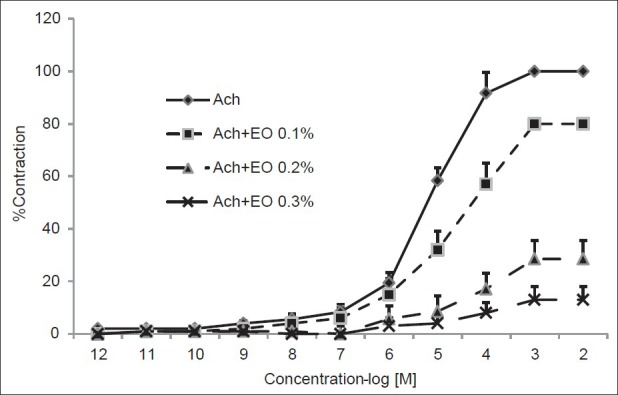
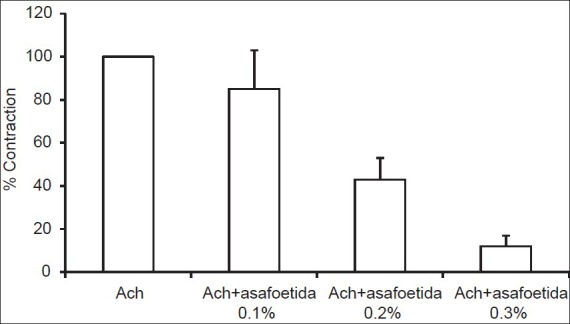
Asafoetida produced an antispasmodic effect on Ach induced contraction in 0.2% and 0.3% concentrations. Our findings also showed that essential oil has significant antispasmodic action against cumulative concentrations of 10(-12) up to 10(-2) M Ach. In spasmolytic evaluation, our findings showed that the essential oil derived from F. assa-foetida seed in concentrations of 0.2% and 0.3% significantly reduced Ach (10(-4) M) induced contractions. Exposure to the 0.2% and 0.3% asafoetida, reduced the percentage of maximum contraction induced by 10(-4) M Ach to 43% and 12% respectively, which this reduction was statistically significant.
The results of the present study, supports the traditional claim of asafoetida as an antispasmodic therapeutic.
在伊朗民间医学中,有几种植物被用于治疗胃肠道疾病,如腹泻和痉挛。其中一种草药是从阿魏(Ferula assa-foetida L.)种子中提取的精油以及从其根部渗出的一种油胶树脂,即阿魏树脂。阿魏在伊朗南部和中部山区野生生长。
在本研究中,研究了阿魏树脂和阿魏种子精油在三种剂量下对离体大鼠回肠的松弛作用。
总共取出5厘米的回肠并设置用于记录其等张收缩。评估在给予累积对数浓度的乙酰胆碱(Ach)前后,不同剂量的阿魏树脂和精油诱导的收缩幅度。在离体大鼠回肠中研究了阿魏树脂和阿魏种子精油在三种剂量(0.1%、0.2%和0.3%)下的松弛作用。所有统计分析均使用GraphPad Prism 5(加利福尼亚州圣地亚哥)进行,比较采用方差分析后进行Tukey检验。统计学显著性被认为是P < 0.05。
阿魏树脂在0.2%和0.3%浓度下对Ach诱导的收缩产生解痉作用。我们的数据还表明,精油对累积浓度为10(-12)至10(-2) M的Ach具有显著的解痉作用。在解痉评估中,我们的数据表明,阿魏种子精油在0.2%和0.3%浓度下显著降低了Ach(10(-4) M)诱导的收缩。暴露于0.2%和0.3%的阿魏树脂后,10(-4) M Ach诱导的最大收缩百分比分别降至43%和12%,这种降低具有统计学显著性。
本研究结果支持了阿魏作为解痉治疗药物的传统说法。