Department of Environmental Sciences, Section of Plant Physiology, University of Basel, Zurich-Basel Plant Science Center, Part of the Swiss Plant Science Web, Basel, Switzerland.
Department of Environmental Sciences, Section of Plant Physiology, University of Basel, Zurich-Basel Plant Science Center, Part of the Swiss Plant Science Web, Basel, Switzerland; Department of Gene Expression, Faculty of Biology, Adam Mickiewicz University, Poznan, Poland.
PLoS One. 2014 Apr 24;9(4):e95972. doi: 10.1371/journal.pone.0095972. eCollection 2014.
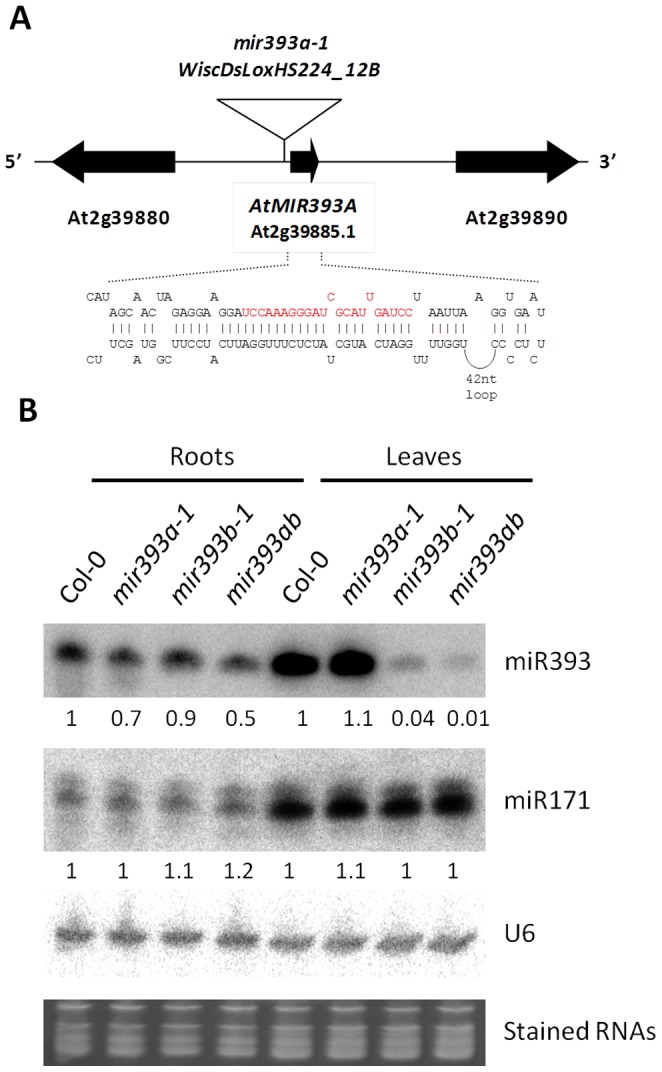
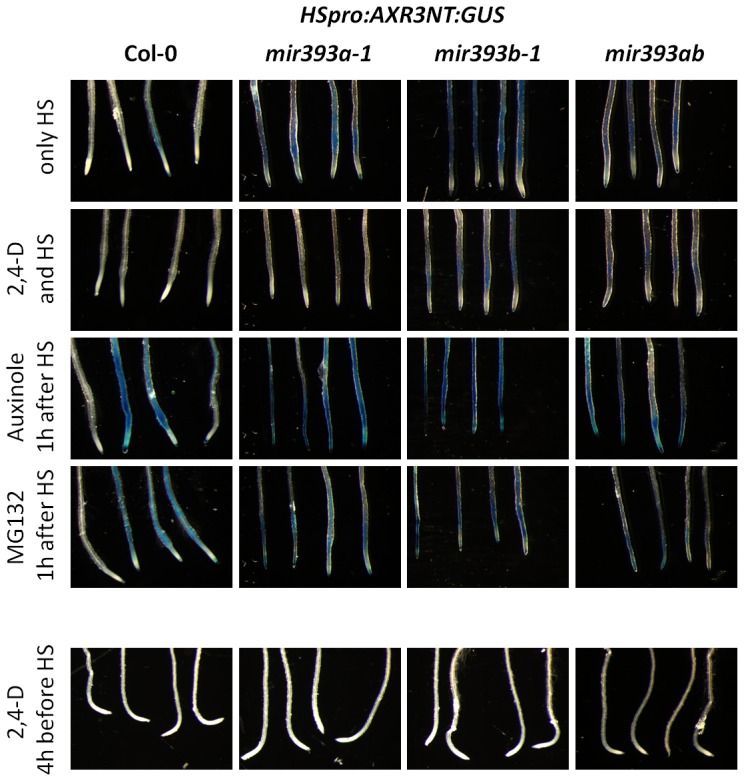
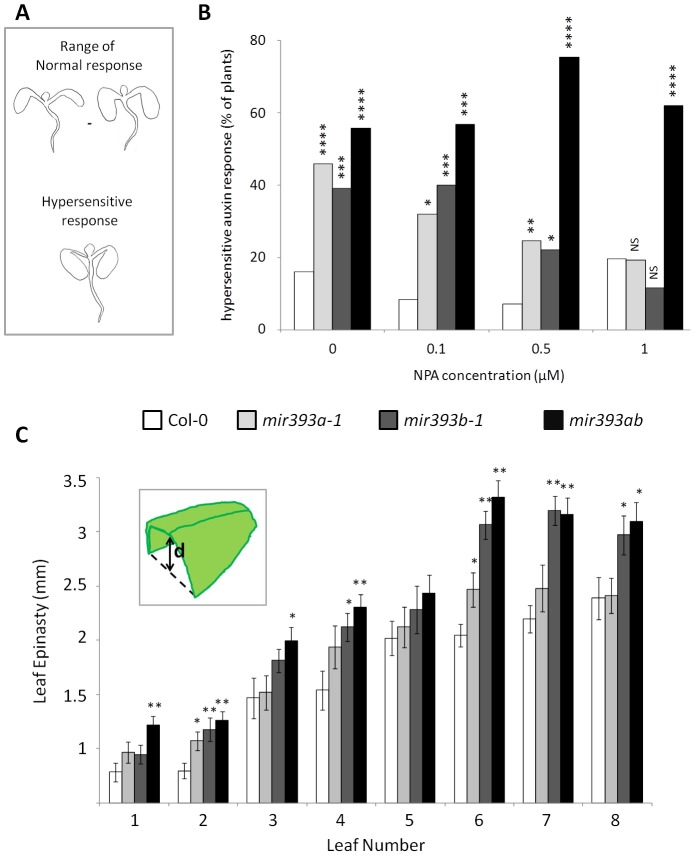
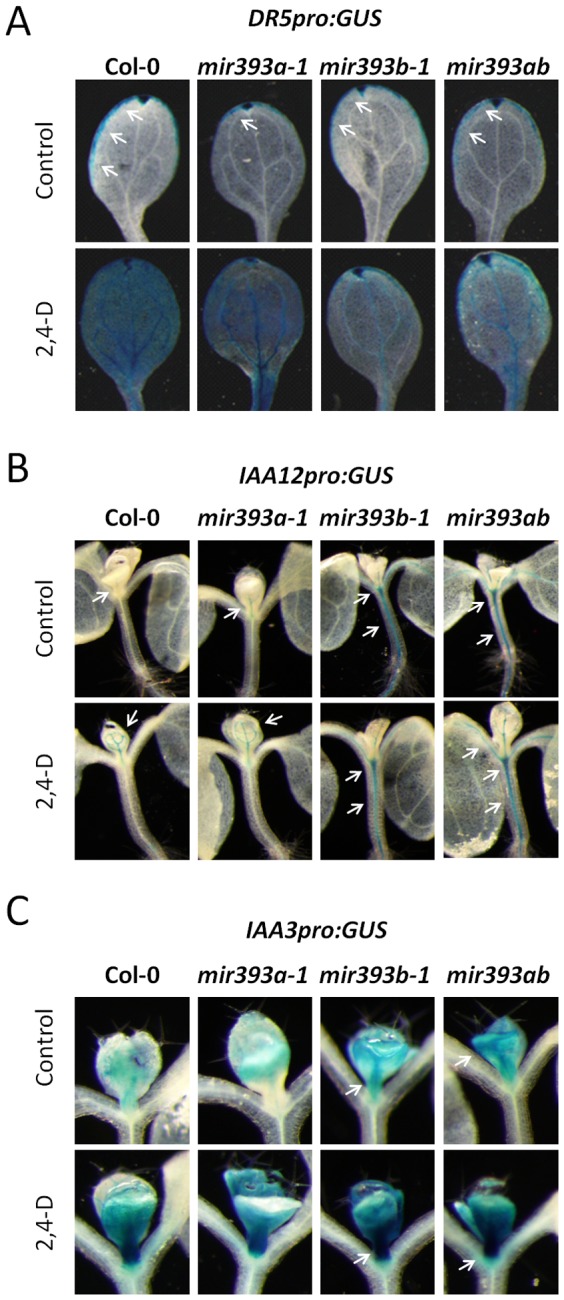
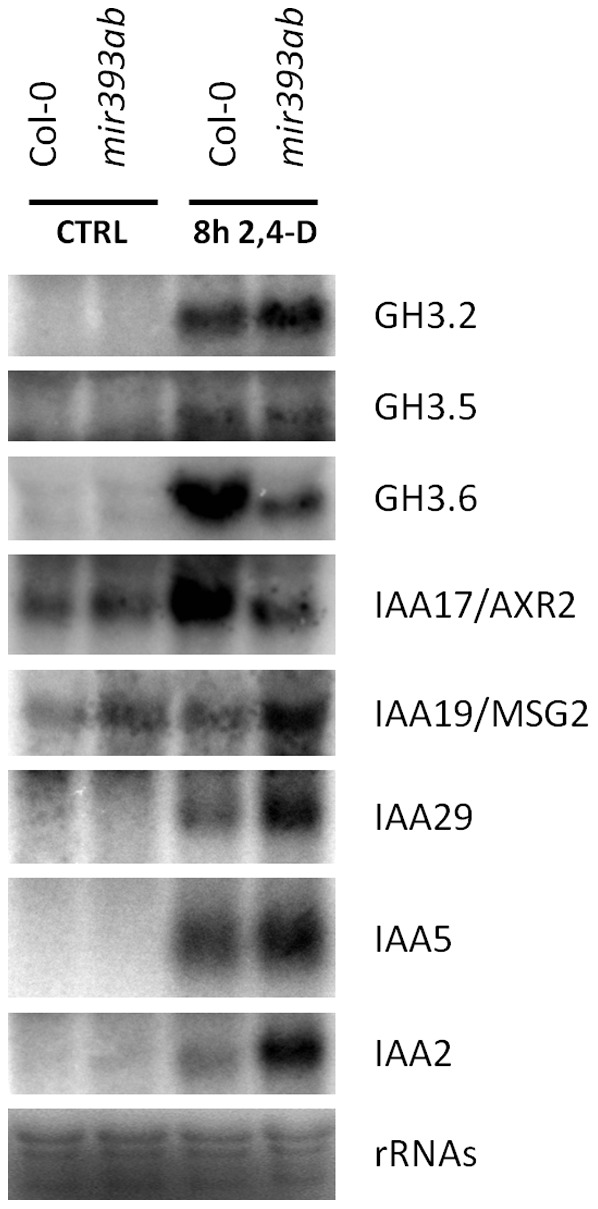
Auxins are crucial for plant growth and development. Auxin signalling primarily depends on four partially redundant F-box proteins of the TIR1/AFB2 Auxin Receptor (TAAR) clade to trigger the degradation of AUX/IAA transcriptional repressors. Auxin signalling is a balanced system which involves complex feedback regulations. miR393 regulation of TAAR genes is important for different developmental programs and for responses to environment. However, so far, the relevance of the two MIR393 genes for Arabidopsis leaf development and their significance for auxin signalling homeostasis have not been evaluated. First, our analyses of mir393a-1 and mir393b-1 mutants and of mir393ab double mutant show that the two genes have only partially redundant functions for leaf development. Expression analyses of typical auxin-induced reporter genes have shown that the loss of miR393 lead to several unanticipated changes in auxin signalling. The expression of DR5pro:GUS is decreased, the expression of primary AUX/IAA auxin-responsive genes is slightly increased and the degradation of the AXR3-NT:GUS reporter protein is delayed in mir393ab mutants. Additional analyses using synthetic auxin and auxin antagonists indicated that miR393 deficient mutants have higher levels of endogenous AUX/IAA proteins, which in turn create a competition for degradation. We propose that the counter-intuitive changes in the expression of AUX/IAA genes and in the accumulation of AUX/IAA proteins are explained by the intrinsic nature of AUX/IAA genes which are feedback regulated by the AUX/IAA proteins which they produce. Altogether our experiments provide an additional highlight of the complexity of auxin signaling homeostasis and show that miR393 is an important component of this homeostasis.
植物生长素对于植物的生长和发育至关重要。生长素信号主要依赖于 TIR1/AFB2 生长素受体 (TAAR) 族的四个部分冗余的 F-box 蛋白,以触发 AUX/IAA 转录阻遏物的降解。生长素信号是一个平衡的系统,涉及复杂的反馈调节。miR393 对 TAAR 基因的调控对于不同的发育程序和对环境的反应都很重要。然而,到目前为止,两个 MIR393 基因对于拟南芥叶片发育的相关性及其对生长素信号稳态的意义尚未得到评估。首先,我们对 mir393a-1 和 mir393b-1 突变体以及 mir393ab 双突变体的分析表明,这两个基因在叶片发育中只有部分冗余的功能。典型的生长素诱导报告基因的表达分析表明,miR393 的缺失导致生长素信号的几个意外变化。DR5pro:GUS 的表达减少,主要的 AUX/IAA 生长素反应基因的表达略有增加,AXR3-NT:GUS 报告蛋白的降解在 mir393ab 突变体中延迟。使用合成生长素和生长素拮抗剂的额外分析表明,miR393 缺陷突变体具有更高水平的内源性 AUX/IAA 蛋白,这反过来又为降解创造了竞争。我们提出,AUX/IAA 基因表达和 AUX/IAA 蛋白积累的反直觉变化可以用 AUX/IAA 基因的内在性质来解释,这些基因受到它们产生的 AUX/IAA 蛋白的反馈调节。总之,我们的实验提供了生长素信号稳态复杂性的另一个亮点,并表明 miR393 是这种稳态的一个重要组成部分。