He Hongtao, Ni Jiangdong, Huang Jun
Department of Orthopedics, The Second Xiangya Hospital, Central South University, Changsha, Hunan, P.R. China.
Oncol Lett. 2014 May;7(5):1352-1362. doi: 10.3892/ol.2014.1935. Epub 2014 Mar 4.
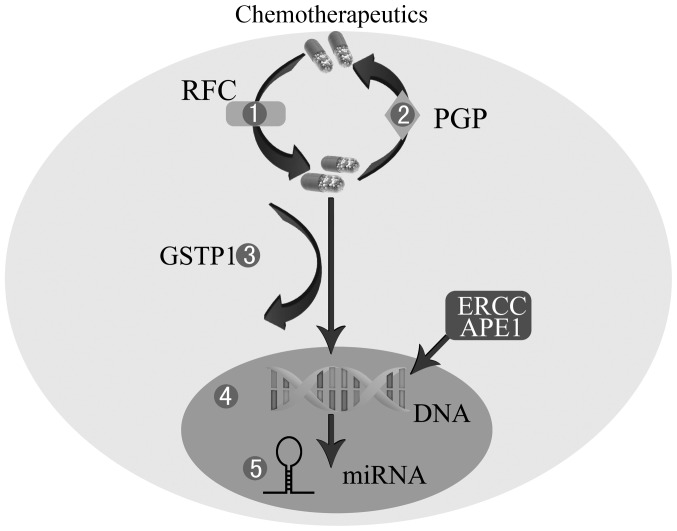
Due to the emergence of adjuvant and neoadjuvant chemotherapy, the survival rate has been greatly improved in osteosarcoma (OS) patients with localized disease. However, this survival rate has remained unchanged over the past 30 years, and the long-term survival rate for OS patients with metastatic or recurrent disease remains poor. To a certain extent, the reason behind this may be ascribed to the chemoresistance to anti-OS therapy. Chemoresistance in OS appears to be mediated by numerous mechanisms, which include decreased intracellular drug accumulation, drug inactivation, enhanced DNA repair, perturbations in signal transduction pathways, apoptosis- and autophagy-related chemoresistance, microRNA (miRNA) dysregulation and cancer stem cell (CSC)-mediated drug resistance. In addition, methods employed to circumvent these resistance mechanism have been shown to be effective in the treatment of OS. However, almost all the current studies on the mechanisms of chemoresistance in OS are in their infancy. Further studies are required to focus on the following aspects: i) Improving the delivery of efficacy through novel delivery patterns; ii) improving the understanding of the signal transduction pathways that regulate the proliferation and growth of OS cells; iii) elucidating the signaling pathways of autophagy and its association with apoptosis in OS cells; iv) utilizing high-throughput miRNA expression analysis to identify miRNAs associated with chemoresistance in OS; and v) identifying the role that CSCs play in tumor metastasis and in-depth study of the mechanism of chemoresistance in the CSCs of OS.
由于辅助化疗和新辅助化疗的出现,局限性骨肉瘤(OS)患者的生存率有了显著提高。然而,在过去30年中,这一生存率并未改变,转移性或复发性OS患者的长期生存率仍然很低。在一定程度上,其背后的原因可能归因于对OS治疗的化疗耐药性。OS中的化疗耐药似乎由多种机制介导,包括细胞内药物积累减少、药物失活、DNA修复增强、信号转导通路紊乱、凋亡和自噬相关的化疗耐药、微小RNA(miRNA)失调以及癌症干细胞(CSC)介导的耐药性。此外,已证明用于规避这些耐药机制的方法在OS治疗中是有效的。然而,目前几乎所有关于OS化疗耐药机制的研究都尚处于起步阶段。需要进一步研究关注以下方面:i)通过新型给药方式提高疗效的传递;ii)增进对调节OS细胞增殖和生长的信号转导通路的理解;iii)阐明OS细胞中自噬的信号通路及其与凋亡的关联;iv)利用高通量miRNA表达分析鉴定与OS化疗耐药相关的miRNA;v)确定CSCs在肿瘤转移中的作用,并深入研究OS的CSCs中的化疗耐药机制。