Alvarez-Uria Gerardo, Priyadarshini Uvummala, Naik Praveen K, Midde Manoranjan, Reddy Raghuprakash
Department of Infectious Diseases;
Department of Microbiology, Rural Development Trust Hospital, Bathalapalli, Anantapur district, AP, India.
Clin Pract. 2012 Aug 21;2(3):e76. doi: 10.4081/cp.2012.e76. eCollection 2012 May 29.
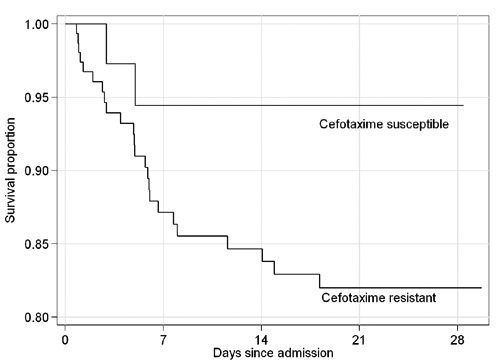
Studies performed in developed countries have shown that infections by third generation cephalosporin resistant Escherichia coli (G3CREC) are associated with increased mortality, but data from developing countries are scarce. In this observational study, we collected clinical and microbiological information of 194 patients admitted to a district hospital in India who had community-acquired isolation of Escherichia coli. The proportion of patients with G3CREC was 79.4%. In a multivariable logistic regression analysis, factors associated with 21-day mortality were isolation from a normally sterile site, HIV infection and isolation of G3CREC. Strains of Escherichia coli isolated from normally sterile sites had lower levels of resistance to quinolones and beta-lactam antibiotics. The proportion of meropenem and ciprofloxacin resistance was 11.1% and 80.9% respectively. The high proportion of G3CREC in the community and the association of G3CREC with 21-day mortality indicate that G3CREC is a major public health problem in developing countries.
在发达国家进行的研究表明,第三代头孢菌素耐药性大肠杆菌(G3CREC)感染与死亡率增加有关,但来自发展中国家的数据却很稀少。在这项观察性研究中,我们收集了印度一家地区医院收治的194例社区获得性大肠杆菌分离患者的临床和微生物学信息。G3CREC患者的比例为79.4%。在多变量逻辑回归分析中,与21天死亡率相关的因素包括从通常无菌部位分离出病原体、HIV感染以及G3CREC分离。从通常无菌部位分离出的大肠杆菌菌株对喹诺酮类和β-内酰胺类抗生素的耐药水平较低。美罗培南和环丙沙星的耐药比例分别为11.1%和80.9%。社区中G3CREC的高比例以及G3CREC与21天死亡率的关联表明,G3CREC是发展中国家的一个主要公共卫生问题。