Zhou Hui, Warren Peter G, Froehlich John W, Lee Richard S
Department of Urology and The Proteomics Center, Boston Children's Hospital and Harvard Medical School , Boston, Massachusetts 02115, United States.
Anal Chem. 2014 Jul 1;86(13):6277-84. doi: 10.1021/ac500298a. Epub 2014 Jun 11.
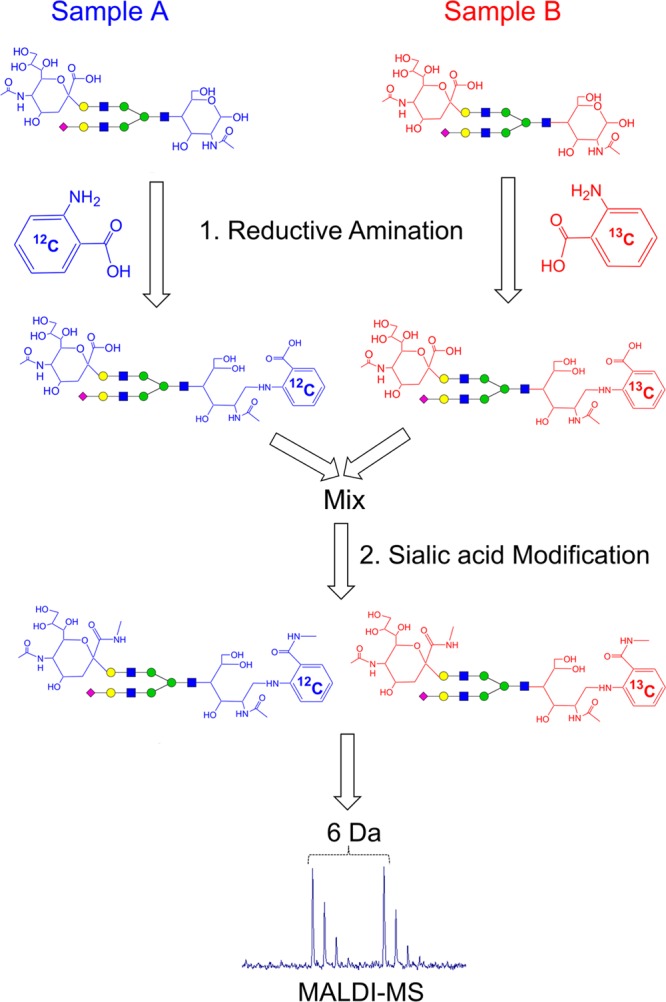
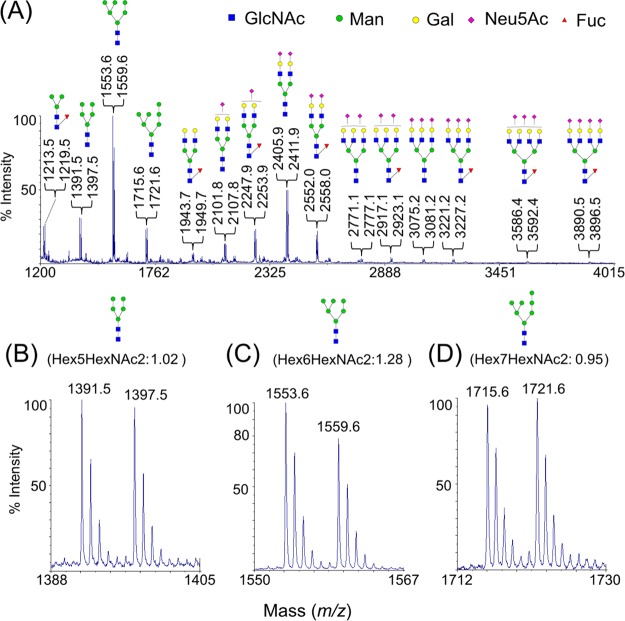
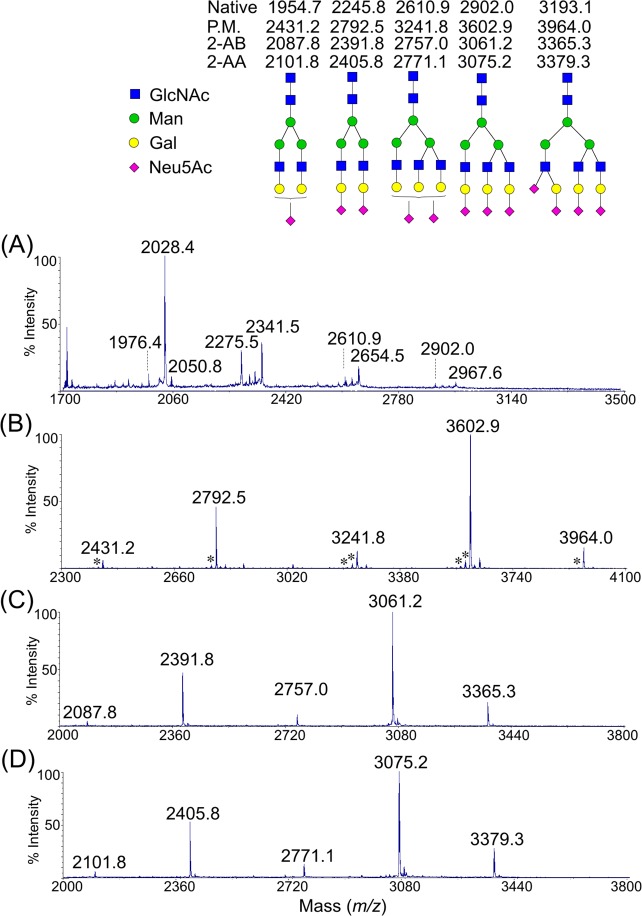
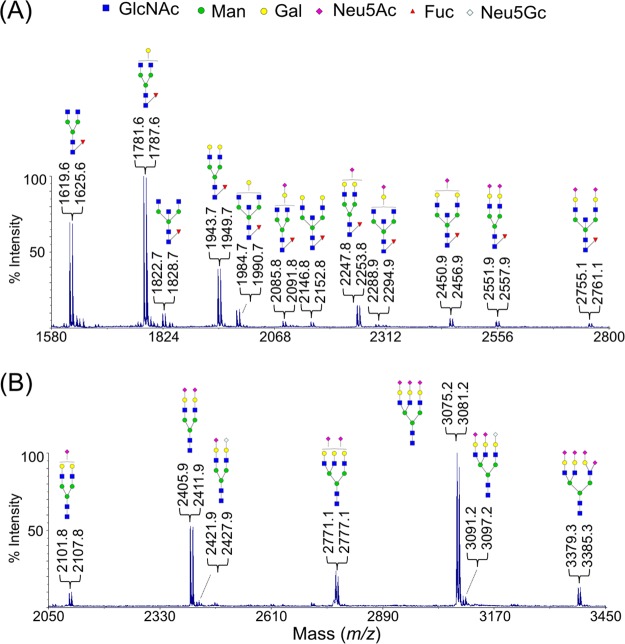
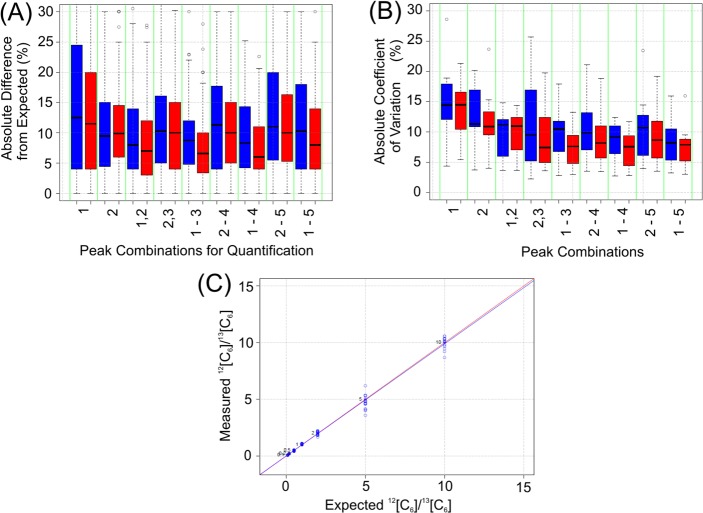
Differences in ionization efficiency among neutral and sialylated glycans prevent direct quantitative comparison by their respective mass spectrometric signals. To overcome this challenge, we developed an integrated chemical strategy, Dual Reactions for Analytical Glycomics (DRAG), to quantitatively compare neutral and sialylated glycans simultaneously by MALDI-MS. Initially, two glycan samples to be compared undergo reductive amination with 2-aminobenzoic acid and 2-(13)[C6]-aminobenzoic acid, respectively. The different isotope-incorporated glycans are then combined and subjected to the methylamidation of the sialic acid residues in one mixture, homogenizing the ionization responses for all neutral and sialylated glycans. By this approach, the expression change of relevant glycans between two samples is proportional to the ratios of doublet signals with a static 6 Da mass difference in MALDI-MS and the change in relative abundance of any glycan within samples can also be determined. The strategy was chemically validated using well-characterized N-glycans from bovine fetuin and IgG from human serum. By comparing the N-glycomes from a first morning (AM) versus an afternoon (PM) urine sample obtained from a single donor, we further demonstrated the ability of DRAG strategy to measure subtle quantitative differences in numerous urinary N-glycans.
中性聚糖和唾液酸化聚糖之间的电离效率差异使得无法通过各自的质谱信号进行直接定量比较。为了克服这一挑战,我们开发了一种综合化学策略——分析糖组学双反应(DRAG),以通过基质辅助激光解吸电离质谱(MALDI-MS)同时对中性聚糖和唾液酸化聚糖进行定量比较。首先,将两个待比较的聚糖样品分别与2-氨基苯甲酸和2-(13)[C6]-氨基苯甲酸进行还原胺化反应。然后将掺入不同同位素的聚糖混合,并对其中一种混合物中的唾液酸残基进行甲基酰胺化,使所有中性聚糖和唾液酸化聚糖的电离响应均匀化。通过这种方法,两个样品之间相关聚糖的表达变化与MALDI-MS中具有6 Da固定质量差的双峰信号之比成正比,并且还可以确定样品中任何聚糖相对丰度的变化。该策略使用来自牛胎球蛋白的特征明确的N-聚糖和人血清中的IgG进行了化学验证。通过比较来自单个供体的晨尿(上午)和下午尿样的N-糖组,我们进一步证明了DRAG策略测量众多尿N-聚糖细微定量差异的能力。