Chan D S M, Vieira A R, Aune D, Bandera E V, Greenwood D C, McTiernan A, Navarro Rosenblatt D, Thune I, Vieira R, Norat T
Department of Epidemiology and Biostatistics, School of Public Health, Imperial College London, London, UK.
Department of Epidemiology and Biostatistics, School of Public Health, Imperial College London, London, UK.
Ann Oncol. 2014 Oct;25(10):1901-1914. doi: 10.1093/annonc/mdu042. Epub 2014 Apr 27.
Positive association between obesity and survival after breast cancer was demonstrated in previous meta-analyses of published data, but only the results for the comparison of obese versus non-obese was summarised.
We systematically searched in MEDLINE and EMBASE for follow-up studies of breast cancer survivors with body mass index (BMI) before and after diagnosis, and total and cause-specific mortality until June 2013, as part of the World Cancer Research Fund Continuous Update Project. Random-effects meta-analyses were conducted to explore the magnitude and the shape of the associations.
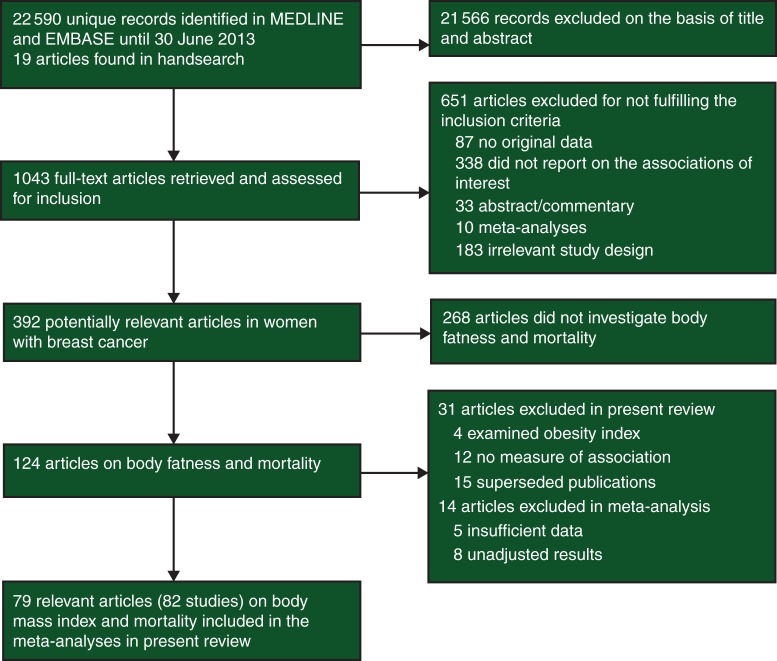
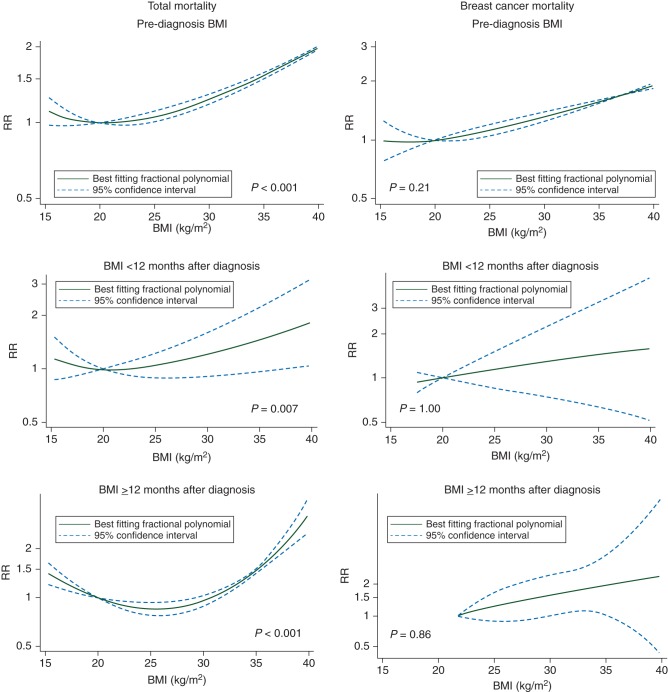
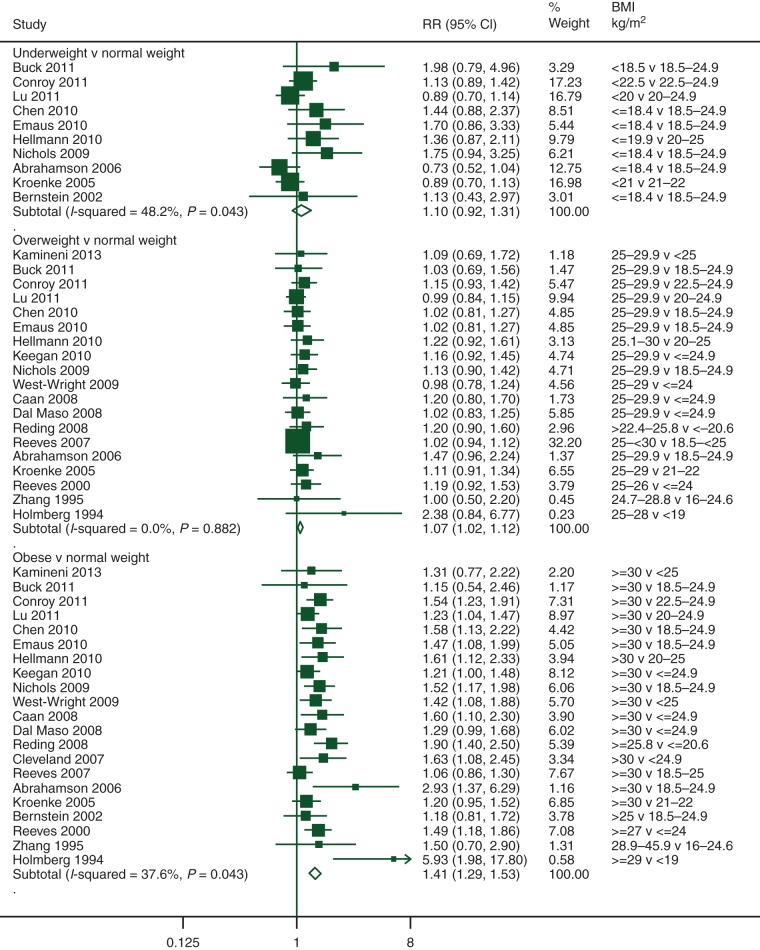
Eighty-two studies, including 213 075 breast cancer survivors with 41 477 deaths (23 182 from breast cancer) were identified. For BMI before diagnosis, compared with normal weight women, the summary relative risks (RRs) of total mortality were 1.41 [95% confidence interval (CI) 1.29-1.53] for obese (BMI >30.0), 1.07 (95 CI 1.02-1.12) for overweight (BMI 25.0-<30.0) and 1.10 (95% CI 0.92-1.31) for underweight (BMI <18.5) women. For obese women, the summary RRs were 1.75 (95% CI 1.26-2.41) for pre-menopausal and 1.34 (95% CI 1.18-1.53) for post-menopausal breast cancer. For each 5 kg/m(2) increment of BMI before, <12 months after, and ≥12 months after diagnosis, increased risks of 17%, 11%, and 8% for total mortality, and 18%, 14%, and 29% for breast cancer mortality were observed, respectively.
Obesity is associated with poorer overall and breast cancer survival in pre- and post-menopausal breast cancer, regardless of when BMI is ascertained. Being overweight is also related to a higher risk of mortality. Randomised clinical trials are needed to test interventions for weight loss and maintenance on survival in women with breast cancer.
既往已发表数据的荟萃分析表明肥胖与乳腺癌患者生存之间存在正相关,但仅总结了肥胖与非肥胖患者对比的结果。
作为世界癌症研究基金会持续更新项目的一部分,我们系统检索了MEDLINE和EMBASE中关于乳腺癌幸存者诊断前后体重指数(BMI)以及截至2013年6月的全因死亡率和特定病因死亡率的随访研究。采用随机效应荟萃分析来探究关联的程度和形态。
共纳入82项研究,包括213075例乳腺癌幸存者,其中41477例死亡(23182例死于乳腺癌)。对于诊断前的BMI,与体重正常的女性相比,肥胖(BMI>30.0)女性全因死亡率的汇总相对危险度(RRs)为1.41[95%置信区间(CI)1.29 - 1.53],超重(BMI 25.0 - <30.0)女性为1.07(95%CI 1.02 - 1.12),体重过轻(BMI <18.5)女性为1.10(95%CI 0.92 - 1.31)。对于肥胖女性,绝经前乳腺癌患者的汇总RRs为1.75(95%CI 1.26 - 2.41),绝经后乳腺癌患者为1.34(95%CI 1.18 - 1.53)。诊断前、诊断后<12个月以及诊断后≥12个月时,BMI每增加5kg/m²,全因死亡率分别增加17%、11%和8%,乳腺癌死亡率分别增加18%、14%和29%。
无论BMI何时确定,肥胖均与绝经前和绝经后乳腺癌患者较差的总体生存及乳腺癌生存相关。超重也与更高的死亡风险相关。需要进行随机临床试验来测试减肥及维持体重的干预措施对乳腺癌女性生存的影响。