Su Ying-Wen, Lin Yun-Ho, Pai Man-Hui, Lo An-Chi, Lee Yu-Chieh, Fang I-Chih, Lin Johnson, Hsieh Ruey-Kuen, Chang Yi-Fang, Chen Chi-Long
Division of Hematology and Medical Oncology, Department of Internal Medicine, Mackay Memorial Hospital, Taipei, Taiwan.
Division of Oral Pathology, Department of Dentistry, Taipei Medical University Hospital, Taipei, Taiwan.
PLoS One. 2014 Apr 25;9(4):e96183. doi: 10.1371/journal.pone.0096183. eCollection 2014.
Epidemiological studies have indicated that impaired glucose metabolism may increase the risk of squamous cell carcinoma of the head and neck (SCCHN). AMP-activated protein kinase (AMPK) regulates glucose and lipid metabolism via the phosphorylation and subsequent inactivation of its downstream target acetyl-CoA carboxylase (ACC).Thus, we analyzed the expression of pAMPK and its downstream target phosphorylated acetyl-CoA carboxylase (pACC), as well as their impact on the survival of patients with resected SCCHN.
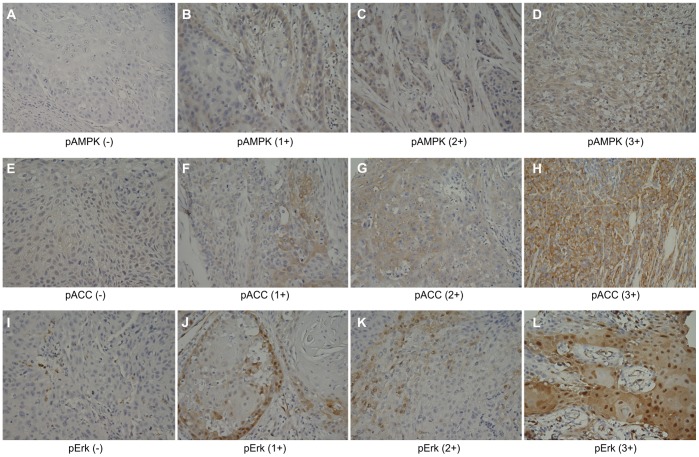
One hundred eighteen patients with surgically resected SCCHN were enrolled. Immunohistochemical (IHC) staining for pAMPK and pACC was performed using tissue microarrays of operative specimens of SCCHN. The expression was divided into two or three groups according to the IHC score [pAMPK: negative (0), positive (1-3); pACC: negative (0), low expression (1, 2), and high expression (3)]. Statistical analysis was performed to determine the association of pAMPK expression with clinicopathological features and pACC and pErk expression.
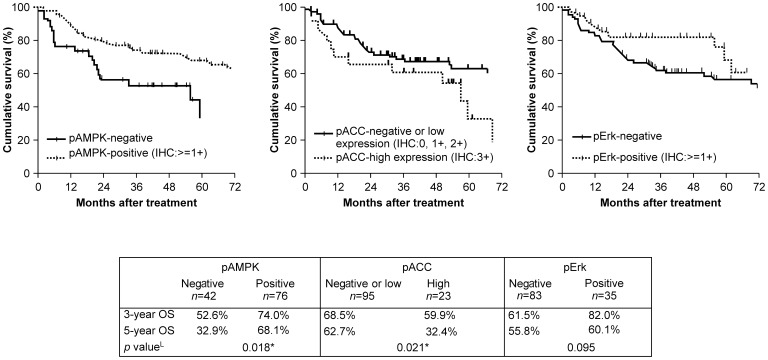
The positive rates of pAMPK and pACC expression were 64.4% (76/118) and 68.6% (81/118), respectively. pAMPK was significantly higher in patients aged younger than 60 years (P = 0.024; χ2 test) and those with early-stage (T1/T2; P = 0.02; χ2 test) and oral cavity (P = 0.026; Fisher's exact test) tumors. In multivariate analysis, pAMPK expression was not significantly correlated with overall survival (OS) (adjusted hazard ratio [HR]: 0.66; 95% confidence interval [CI]: 0.35-1.23), whereas high pACC expression was independently associated with worse OS in node-positive patients (adjusted HR: 17.58; 95% CI: 3.50-88.18).
Strong expression of pACC was found to be an independent prognostic marker for patients with node-positive SCCHN. Our results suggest that pACC may play a role in tumor progression of SCCHN and may help to identify patient subgroups at high risk for poor disease outcome.
流行病学研究表明,糖代谢受损可能会增加头颈部鳞状细胞癌(SCCHN)的发病风险。AMP激活的蛋白激酶(AMPK)通过磷酸化其下游靶点乙酰辅酶A羧化酶(ACC)并使其失活来调节葡萄糖和脂质代谢。因此,我们分析了磷酸化AMPK(pAMPK)及其下游靶点磷酸化乙酰辅酶A羧化酶(pACC)的表达情况,以及它们对接受手术切除的SCCHN患者生存的影响。
纳入118例接受手术切除的SCCHN患者。使用SCCHN手术标本的组织芯片对pAMPK和pACC进行免疫组织化学(IHC)染色。根据IHC评分将表达分为两组或三组[pAMPK:阴性(0),阳性(1-3);pACC:阴性(0),低表达(1,2),高表达(3)]。进行统计学分析以确定pAMPK表达与临床病理特征以及pACC和pErk表达之间的关联。
pAMPK和 pACC表达的阳性率分别为64.4%(76/118)和68.6%(81/118)。年龄小于60岁的患者(P = 0.024;χ²检验)、早期(T1/T2;P = 0.02;χ²检验)和口腔肿瘤患者(P = 0.026;Fisher精确检验)的pAMPK表达显著更高。在多变量分析中,pAMPK表达与总生存期(OS)无显著相关性(校正风险比[HR]:0.66;95%置信区间[CI]:0.35-1.23),而pACC高表达与淋巴结阳性患者的较差OS独立相关(校正HR:17.58;95%CI:3.50-88.18)。
发现pACC的强表达是淋巴结阳性SCCHN患者的独立预后标志物。我们的结果表明,pACC可能在SCCHN的肿瘤进展中起作用,并可能有助于识别疾病预后不良的高危患者亚组。