Institute of Pharmacology and Toxicology, University of Zürich-Vetsuisse, Zürich CH-8057, Switzerland.
Institute of Human Genetics, University of Ulm, Ulm D-89081, Germany.
Nat Commun. 2014 Apr 28;5:3695. doi: 10.1038/ncomms4695.
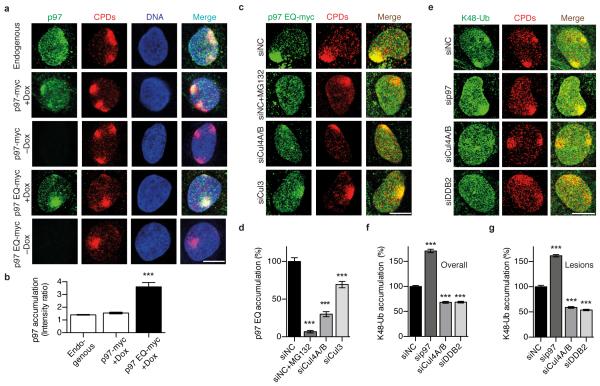
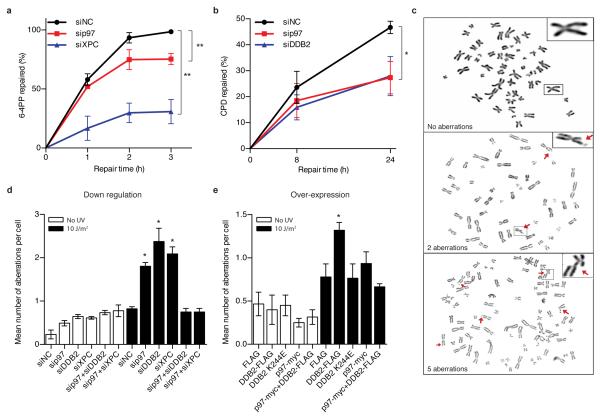
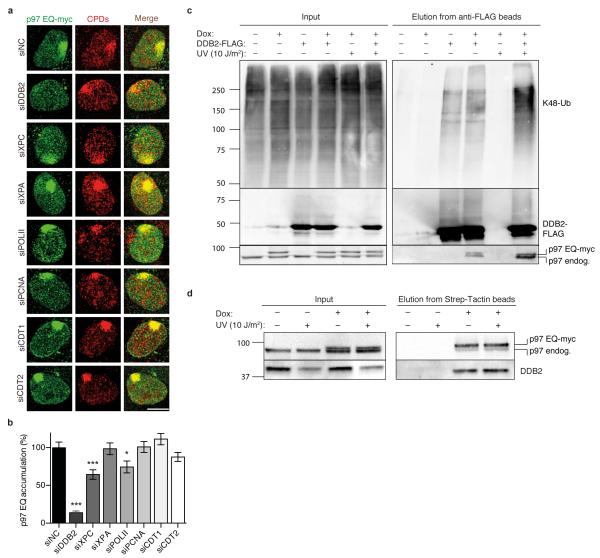
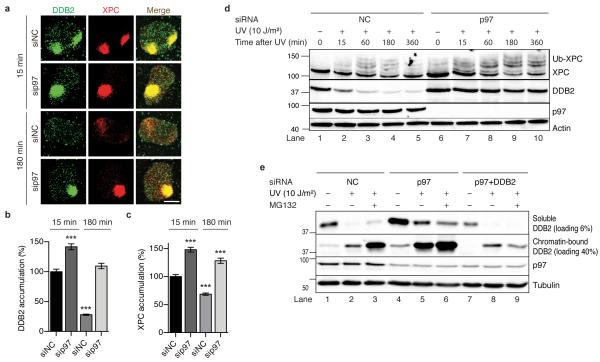
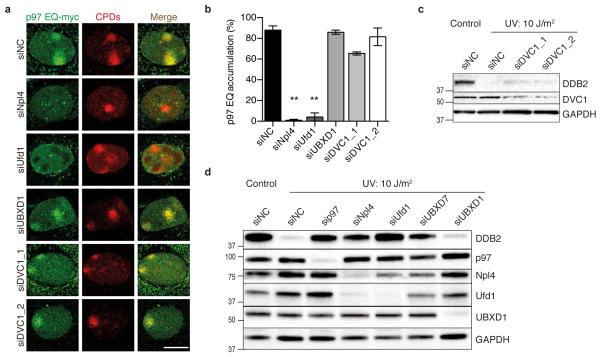
DNA damage recognition subunits such as DDB2 and XPC protect the human skin from ultraviolet (UV) light-induced genome instability and cancer, as demonstrated by the devastating inherited syndrome xeroderma pigmentosum. Here we show that the beneficial DNA repair response triggered by these two genome caretakers critically depends on a dynamic spatiotemporal regulation of their homeostasis. The prolonged retention of DDB2 and XPC in chromatin, because of a failure to readily remove both recognition subunits by the ubiquitin-dependent p97/VCP/Cdc48 segregase complex, leads to impaired DNA excision repair of UV lesions. Surprisingly, the ensuing chromosomal aberrations in p97-deficient cells are alleviated by a concomitant downregulation of DDB2 or XPC. Also, genome instability resulting from an excess of DDB2 persisting in UV-irradiated cells is prevented by concurrent p97 overexpression. Our findings demonstrate that DNA damage sensors and repair initiators acquire unexpected genotoxic properties if not controlled by timely extraction from chromatin.
DNA 损伤识别亚基(如 DDB2 和 XPC)可保护人体皮肤免受紫外线(UV)诱导的基因组不稳定性和癌症的影响,这已被破坏性遗传性综合征着色性干皮病所证明。在这里,我们表明,这两种基因组守护者触发的有益 DNA 修复反应严重依赖于它们的动态时空调节。由于泛素依赖性 p97/VCP/Cdc48 分选酶复合物不能轻易去除这两个识别亚基,导致 DDB2 和 XPC 在染色质中的保留时间延长,从而导致 UV 损伤的 DNA 切除修复受损。令人惊讶的是,p97 缺陷细胞中的随后染色体畸变通过 DDB2 或 XPC 的伴随下调而减轻。此外,通过同时过表达 p97,可防止在 UV 照射的细胞中持续存在过多的 DDB2 导致的基因组不稳定性。我们的研究结果表明,如果不能及时从染色质中提取出来,DNA 损伤传感器和修复起始物就会获得意想不到的遗传毒性特性。