Isordia-Salas Irma, Galván-Plata María Eugenia, Leaños-Miranda Alfredo, Aguilar-Sosa Eberth, Anaya-Gómez Francisco, Majluf-Cruz Abraham, Santiago-Germán David
Unidad de Investigación Médica en Trombosis, Hemostasia y Aterogénesis, H.G.R. No. 1 "Dr. Carlos Mac Gregor Sánchez Navarro" Instituto Mexicano del Seguro Social, Apartado Postal B 32, Coahuila No. 5, 06703 México, DF, Mexico.
Servicio de Medicina Interna, UMAE, Hospital de Especialidades, Centro Médico Nacional Siglo XXI, Instituto Mexicano del Seguro Social, 06720 México, DF, Mexico.
J Diabetes Res. 2014;2014:631902. doi: 10.1155/2014/631902. Epub 2014 Mar 17.
Inflammation has been associated with insulin resistance, type 2 diabetes mellitus (T2DM), and atherothrombosis.
To determine differences in levels of proinflammatory and prothrombotic markers such as high sensitivity C-reactive protein (hs-CRP) and fibrinogen in subjects with normal glucose tolerance (NGT), prediabetes, and T2DM and to establish their relationship with other cardiovascular risk factors before clinical manifestations of cardiovascular disease.
We conducted a nonrandomized, cross-sectional assay in a hospital at México City. The levels of hs-CRP and fibrinogen were measured and compared according to glucose tolerance status.
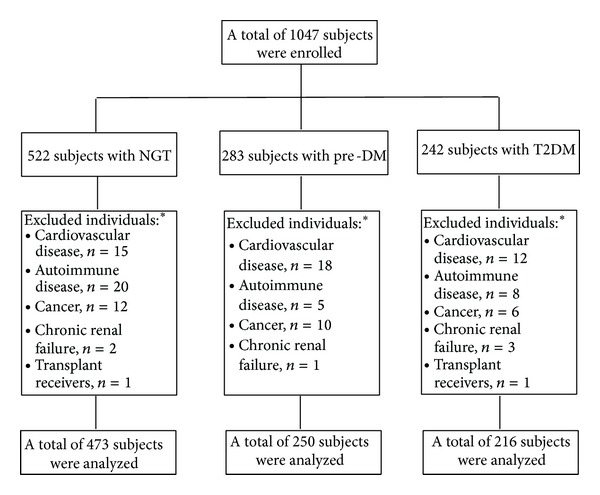
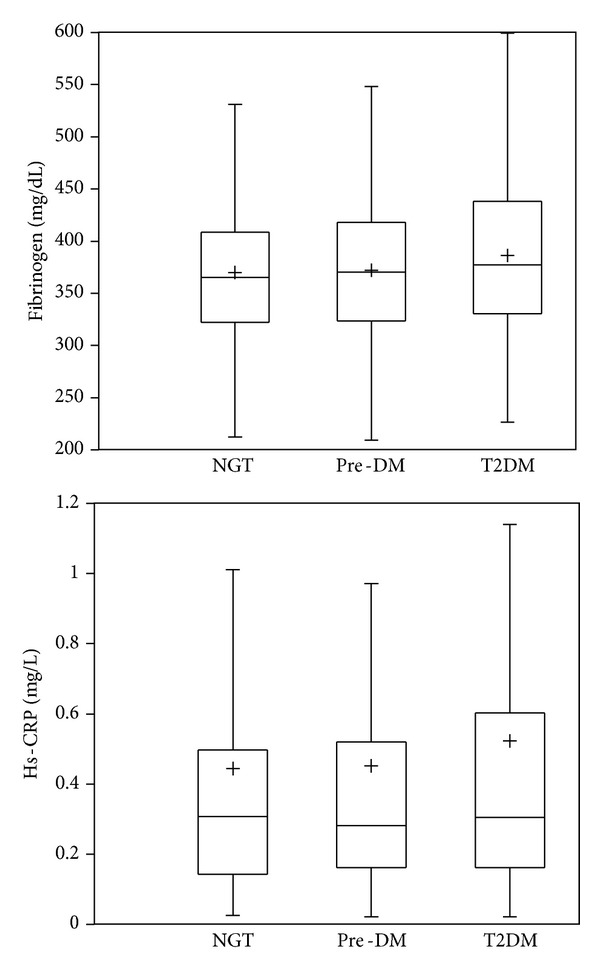
We enrolled 1047 individuals and they were distributed into NGT n = 473, pre-DM n = 250, and T2DM n = 216. There was a statistical difference between NGT and T2DM groups for fibrinogen (P = 0.01) and hs-CRP (P = 0.05). Fibrinogen and hs-CRP showed a significant positive correlation coefficient (r = 0.53, P<0.0001). In a multiple stepwise regression analysis, the variability in fibrinogen levels was explained by age, HbA1c, and hs-CRP (adjusted R² = 0.31, P<0.0001), and for hs-CRP it was explained by BMI and fibrinogen (adjusted R² = 0.33, P<0.0001).
Inflammation and prothrombotic state are present in people with T2DM lacking cardiovascular disease. Fibrinogen and Hs-CRP are positively correlated. Fibrinogen and hs-CRP concentrations are predominantly determined by BMI rather than glucose levels.
炎症与胰岛素抵抗、2型糖尿病(T2DM)及动脉粥样硬化血栓形成有关。
确定血糖正常(NGT)、糖尿病前期和T2DM患者中促炎和促血栓形成标志物如高敏C反应蛋白(hs-CRP)和纤维蛋白原水平的差异,并在心血管疾病临床表现出现之前确定它们与其他心血管危险因素的关系。
我们在墨西哥城的一家医院进行了一项非随机横断面分析。根据糖耐量状态测量并比较hs-CRP和纤维蛋白原水平。
我们纳入了1047名个体,他们被分为NGT组(n = 473)、糖尿病前期组(n = 250)和T2DM组(n = 216)。NGT组和T2DM组之间的纤维蛋白原(P = 0.01)和hs-CRP(P = 0.05)存在统计学差异。纤维蛋白原和hs-CRP显示出显著的正相关系数(r = 0.53,P<0.0001)。在多元逐步回归分析中,纤维蛋白原水平的变异性由年龄、糖化血红蛋白和hs-CRP解释(调整R² = 0.31,P<0.0001),而hs-CRP的变异性由体重指数和纤维蛋白原解释(调整R² = 0.33,P<0.0001)。
缺乏心血管疾病的T2DM患者存在炎症和促血栓形成状态。纤维蛋白原和Hs-CRP呈正相关。纤维蛋白原和hs-CRP浓度主要由体重指数而非血糖水平决定。