Department of Medicine, University of Otago, Christchurch 8011, New Zealand.
Lipid and Diabetes Research Group, Canterbury District Health Board, Christchurch 8011, New Zealand.
Nutrients. 2017 Sep 9;9(9):997. doi: 10.3390/nu9090997.
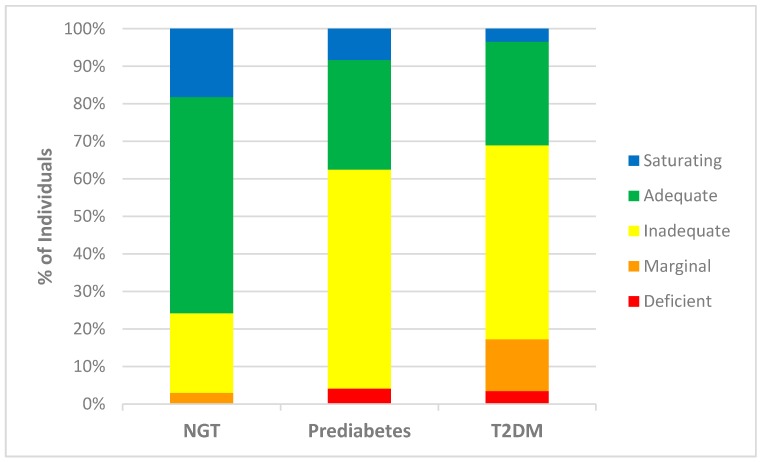
Vitamin C (ascorbate) is an essential micronutrient in humans, being required for a number of important biological functions via acting as an enzymatic cofactor and reducing agent. There is some evidence to suggest that people with type 2 diabetes mellitus (T2DM) have lower plasma vitamin C concentrations compared to those with normal glucose tolerance (NGT). The aim of this study was to investigate plasma vitamin C concentrations across the glycaemic spectrum and to explore correlations with indices of metabolic health. This is a cross-sectional observational pilot study in adults across the glycaemic spectrum from NGT to T2DM. Demographic and anthropometric data along with information on physical activity were collected and participants were asked to complete a four-day weighed food diary. Venous blood samples were collected and glycaemic indices, plasma vitamin C concentrations, hormone tests, lipid profiles, and high-sensitivity C-reactive protein (hs-CRP) were analysed. A total of 89 participants completed the study, including individuals with NGT ( = 35), prediabetes ( = 25), and T2DM managed by diet alone or on a regimen of Metformin only ( = 29). Plasma vitamin C concentrations were significantly lower in individuals with T2DM compared to those with NGT (41.2 µmol/L versus 57.4 µmol/L, < 0.05) and a higher proportion of vitamin C deficiency (i.e. <11.0 µmol/L) was observed in both the prediabetes and T2DM groups. The results showed fasting glucose ( = 0.001), BMI ( = 0.001), smoking history ( = 0.003), and dietary vitamin C intake ( = 0.032) to be significant independent predictors of plasma vitamin C concentrations. In conclusion, these results suggest that adults with a history of smoking, prediabetes or T2DM, and/or obesity, have greater vitamin C requirements. Future research is required to investigate whether eating more vitamin C rich foods and/or taking vitamin C supplements may reduce the risk of progression to, and/or complications associated with, T2DM.
维生素 C(抗坏血酸)是人体必需的微量营养素,通过作为酶辅因子和还原剂发挥作用,对许多重要的生物学功能至关重要。有一些证据表明,2 型糖尿病(T2DM)患者的血浆维生素 C 浓度低于葡萄糖耐量正常(NGT)的患者。本研究旨在调查血糖谱范围内的血浆维生素 C 浓度,并探讨其与代谢健康指标的相关性。这是一项在血糖谱范围内从 NGT 到 T2DM 的成年人中进行的横断面观察性试点研究。收集了人口统计学和人体测量学数据以及有关身体活动的信息,并要求参与者完成为期四天的称重食物日记。采集静脉血样,分析血糖指数、血浆维生素 C 浓度、激素测试、血脂谱和高敏 C 反应蛋白(hs-CRP)。共有 89 名参与者完成了这项研究,包括 NGT 组(n=35)、糖尿病前期组(n=25)和仅通过饮食或二甲双胍治疗的 T2DM 组(n=29)。与 NGT 相比,T2DM 患者的血浆维生素 C 浓度明显较低(41.2µmol/L 比 57.4µmol/L,<0.05),且糖尿病前期和 T2DM 组中维生素 C 缺乏(即<11.0µmol/L)的比例更高。结果表明,空腹血糖(=0.001)、BMI(=0.001)、吸烟史(=0.003)和膳食维生素 C 摄入量(=0.032)是血浆维生素 C 浓度的显著独立预测因子。总之,这些结果表明,有吸烟史、糖尿病前期或 T2DM 史以及/或肥胖的成年人有更高的维生素 C 需求。需要进一步的研究来探讨是否增加富含维生素 C 的食物的摄入量和/或服用维生素 C 补充剂是否可以降低进展为 T2DM 以及/或与 T2DM 相关的并发症的风险。