Department of Biomedical Engineering, California Baptist University, 8432 Magnolia Avenue, Riverside, CA 92504, USA.
J Neuroeng Rehabil. 2014 Apr 28;11:74. doi: 10.1186/1743-0003-11-74.
Gait rehabilitation often utilizes correction of stepping movements, and visual feedback is one of the interactive forms that can be used for rehabilitation. We presented a paradigm called visual feedback distortion in which we manipulated the visual representation of step length. Our previous work showed that an implicit distortion of visual feedback of step length entails unintentional modulations in the subjects' gait spatial pattern. Even in the presence of cognitive load through a distraction task, distortion of visual feedback still induced modulation of gait step length. In the current study, subjects were aware of the imposed distortion of visual feedback and they were instructed to maintain their natural gait symmetric pattern during trials. We then studied whether such an explicit "visual feedback distortion" would still influence gait spatial pattern.
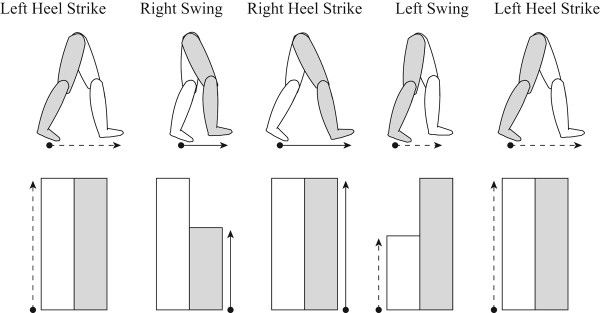
Nine healthy subjects participated in the treadmill walking trial. The step length was defined as the distance between each foot. The on-line visual feedback showing right and left step length information as bar graphs was displayed on a computer screen. When distorting the visual feedback, the height of the bar for only one side was manipulated, so that subjects perceived their step length as being asymmetric. Actual step lengths were measured during trial and analyzed to see the effects of visual feedback distortion.
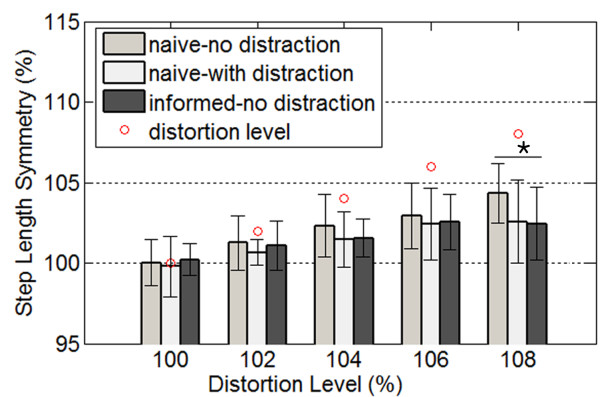
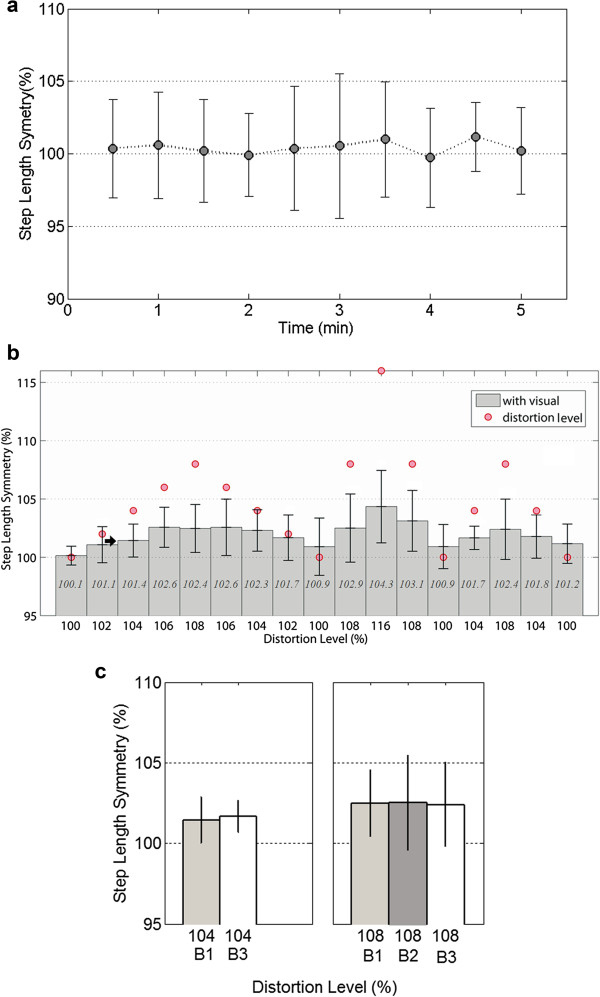
Our results showed that a gradual distortion of visual feedback systematically modulated gait step length away from symmetry even at the expense of an opposing apparent task goal. It was also observed that the amount of induced gait modulation was reduced during the explicit condition compared to the implicit condition where subjects were not aware of distortion.
Our study demonstrated that although the visual feedback display used in this study did not alter visual space or evoke illusions of motion, perturbation of visual information about subjects' movement can cause unintentional motor functions. This suggests that the effect of visual feedback distortion is spontaneous and a gait training involving the visual distortion paradigm may provide an effective way to help subjects correct gait patterns by driving implicit motor functions, thereby bringing benefits to rehabilitation.
步态康复通常利用对迈步动作的纠正,而视觉反馈是可用于康复的一种互动形式。我们提出了一种称为视觉反馈失真的范式,其中我们操纵步长的视觉表示。我们之前的工作表明,对步长视觉反馈的隐性失真会导致受试者步态空间模式的无意识调节。即使在通过分心任务施加认知负荷的情况下,视觉反馈的失真仍然会引起步长的步态调节。在当前的研究中,受试者意识到所施加的视觉反馈失真,并被指示在试验中保持其自然的步态对称模式。然后,我们研究了这种明确的“视觉反馈失真”是否仍会影响步态空间模式。
9 名健康受试者参加了跑步机行走试验。步长定义为每只脚之间的距离。在线显示右和左步长信息的条形图的视觉反馈显示在计算机屏幕上。当失真视觉反馈时,仅操纵一侧的条形图的高度,使得受试者感觉到他们的步长不对称。在试验期间测量实际步长并进行分析,以观察视觉反馈失真的效果。
我们的结果表明,即使以牺牲相反的明显任务目标为代价,视觉反馈的逐渐失真也会系统地调节步态步长,使其远离对称。还观察到,在明确条件下,与受试者不知道失真的隐含条件相比,诱导的步态调节量减少。
我们的研究表明,尽管本研究中使用的视觉反馈显示没有改变视觉空间或引起运动错觉,但对受试者运动的视觉信息的干扰会导致无意识的运动功能。这表明视觉反馈失真的效果是自发的,涉及视觉失真范式的步态训练可能通过驱动隐性运动功能为患者提供一种有效的方法来帮助他们纠正步态模式,从而为康复带来益处。