Departments of Chemical Engineering, Chemistry, and Biochemistry, Stanford University , Stanford, California 94305, United States.
Biochemistry. 2014 May 13;53(18):2875-83. doi: 10.1021/bi500290t. Epub 2014 May 1.
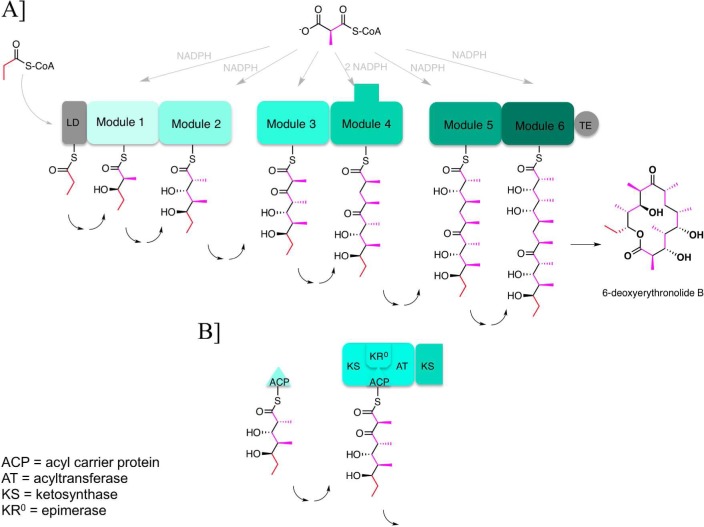
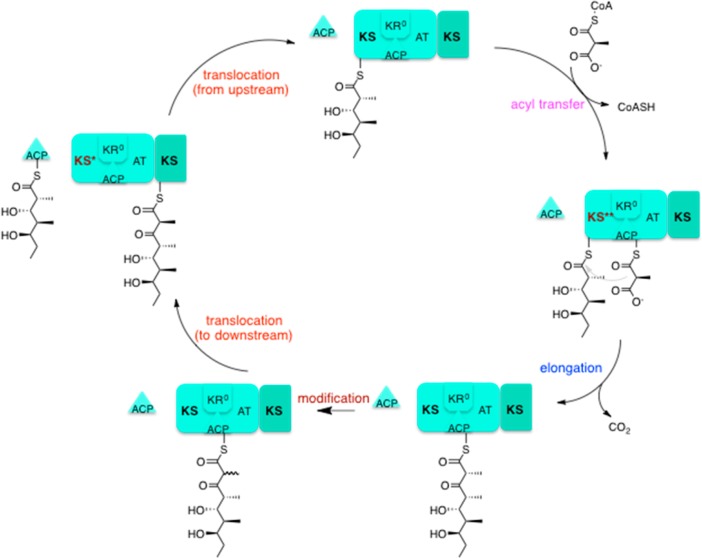
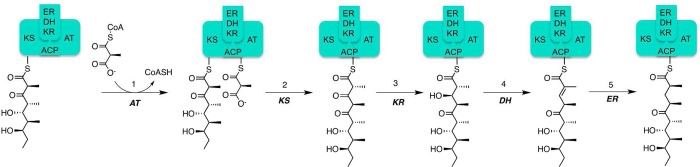
Two hallmarks of assembly line polyketide synthases have motivated an interest in these unusual multienzyme systems, their stereospecificity and their capacity for directional biosynthesis. In this review, we summarize the state of knowledge regarding the mechanistic origins of these two remarkable features, using the 6-deoxyerythronolide B synthase as a prototype. Of the 10 stereocenters in 6-deoxyerythronolide B, the stereochemistry of nine carbon atoms is directly set by ketoreductase domains, which catalyze epimerization and/or diastereospecific reduction reactions. The 10th stereocenter is established by the sequential action of three enzymatic domains. Thus, the problem has been reduced to a challenge in mainstream enzymology, where fundamental gaps remain in our understanding of the structural basis for this exquisite stereochemical control by relatively well-defined active sites. In contrast, testable mechanistic hypotheses for the phenomenon of vectorial biosynthesis are only just beginning to emerge. Starting from an elegant theoretical framework for understanding coupled vectorial processes in biology [Jencks, W. P. (1980) Adv. Enzymol. Relat. Areas Mol. Biol. 51, 75-106], we present a simple model that can explain assembly line polyketide biosynthesis as a coupled vectorial process. Our model, which highlights the important role of domain-domain interactions, not only is consistent with recent observations but also is amenable to further experimental verification and refinement. Ultimately, a definitive view of the coordinated motions within and between polyketide synthase modules will require a combination of structural, kinetic, spectroscopic, and computational tools and could be one of the most exciting frontiers in 21st Century enzymology.
装配线聚酮合酶的两个特征标志激发了人们对这些不寻常的多酶系统的兴趣,其立体特异性和定向生物合成能力。在这篇综述中,我们以 6-脱氧红霉内酯 B 合酶为原型,总结了关于这两个显著特征的机械起源的知识状态。在 6-脱氧红霉内酯 B 的 10 个手性中心中,9 个碳原子的立体化学直接由酮还原酶结构域设定,酮还原酶结构域催化差向异构化和/或立体特异性还原反应。第 10 个手性中心由三个酶结构域的顺序作用建立。因此,问题已经简化为主流酶学中的一个挑战,在主流酶学中,我们对相对定义明确的活性位点对这种精致的立体化学控制的结构基础的理解仍然存在根本差距。相比之下,关于定向生物合成现象的可测试机械假设才刚刚开始出现。从理解生物学中耦合定向过程的优雅理论框架[Jencks,WP(1980)Adv。Enzymol。Relat。Areas Mol。Biol。51,75-106]开始,我们提出了一个简单的模型,可以将装配线聚酮生物合成解释为耦合定向过程。我们的模型突出了结构域-结构域相互作用的重要作用,不仅与最近的观察结果一致,而且易于进一步的实验验证和改进。最终,在聚酮合酶模块内部和之间协调运动的明确观点将需要结构、动力学、光谱学和计算工具的组合,并且可能成为 21 世纪酶学中最令人兴奋的前沿之一。