Johnson D H, Khanna S, Smyrk T C, Loftus E V, Anderson K S, Mahoney D W, Ahlquist D A, Kisiel J B
Divsion of Internal Medicine, Mayo Clinic, Rochester, MN, USA.
Aliment Pharmacol Ther. 2014 Jun;39(12):1408-17. doi: 10.1111/apt.12774. Epub 2014 Apr 30.
Chronic ulcerative colitis (CUC) and colonic Crohn's disease (CD) increase colorectal neoplasia (CRN) risk. While sessile serrated polyp (SSP) is a known cancer precursor, serrated epithelial changes (SEC) are of uncertain prevalence and neoplastic risk.
To assess the serrated lesion detection rates in CUC and CD and documented incidence of subsequent CRN in a retrospective, single-centre cohort study.
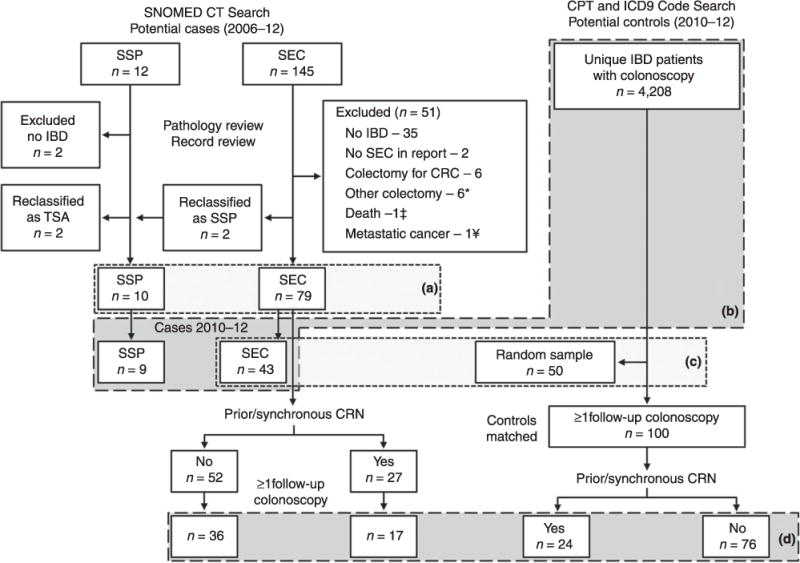
Patients were identified by a central diagnostic index and pathology review confirmed SEC, SSP, CUC and CD diagnoses from 2006-12. Matched controls were identified from among all CUC and CD patients having colonoscopy during the second half of the time period. All were followed for incident CRN, estimated by the Kaplan-Meier method.
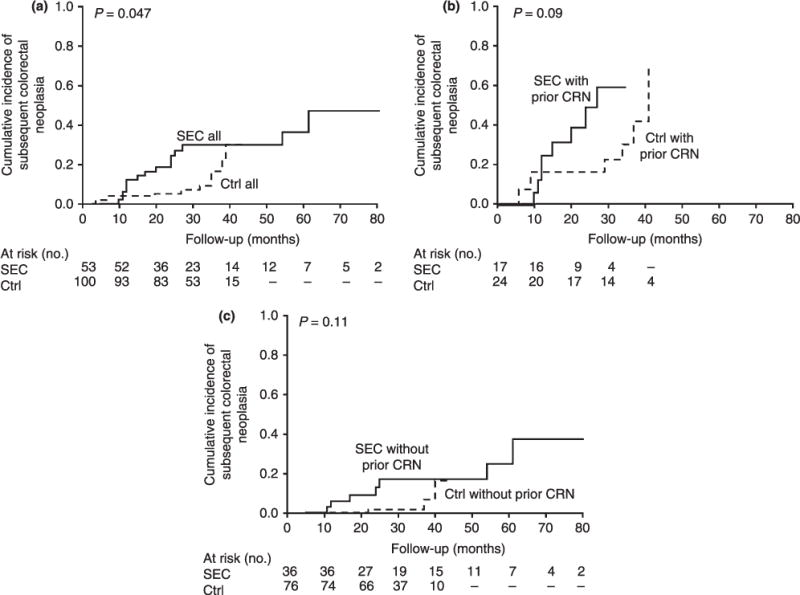
Between 2006 and 2012, 79 SEC and 10 SSP cases were identified. Detection rates were estimated to be 10/1000 and 2/1000 patients, for SEC and SSP respectively, among 4208 unique CUC or CD patients having colonoscopy from 2010-12. With only 10 cases, SSP patients were not further analysed. Cumulative incidence of subsequent CRN at 1 and 3 years was 12% (95% CI, 0-30%) and 30% (3-57%), respectively, in SEC patients compared to 4% (0-12%) and 9% (0-23%), respectively, in CUC or CD controls (P = 0.047, log-rank). However, this statistical difference was not significant after patients were stratified for history of prior or synchronous dysplasia (P = 0.09).
Serrated epithelial changes and sessile serrated polyps are uncommonly detected by colonoscopy in chronic ulcerative colitis and Crohn's disease patients. Histology with changes of serrated epithelium may be associated with risk of subsequent colorectal neoplasia, however further studies are needed to explore this relationship.
慢性溃疡性结肠炎(CUC)和结肠克罗恩病(CD)会增加结直肠肿瘤(CRN)风险。虽然无蒂锯齿状息肉(SSP)是已知的癌症前体,但锯齿状上皮改变(SEC)的患病率和肿瘤风险尚不确定。
在一项回顾性单中心队列研究中,评估CUC和CD中锯齿状病变的检出率以及随后记录的CRN发病率。
通过中央诊断指数识别患者,并经病理检查确认2006年至2012年期间的SEC、SSP、CUC和CD诊断。匹配的对照组从该时间段后半期接受结肠镜检查的所有CUC和CD患者中识别。所有患者均随访新发CRN情况,采用Kaplan-Meier方法估计。
2006年至2012年期间,共识别出79例SEC和10例SSP病例。在2010年至2012年接受结肠镜检查的4208例独特的CUC或CD患者中,SEC和SSP的检出率分别估计为每1000例患者中有10例和2例。由于只有10例SSP患者,未对其进行进一步分析。SEC患者1年和3年后新发CRN的累积发病率分别为12%(95%CI,0 - 30%)和30%(3 - 57%),而CUC或CD对照组分别为4%(0 - 12%)和9%(0 - 23%)(P = 0.047,对数秩检验)。然而,在根据既往或同步发育异常病史对患者进行分层后,这种统计学差异并不显著(P = 0.09)。
在慢性溃疡性结肠炎和克罗恩病患者中,结肠镜检查很少能检测到锯齿状上皮改变和无蒂锯齿状息肉。具有锯齿状上皮改变的组织学特征可能与随后的结直肠肿瘤风险相关,然而需要进一步研究来探讨这种关系。