Daveson Barbara A, Harding Richard, Shipman Cathy, Mason Bruce L, Epiphaniou Eleni, Higginson Irene J, Ellis-Smith Clare, Henson Lesley, Munday Dan, Nanton Veronica, Dale Jeremy R, Boyd Kirsty, Worth Allison, Barclay Stephen, Donaldson Anne, Murray Scott
King's College London, Department of Palliative Care, Policy & Rehabilitation, Cicely Saunders Institute, London, United Kingdom.
University of Edinburgh, Centre for Population Health Sciences, Medical School, Edinburgh, United Kingdom.
PLoS One. 2014 May 2;9(5):e95523. doi: 10.1371/journal.pone.0095523. eCollection 2014.
To develop a model of care coordination for patients living with advanced progressive illness and their unpaid caregivers, and to understand their perspective regarding care coordination.
A prospective longitudinal, multi-perspective qualitative study involving a case-study approach.
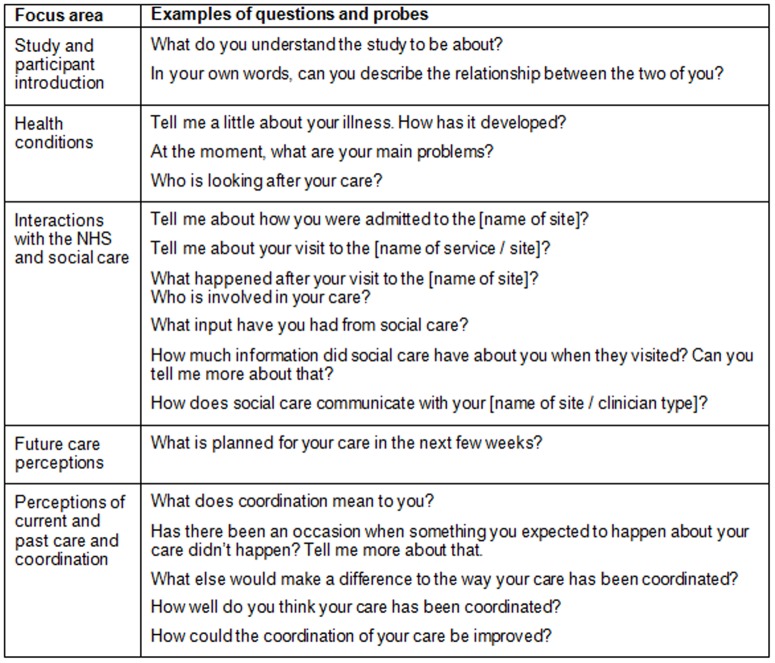
Serial in-depth interviews were conducted, transcribed verbatim and then analyzed through open and axial coding in order to construct categories for three cases (sites). This was followed by continued thematic analysis to identify underlying conceptual coherence across all cases in order to produce one coherent care coordination model.
Fifty-six purposively sampled patients and 27 case-linked unpaid caregivers.
Three cases from contrasting primary, secondary and tertiary settings within Britain.
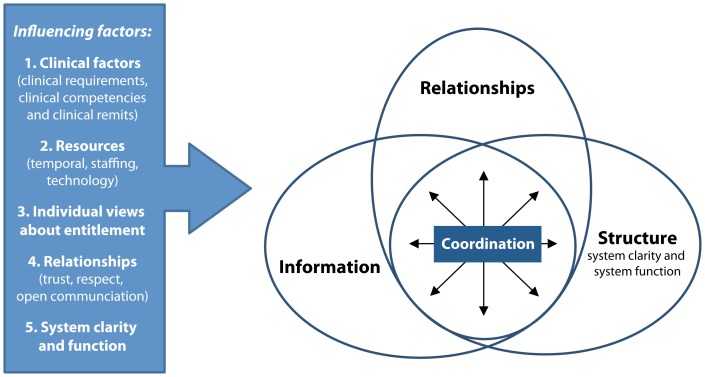
Coordination is a deliberate cross-cutting action that involves high-quality, caring and well-informed staff, patients and unpaid caregivers who must work in partnership together across health and social care settings. For coordination to occur, it must be adequately resourced with efficient systems and services that communicate. Patients and unpaid caregivers contribute substantially to the coordination of their care, which is sometimes volunteered at a personal cost to them. Coordination is facilitated through flexible and patient-centered care, characterized by accurate and timely information communicated in a way that considers patients' and caregivers' needs, preferences, circumstances and abilities.
Within the midst of advanced progressive illness, coordination is a shared and complex intervention involving relational, structural and information components. Our study is one of the first to extensively examine patients' and caregivers' views about coordination, thus aiding conceptual fidelity. These findings can be used to help avoid oversimplifying a real-world problem, such as care coordination. Avoiding oversimplification can help with the development, evaluation and implementation of real-world coordination interventions for patients and their unpaid caregivers in the future.
为患有晚期进行性疾病的患者及其无偿照护者建立一种护理协调模式,并了解他们对护理协调的看法。
一项前瞻性纵向、多视角的定性研究,采用案例研究方法。
进行系列深入访谈,逐字转录,然后通过开放式编码和轴心式编码进行分析,以便为三个案例(地点)构建类别。随后进行持续的主题分析,以确定所有案例中潜在的概念连贯性,从而产生一个连贯的护理协调模式。
56名经过有目的抽样的患者和27名与案例相关的无偿照护者。
来自英国不同的初级、二级和三级医疗机构的三个案例。
协调是一种经过深思熟虑的贯穿各领域的行动,涉及高素质、有爱心且见多识广的工作人员、患者和无偿照护者,他们必须在卫生和社会护理环境中共同合作。为了实现协调,必须为其提供充足资源,具备高效的沟通系统和服务。患者和无偿照护者在很大程度上参与了自身护理的协调,有时这是以他们个人的代价自愿进行的。通过灵活且以患者为中心的护理来促进协调,其特点是以一种考虑患者和照护者的需求、偏好、情况和能力的方式传达准确及时的信息。
在晚期进行性疾病的背景下,协调是一种涉及关系、结构和信息要素的共同且复杂的干预措施。我们的研究是首批广泛考察患者和照护者对协调看法的研究之一,从而有助于概念的准确性。这些发现可用于帮助避免过度简化诸如护理协调这样的现实世界问题。避免过度简化有助于未来为患者及其无偿照护者开发、评估和实施现实世界的协调干预措施。