van der Mark Marianne, Nijssen Peter C G, Vlaanderen Jelle, Huss Anke, Mulleners Wim M, Sas Antonetta M G, van Laar Teus, Kromhout Hans, Vermeulen Roel
Division of Environmental Epidemiology, Institute for Risk Assessment Sciences, Utrecht University, Utrecht, the Netherlands.
Department of Neurology, St Elisabeth Hospital, Tilburg, the Netherlands; Department of Neurology, TweeSteden Hospital, Tilburg, the Netherlands.
PLoS One. 2014 Apr 30;9(4):e95297. doi: 10.1371/journal.pone.0095297. eCollection 2014.
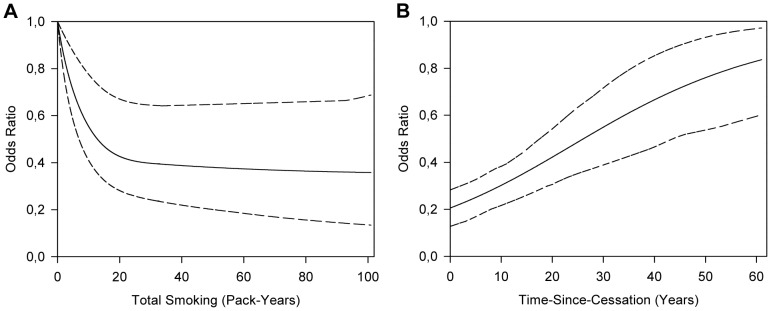
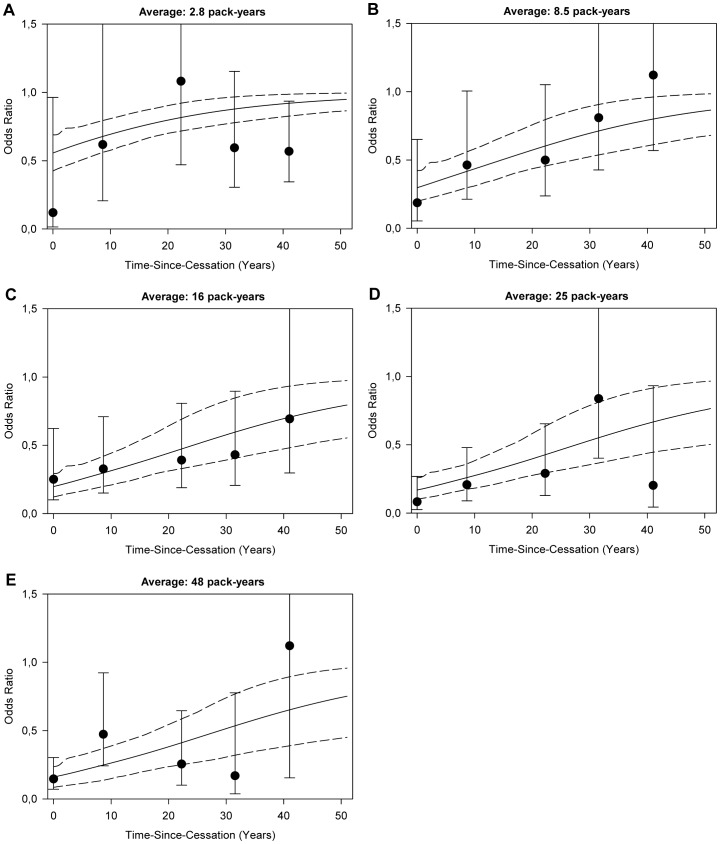
The aim of this study was to investigate the possible reduced risk of Parkinson Disease (PD) due to coffee, alcohol, and/or cigarette consumption. In addition, we explored the potential effect modification by intensity, duration and time-since-cessation of smoking on the association between cumulative pack-years of cigarette smoking (total smoking) and PD risk. Data of a hospital based case-control study was used including 444 PD patients, diagnosed between 2006 and 2011, and 876 matched controls from 5 hospitals in the Netherlands. A novel modeling method was applied to derive unbiased estimates of the potential modifying effects of smoking intensity, duration, and time-since-cessation by conditioning on total exposure. We observed no reduced risk of PD by alcohol consumption and only a weak inverse association between coffee consumption and PD risk. However, a strong inverse association of total smoking with PD risk was observed (OR=0.27 (95%CI: 0.18-0.42) for never smokers versus highest quartile of tobacco use). The observed protective effect of total smoking was significantly modified by time-since-cessation with a diminishing protective effect after cessation of smoking. No effect modification by intensity or duration of smoking was observed indicating that both intensity and duration have an equal contribution to the reduced PD risk. Understanding the dynamics of the protective effect of smoking on PD risk aids in understanding PD etiology and may contribute to strategies for prevention and treatment.
本研究的目的是调查因饮用咖啡、酒精和/或吸烟导致帕金森病(PD)风险可能降低的情况。此外,我们探讨了吸烟强度、持续时间和戒烟时长对吸烟累积包年数(总吸烟量)与PD风险之间关联的潜在效应修正作用。使用了一项基于医院的病例对照研究数据,包括2006年至2011年期间诊断的444例PD患者以及来自荷兰5家医院的876名匹配对照。应用了一种新的建模方法,通过对总暴露进行条件设定来得出吸烟强度、持续时间和戒烟时长潜在修正效应的无偏估计。我们观察到饮酒并未降低PD风险,咖啡消费与PD风险之间仅存在微弱的负相关。然而,观察到总吸烟量与PD风险之间存在强烈的负相关(从不吸烟者与烟草使用最高四分位数者相比,OR = 0.27(95%CI:0.18 - 0.42))。观察到的总吸烟量的保护作用因戒烟时长而有显著修正,戒烟后保护作用逐渐减弱。未观察到吸烟强度或持续时间的效应修正,这表明强度和持续时间对降低PD风险的贡献相同。了解吸烟对PD风险的保护作用动态有助于理解PD病因,并可能有助于制定预防和治疗策略。