Infrastructure for Systems Biology Europe (ISBE.NL), Amsterdam, The Netherlands.
Luxembourg Centre for Systems Biomedicine, University of Luxembourg, Esch-sur-Alzette, Luxembourg.
NPJ Syst Biol Appl. 2020 Oct 26;6(1):34. doi: 10.1038/s41540-020-00150-w.
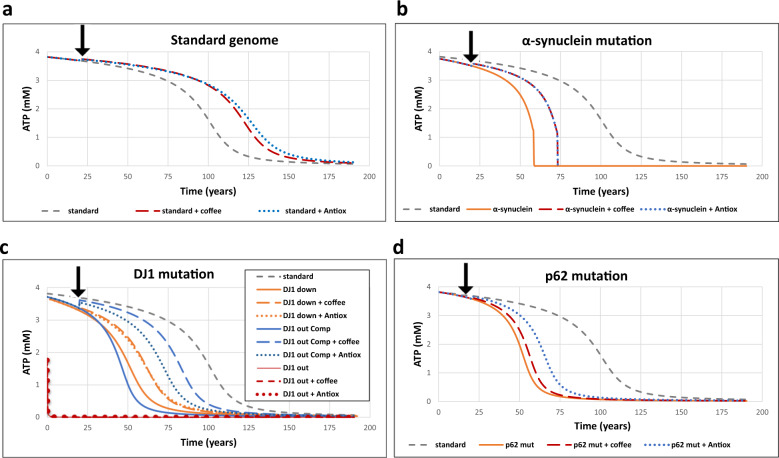
How the network around ROS protects against oxidative stress and Parkinson's disease (PD), and how processes at the minutes timescale cause disease and aging after decades, remains enigmatic. Challenging whether the ROS network is as complex as it seems, we built a fairly comprehensive version thereof which we disentangled into a hierarchy of only five simpler subnetworks each delivering one type of robustness. The comprehensive dynamic model described in vitro data sets from two independent laboratories. Notwithstanding its five-fold robustness, it exhibited a relatively sudden breakdown, after some 80 years of virtually steady performance: it predicted aging. PD-related conditions such as lack of DJ-1 protein or increased α-synuclein accelerated the collapse, while antioxidants or caffeine retarded it. Introducing a new concept (aging-time-control coefficient), we found that as many as 25 out of 57 molecular processes controlled aging. We identified new targets for "life-extending interventions": mitochondrial synthesis, KEAP1 degradation, and p62 metabolism.
ROS 网络如何抵御氧化应激和帕金森病 (PD),以及在数分钟时间尺度上的过程如何在数十年后导致疾病和衰老,仍然是个谜。为了挑战 ROS 网络是否像看起来那样复杂,我们构建了一个相当全面的版本,并将其分解为仅由五个更简单的子网组成的层次结构,每个子网提供一种稳健性。这个综合的动态模型描述了来自两个独立实验室的体外数据集。尽管它具有五倍的稳健性,但在经过大约 80 年几乎稳定的性能之后,它还是突然崩溃了:它预测了衰老。缺乏 DJ-1 蛋白或增加 α-突触核蛋白等与 PD 相关的情况会加速崩溃,而抗氧化剂或咖啡因则会减缓崩溃。通过引入一个新概念(衰老时间控制系数),我们发现多达 57 个分子过程中的 25 个控制着衰老。我们确定了新的“延长寿命干预”目标:线粒体合成、KEAP1 降解和 p62 代谢。