Wong Carlos K H, Wong William C W, Lam Cindy L K, Wan Y F, Wong Winnie H T, Chung K L, Dai Daisy, Tsui Eva L H, Fong Daniel Y T
Department of Family Medicine and Primary Care, The University of Hong Kong, Hong Kong.
Integrated Care Programs, Hospital Authority Head Office, Hong Kong Hospital Authority, Kowloon, Hong Kong.
PLoS One. 2014 May 1;9(5):e95328. doi: 10.1371/journal.pone.0095328. eCollection 2014.
To evaluate the effects of a large population-based patient empowerment programme (PEP) on clinical outcomes and health service utilization rates in type 2 diabetes mellitus (T2DM) patients in the primary care setting.
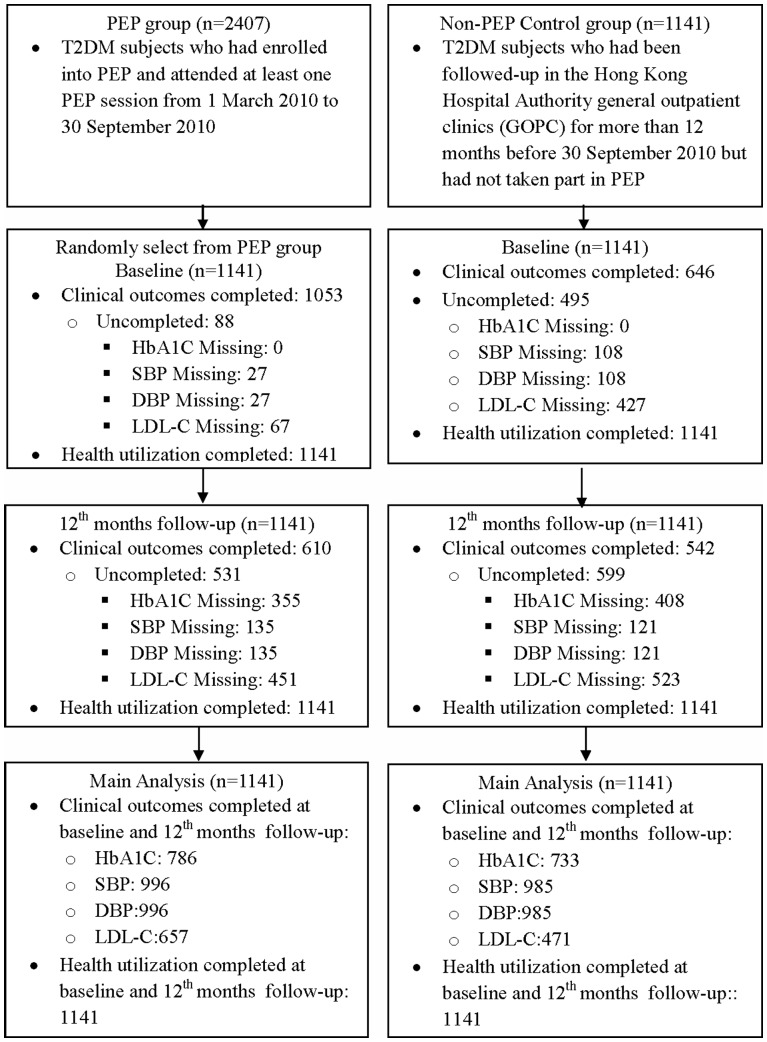
A stratified random sample of 1,141 patients with T2DM enrolled to PEP between March and September 2010 were selected from general outpatient clinics (GOPC) across Hong Kong and compared with an equal number of T2DM patients who had not participated in the PEP (non-PEP group) matched by age, sex and HbA1C level group.
Clinical outcomes of HbA1c, SBP, DBP and LDL-C levels, and health service utilization rates including numbers of visits to GOPC, specialist outpatient clinics (SOPC), emergency department (ED) and inpatient admissions, were measured at baseline and at 12-month post-recruitment. The effects of PEP on clinical outcomes and health service utilization rates were assessed by the difference-in-difference estimation, using the generalized estimating equation models.
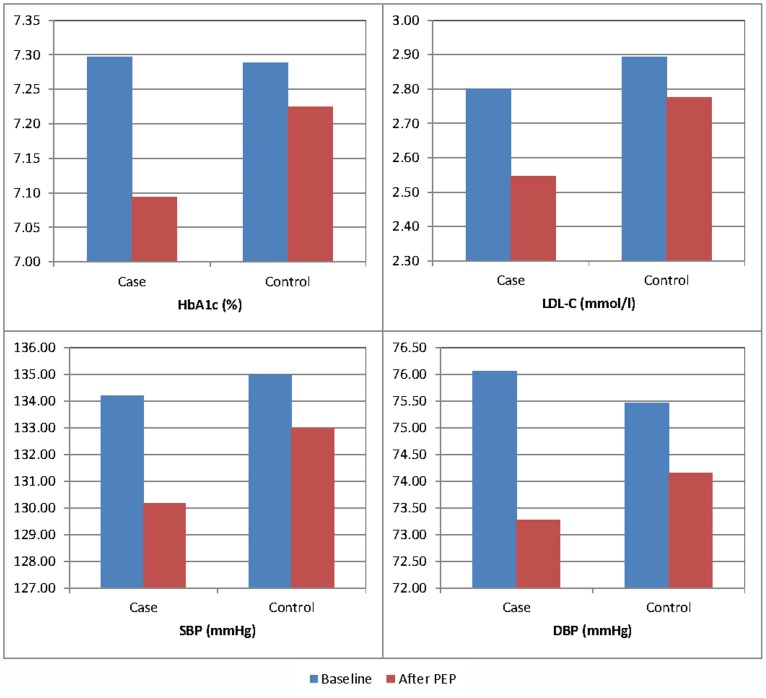
Compared with non-PEP group, PEP group achieved additional improvements in clinical outcomes over the 12-month period. A significantly greater percentage of patients in the PEP group attained HbA1C≤7% or LDL-C≤2.6 mmol/L at 12-month follow-up compared with the non-PEP group. PEP group had a mean 0.813 fewer GOPC visits in comparison with the non-PEP group.
PEP was effective in improving the clinical outcomes and reduced the general outpatient clinic utilization rate over a 12-month period. Empowering T2DM patients on self-management of their disease can enhance the quality of diabetes care in primary care.
ClinicalTrials.gov NCT01935349.
评估一项基于大量人群的患者赋权计划(PEP)对基层医疗环境中2型糖尿病(T2DM)患者临床结局和医疗服务利用率的影响。
从香港各地的普通门诊诊所(GOPC)中选取了2010年3月至9月期间纳入PEP的1141例T2DM患者作为分层随机样本,并与同等数量未参与PEP的T2DM患者(非PEP组)进行比较,后者按年龄、性别和糖化血红蛋白(HbA1C)水平分组进行匹配。
在基线和招募后12个月时测量糖化血红蛋白(HbA1c)、收缩压(SBP)、舒张压(DBP)和低密度脂蛋白胆固醇(LDL-C)水平的临床结局,以及医疗服务利用率,包括前往GOPC、专科门诊诊所(SOPC)、急诊科(ED)就诊的次数和住院次数。采用广义估计方程模型,通过差异-in-差异估计法评估PEP对临床结局和医疗服务利用率的影响。
与非PEP组相比,PEP组在12个月期间临床结局有额外改善。在12个月随访时,PEP组达到糖化血红蛋白≤7%或低密度脂蛋白胆固醇≤2.6 mmol/L的患者比例显著高于非PEP组。与非PEP组相比,PEP组前往GOPC就诊的平均次数少0.813次。
PEP在12个月期间有效改善了临床结局并降低了普通门诊诊所的利用率。赋予T2DM患者疾病自我管理的权力可提高基层医疗中糖尿病护理的质量。
ClinicalTrials.gov NCT01935349。