Sridhar Sneha B, Xu Fei, Darbinian Jeanne, Quesenberry Charles P, Ferrara Assiamira, Hedderson Monique M
Division of Research, Kaiser Permanente Northern California, Oakland, CA
Division of Research, Kaiser Permanente Northern California, Oakland, CA.
Diabetes Care. 2014 Jul;37(7):1878-84. doi: 10.2337/dc13-2229. Epub 2014 May 2.
Liver enzymes are independent predictors of type 2 diabetes. Although liver fat content correlates with features of insulin resistance, a risk factor for developing gestational diabetes mellitus (GDM), the relationship between liver enzymes and GDM is unclear. The objective of this study was to assess whether pregravid liver enzyme levels are associated with subsequent risk of GDM.
A nested case-control study was conducted among women who participated in the Kaiser Permanente Northern California multiphasic health checkup (1984-1996) and had a subsequent pregnancy (1984-2009). Case patients were 256 women who developed GDM. Two control subjects were selected for each case patient and matched for year of blood draw, age at examination, age at pregnancy, and number of intervening pregnancies.
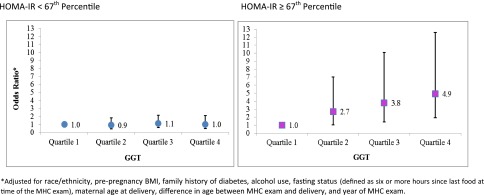
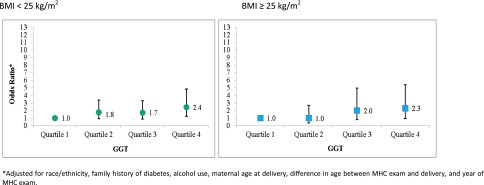
Being in the highest quartile versus the lowest quartile of γ-glutamyl transferase (GGT) levels was associated with a twofold increased risk of subsequent GDM (odds ratio 1.97 [95% CI 1.14-3.42]), after adjusting for race/ethnicity, prepregnancy BMI, family history of diabetes, and alcohol use. This result was attenuated after adjusting for homeostasis model assessment of insulin resistance (HOMA-IR), fasting status, and rate of gestational weight gain. There was significant interaction between GGT and HOMA-IR; the association with GGT was found among women in the highest tertile of HOMA-IR. Aspartate aminotransferase and alanine aminotransferase were not associated with increased GDM risk.
Pregravid GGT level, but not alanine aminotransferase or aspartate aminotransferase level, predicted the subsequent risk of GDM. Markers of liver fat accumulation, such as GGT level, are present years before pregnancy and may help to identify women at increased risk for subsequent GDM.
肝酶是2型糖尿病的独立预测指标。虽然肝脏脂肪含量与胰岛素抵抗特征相关,而胰岛素抵抗是发生妊娠期糖尿病(GDM)的一个危险因素,但肝酶与GDM之间的关系尚不清楚。本研究的目的是评估孕前肝酶水平是否与随后发生GDM的风险相关。
在参加北加利福尼亚凯撒医疗集团多阶段健康检查(1984 - 1996年)且随后怀孕(1984 - 2009年)的女性中进行了一项巢式病例对照研究。病例组为256例发生GDM的女性。为每个病例患者选择两名对照对象,并根据采血年份、检查时年龄、怀孕时年龄以及中间怀孕次数进行匹配。
在校正种族/族裔、孕前体重指数、糖尿病家族史和饮酒情况后,γ-谷氨酰转移酶(GGT)水平处于最高四分位数组与最低四分位数组相比,随后发生GDM的风险增加两倍(比值比1.97 [95%可信区间1.14 - 3.42])。在校正胰岛素抵抗的稳态模型评估(HOMA-IR)、空腹状态和孕期体重增加率后,这一结果有所减弱。GGT与HOMA-IR之间存在显著交互作用;在HOMA-IR最高三分位数组的女性中发现了与GGT的关联。天冬氨酸氨基转移酶和丙氨酸氨基转移酶与GDM风险增加无关。
孕前GGT水平而非丙氨酸氨基转移酶或天冬氨酸氨基转移酶水平可预测随后发生GDM的风险。肝脏脂肪堆积标志物,如GGT水平,在怀孕前数年就已存在,可能有助于识别随后发生GDM风险增加的女性。