Laboratory of Quantitative Neuromorphology, Psychology, Colorado College Colorado Springs, CO, USA.
Faculty of Health Sciences, School of Anatomical Sciences, University of the Witwatersrand Johannesburg, South Africa.
Front Neuroanat. 2014 Apr 23;8:24. doi: 10.3389/fnana.2014.00024. eCollection 2014.
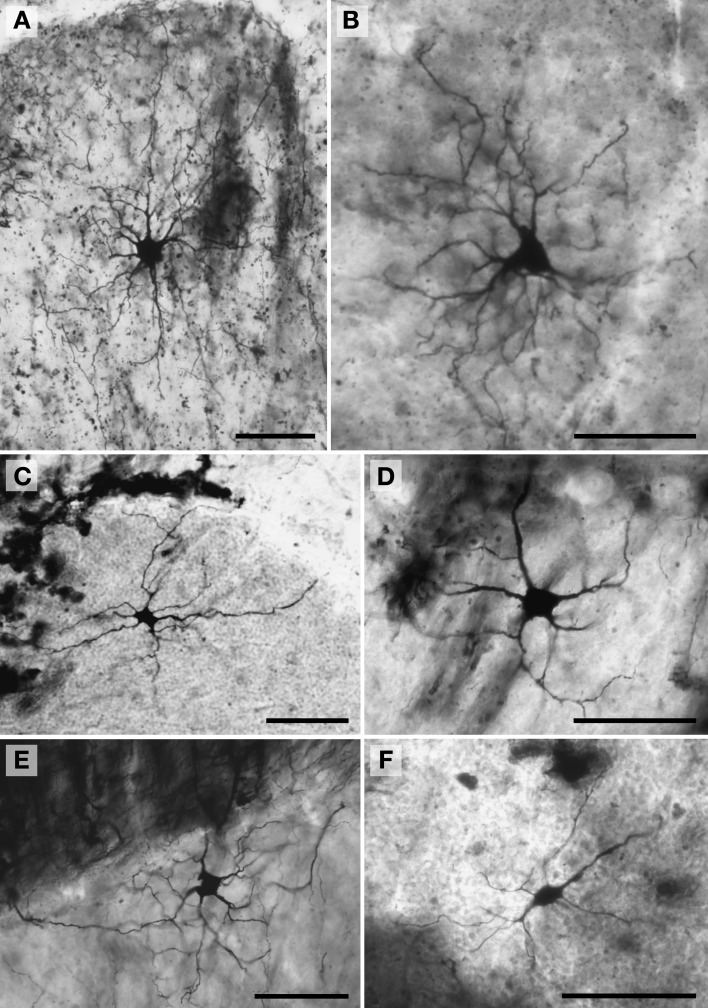
Although the basic morphological characteristics of neurons in the cerebellar cortex have been documented in several species, virtually nothing is known about the quantitative morphological characteristics of these neurons across different taxa. To that end, the present study investigated cerebellar neuronal morphology among eight different, large-brained mammalian species comprising a broad phylogenetic range: afrotherians (African elephant, Florida manatee), carnivores (Siberian tiger, clouded leopard), cetartiodactyls (humpback whale, giraffe) and primates (human, common chimpanzee). Specifically, several neuron types (e.g., stellate, basket, Lugaro, Golgi, and granule neurons; N = 317) of the cerebellar cortex were stained with a modified rapid Golgi technique and quantified on a computer-assisted microscopy system. There was a 64-fold variation in brain mass across species in our sample (from clouded leopard to the elephant) and a 103-fold variation in cerebellar volume. Most dendritic measures tended to increase with cerebellar volume. The cerebellar cortex in these species exhibited the trilaminate pattern common to all mammals. Morphologically, neuron types in the cerebellar cortex were generally consistent with those described in primates (Fox et al., 1967) and rodents (Palay and Chan-Palay, 1974), although there was substantial quantitative variation across species. In particular, Lugaro neurons in the elephant appeared to be disproportionately larger than those in other species. To explore potential quantitative differences in dendritic measures across species, MARSplines analyses were used to evaluate whether species could be differentiated from each other based on dendritic characteristics alone. Results of these analyses indicated that there were significant differences among all species in dendritic measures.
尽管已经在几种物种中记录了小脑皮层神经元的基本形态特征,但实际上对于这些神经元在不同分类群中的定量形态特征几乎一无所知。为此,本研究调查了包括广泛进化范围的 8 种不同的大型哺乳动物物种中的小脑神经元形态:非洲有蹄类动物(非洲象、佛罗里达海牛)、食肉动物(西伯利亚虎、云豹)、偶蹄目动物(座头鲸、长颈鹿)和灵长类动物(人类、普通黑猩猩)。具体来说,使用改良的快速 Golgi 技术对小脑皮层中的几种神经元类型(例如星状、篮状、Lugaro、Golgi 和颗粒神经元;N = 317)进行染色,并在计算机辅助显微镜系统上进行定量。在我们的样本中,物种间的脑质量差异有 64 倍(从云豹到大象),小脑体积差异有 103 倍。大多数树突测量值往往随小脑体积增加而增加。这些物种的小脑皮层表现出所有哺乳动物共有的三层模式。小脑皮层中的神经元类型通常与灵长类动物(Fox 等人,1967 年)和啮齿动物(Palay 和 Chan-Palay,1974 年)描述的类型一致,尽管物种间存在大量的定量差异。特别是大象中的 Lugaro 神经元似乎比其他物种的神经元明显更大。为了探索物种间树突测量值的潜在定量差异,使用 MARSplines 分析来评估仅基于树突特征是否可以将物种彼此区分开来。这些分析的结果表明,所有物种的树突测量值都存在显著差异。