Independent Researcher, Birmingham, United Kingdom.
Automated Scheduling, Optimisation and Planning (ASAP) research group, School of Computer Science, University of Nottingham, Nottingham, United Kingdom.
PLoS One. 2014 May 5;9(5):e95742. doi: 10.1371/journal.pone.0095742. eCollection 2014.
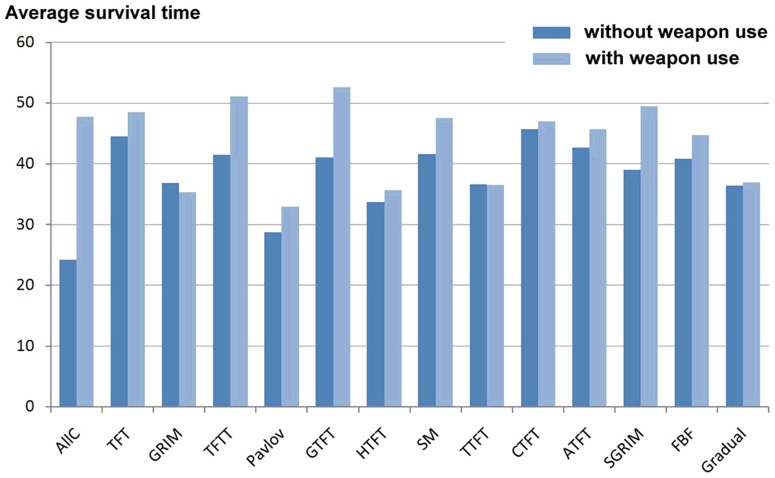
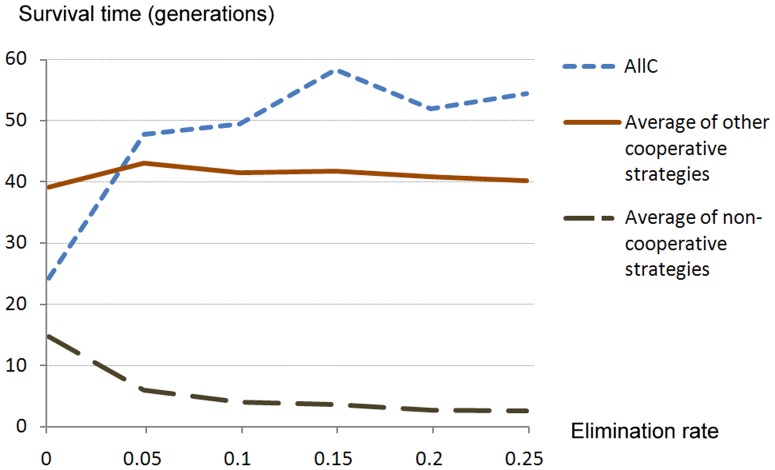
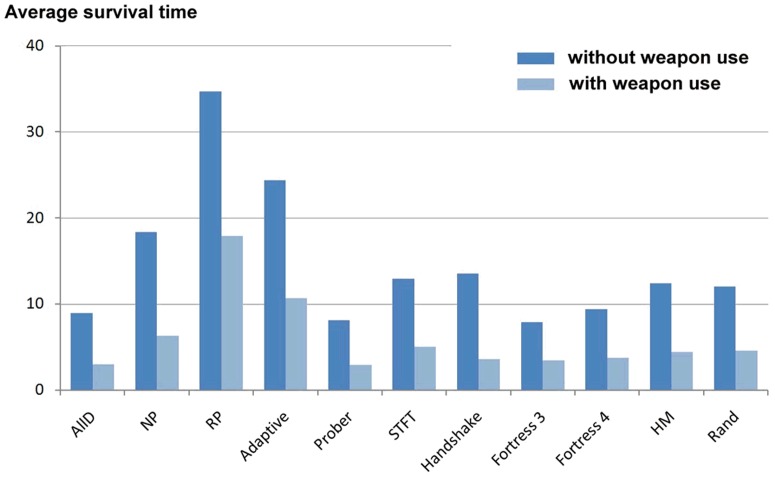
Human cooperation and altruism towards non-kin is a major evolutionary puzzle, as is 'strong reciprocity' where no present or future rewards accrue to the co-operator/altruist. Here, we test the hypothesis that the development of extra-somatic weapons could have influenced the evolution of human cooperative behaviour, thus providing a new explanation for these two puzzles. Widespread weapons use could have made disputes within hominin groups far more lethal and also equalized power between individuals. In such a cultural niche non-cooperators might well have become involved in such lethal disputes at a higher frequency than cooperators, thereby increasing the relative fitness of genes associated with cooperative behaviour. We employ two versions of the evolutionary Iterated Prisoner's Dilemma (IPD) model--one where weapons use is simulated and one where it is not. We then measured the performance of 25 IPD strategies to evaluate the effects of weapons use on them. We found that cooperative strategies performed significantly better, and non-cooperative strategies significantly worse, under simulated weapons use. Importantly, the performance of an 'Always Cooperate' IPD strategy, equivalent to that of 'strong reciprocity', improved significantly more than that of all other cooperative strategies. We conclude that the development of extra-somatic weapons throws new light on the evolution of human altruistic and cooperative behaviour, and particularly 'strong reciprocity'. The notion that distinctively human altruism and cooperation could have been an adaptive trait in a past environment that is no longer evident in the modern world provides a novel addition to theory that seeks to account for this major evolutionary puzzle.
人类对非亲属的合作和利他行为是一个主要的进化难题,而“强互惠”也是一个难题,即在没有当前或未来回报的情况下,合作/利他主义者不会得到回报。在这里,我们测试了这样一个假设,即体外武器的发展可能影响了人类合作行为的进化,从而为这两个难题提供了一个新的解释。广泛使用武器可能使人类群体内部的争端更加致命,也使个体之间的权力均等化。在这样的文化环境中,不合作者参与这种致命争端的频率可能比合作者高,从而增加了与合作行为相关的基因的相对适应性。我们使用了两种版本的进化重复囚徒困境(IPD)模型——一种模拟武器使用的模型,一种不模拟武器使用的模型。然后,我们测量了 25 种 IPD 策略的性能,以评估武器使用对它们的影响。我们发现,在模拟武器使用的情况下,合作策略的表现明显更好,而不合作策略的表现明显更差。重要的是,“始终合作”的 IPD 策略的表现,相当于“强互惠”的表现,比所有其他合作策略的表现都有了显著的提高。我们得出的结论是,体外武器的发展为人类利他主义和合作行为的进化,特别是“强互惠”的进化提供了新的视角。这种观点认为,在现代世界已经不再明显的过去环境中,独特的人类利他主义和合作可能是一种适应性特征,为试图解释这一主要进化难题的理论提供了一个新的补充。